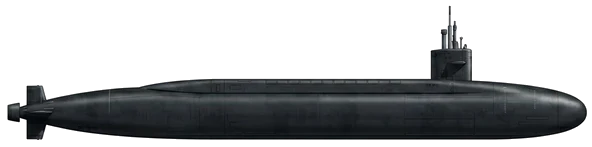
The Ohio class was designed in the 1970s to carry the Trident submarine-launched ballistic missile. Constructed by General Dynamics Electric Boat, the class consists of 18 vessels commissioned between 1981 and 1997. The design succeeded the Benjamin Franklin class and is scheduled for replacement by the Columbia class.
The class utilizes the SCB-304 hull design, constructed in four-deck sections. Propulsion is provided by a pressurized water reactor and geared turbines. Each vessel employs a dual-crew system, designated Blue and Gold, to maintain operational availability during deterrent patrols. To facilitate maintenance and resupply, the hull incorporates logistics hatches that allow for the transfer of supply pallets and machinery modules.
The fleet includes two configurations: ballistic missile submarines (SSBN) and guided-missile submarines (SSGN). SSBN variants carry submarine-launched ballistic missiles as part of the United States nuclear-deterrent triad. SSGN variants, converted from the oldest hulls in the class, carry cruise missiles and include swimmer lockout chambers for special operations personnel. These converted vessels can host submersibles and dry deck shelters. All vessels are equipped with torpedo tubes and a suite of passive bow-mounted, towed, and conformal sonar arrays.
Vessels are stationed at Naval Base Kitsap, Washington, and Naval Submarine Base Kings Bay, Georgia. The SSBNs maintain a schedule of deterrent patrols, with a portion of the fleet kept on station in designated areas. Between 2002 and 2008, the Navy converted the first four boats of the class—Ohio, Michigan, Florida, and Georgia—from ballistic missile to guided-missile configurations to support conventional land-attack and special operations missions. During the same period, the remaining SSBNs were updated to carry the Trident II D5 missile. In 2017, the missile tube capacity of the SSBN fleet was reduced to comply with the New START treaty, which expired on 5 February 2026 with no reported restoration of the deactivated tubes. Current naval planning involves retiring the class as the Columbia and Virginia classes enter service, though the Navy has considered service life extensions for specific hulls. USS Georgia returned to Kings Bay on 27 July 2026 to begin inactivation after 42 years, the first boat of the class to leave service and the start of a phased withdrawal of the four guided-missile conversions.