Whidbey Island-class (LSD-41)
Summary
| Origin country | 🇺🇸 United States |
| Category | Amphibious vessel |
| Subtype | Dock landing ship |
| Manufacturer | Lockheed Shipbuilding and Construction Company |
| Year commissioned | 1985 |
| Approx. unit cost | $250 million |
| Units |
LSD-41 Whidbey Island LSD-42 USS Germantown LSD-43 Fort McHenry LSD-44 USS Gunston Hall LSD-45 USS Comstock LSD-46 USS Tortuga LSD-47 USS Rushmore LSD-48 USS Ashland |
Operators
Technical specifications
| Displacement | 16100 tons |
| Range | 8000 km at 18 knots |
| Crew | 330 members |
| Width | 26.0 m (85.3 ft) |
| Length | 186.0 m (610.2 ft) |
| Air Park |
|
| Propulsion | 4 Colt Industries, 16-cylinder diesel engines, 2 shafts, 33,000 shp (25,000 kW) |
| Thrust | 9200 hp |
| Armament |
|
| Maximum speed | 20 knots |
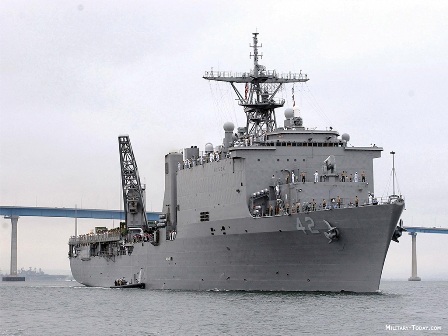
Description
The Whidbey Island class consists of eight dock landing ships operated by the United States Navy. Designed to succeed the Anchorage class, the series was constructed by Lockheed Shipbuilding and Construction Company and Avondale Shipyard. The lead vessel, USS Whidbey Island (LSD-41), was laid down in 1981 and entered fleet service in 1985. The final ship of the class, USS Ashland (LSD-48), was commissioned in 1992.
The class is designed with a well deck and a stern gate to facilitate the transport and launch of United States Marine Corps vehicles. The well deck accommodates four Landing Craft Air Cushion (LCAC) hovercraft, or five if the vehicle ramp is raised. Other configurations include 21 LCM-6s, three LCUs, or up to 36 Amphibious Assault Vehicles (AAVs). The ships feature a large aft flight deck for helicopter and V-22 Osprey operations, though the design does not include a hangar. Characteristics of the class include multiple cranes and a shallow draft for amphibious operations.
Between 2009 and 2014, the class underwent a midlife modernization program. These upgrades replaced original steam systems with all-electric functionality and included improvements to diesel engines, engineering control systems, and cooling capacity. These modifications were intended to extend the service life of the vessels.
Eight ships were completed and entered service. As of late 2023, six remain active and two have been retired. USS Fort McHenry (LSD-43) was decommissioned in 2021, followed by USS Whidbey Island (LSD-41) in 2022. The Navy has proposed the decommissioning of additional units between 2023 and 2026, including USS Germantown, USS Gunston Hall, and USS Tortuga. Modernization plans announced in 2015 sought to extend the service life of specific hulls, such as Whidbey Island, Tortuga, and Germantown, to a total of 44 years. Operational homeports for the class have included Little Creek, Virginia; San Diego, California; and Sasebo, Japan.