Zumwalt-class (DDG-1000)
Summary
| Origin country | 🇺🇸 United States |
| Category | Destroyer |
| Subtype | Guided-missile destroyer |
| Manufacturer | Bath Iron Works |
| Year commissioned | 2016 |
| Approx. unit cost | $4240 million |
| Units |
DDG-1000 USS Zumwalt DDG-1001 USS Michael Monsoor |
Operators
Technical specifications
| Displacement | 15907 tons |
| Crew | 147 members |
| Width | 24.6 m (80.7 ft) |
| Length | 190.0 m (623.4 ft) |
| Air Park |
|
| Propulsion | 2 × Rolls-Royce MT30 gas turbines (35.4 MW each) driving Curtiss-Wright electric generators; 2 × Rolls-Royce RR4500 turbine generators (3.8 MW each); 2 × propellers driven by electric motors (Total: 78 MW) |
| Thrust | 8000 hp |
| Armament |
|
| Maximum speed | 30 knots |
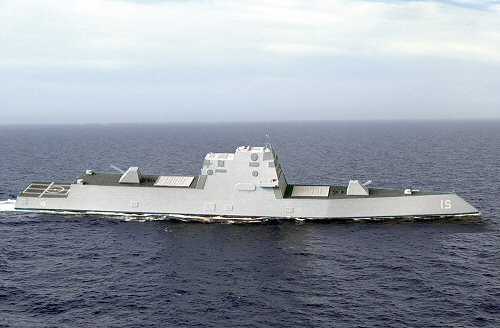
Description
The Zumwalt-class destroyer is a class of three United States Navy guided-missile vessels designed for stealth and multi-mission operations. The class emerged from the DD-21 land attack destroyer program, later designated DD(X), which sought to provide naval gunfire support to meet a congressional mandate for the role previously filled by battleships. While the Navy initially planned to procure 32 ships, research and development costs combined with a shift in the perceived global threat environment led to the reduction of the class to three units. The program reached a total cost of $22.5 billion, resulting in a Nunn-McCurdy Amendment breach.
The design is characterized by a wave-piercing tumblehome hull form, which narrows above the waterline to reduce the ship's radar cross-section. The vessels utilize an integrated electric propulsion system, with gas turbines driving generators that provide power to electric drive motors and shipboard systems via the Total Ship Computing Environment Infrastructure. This Linux-based network manages automated systems for fire suppression and cargo handling, enabling the class to operate with a smaller crew than contemporary destroyers. The hulls incorporate a peripheral vertical launch system, distributing missile cells along the outer shell to protect the interior from magazine explosions. The ship's composite deckhouse encloses many of its sensors, though the final vessel of the class utilizes a steel deckhouse.
The primary armament was originally centered on the Advanced Gun System. Following the cancellation of its specialized ammunition, the Navy re-purposed the ships for surface warfare. Modernization efforts begun in 2023 involve the removal of the gun systems to accommodate hypersonic missiles in advanced payload modules. For undersea warfare, the class utilizes a dual-band sonar suite and a multi-function towed array. Aviation facilities include a flight deck and hangar capable of supporting helicopters and unmanned aerial vehicles.
The lead ship, USS Zumwalt, entered service in October 2016, and USS Michael Monsoor followed in 2019. Both vessels are homeported in San Diego. The third ship, Lyndon B. Johnson, is currently undergoing sea trials. In 2019, the lead vessel conducted heavy weather testing off the coast of Alaska, where the hull form demonstrated stability in sea state six conditions. The class continues to undergo systems integration and modification for its revised surface-strike mission.