M103
Summary
| Origin country | 🇺🇸 United States |
| Category | Main Battle Tank |
| Sub-type | Heavy Main Battle Tank |
| Manufacturer | Detroit Arsenal Tank Plant |
| Number built | 300 units |
Technical specifications
| Crew | 5 personnels |
| Range | 480 km |
| Mass | 58.0 tons |
| Height | 3.23 m (10.6 ft) |
| Width | 3.76 m (12.3 ft) |
| Length | 6.99 m (22.9 ft) |
| Max. speed | 40 km/h (25 mph) |
| Engine | Continental AVDS-1790-2 V12 Diesel Engine with 810 hp |
| Weapon 1 | 1 M58 120mm gun |
| Weapon 2 | 1 M2 HB 12.7mm machine gun |
| Weapon 3 | 1 7.62mm coaxial machine gun |
| Weapon 4 | 1 7.62mm machine gun |
Historical operators
Profile of M103
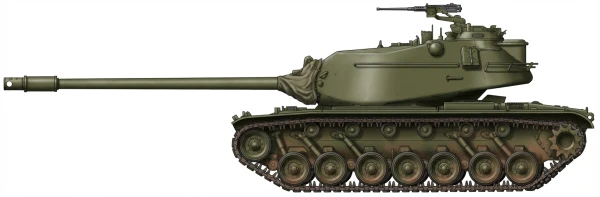
Description
The M103 heavy tank, originally designated the T43, was developed by the United States to counter Soviet heavy armor, such as the IS-series and T-10 tanks. Chrysler received the production contract in January 1951, with design and construction overseen at a dedicated plant in Newark, Delaware. The first pilot model was completed in November 1951, and the vehicle was publicly debuted in 1954. Following unsatisfactory initial testing that led to the fleet being placed in storage, the Army approved 98 improvements. The vehicle was officially redesignated as the M103 in April 1956.
The M103 utilized a two-piece cast elliptic armor scheme for the hull and a single-piece cast turret. The frontal hull glacis featured a compound pike design with a welded center seam. Protection was provided by welded rolled and cast homogeneous steel. The primary armament consisted of the 120mm M58 rifled gun, which fired separate-loading ammunition where the projectile and propellant case were loaded individually. This system required two loaders, resulting in a five-man crew. Secondary armament included coaxial .30-caliber machine guns and a cupola-mounted .50-caliber machine gun. The vehicle employed a torsion bar suspension with seven road wheels per side. Initial production versions used a Continental air-cooled gasoline engine and a two-speed transmission. These early models were underpowered and experienced drivetrain reliability issues and limited operational range. The later M103A2 variant addressed these concerns by incorporating the twin-turbocharged diesel engine from the M60 tank.
The vehicle was operated by the United States Army and the United States Marine Corps. The Army fielded a single heavy tank battalion in Europe, the 2nd Battalion, 33rd Armor Regiment, to supplement its medium tanks. The Marine Corps assigned one M103 company to each of its tank battalions, including reserve units. While the M103 never saw combat, five tanks were deployed to Guantanamo Bay during the Cuban Missile Crisis. The Army deactivated its heavy armor units in 1963 following the adoption of the M60 main battle tank. The Marine Corps maintained the M103 in its inventory until 1973. In 1977, several M103A2 units were modified into Manned Evasive Target Tanks for use in TOW missile training. Only a limited number of these tanks were produced, with the majority of the inventory being accepted and operated by the Marine Corps.