Nagoya Airfield
Summary
| Operating Country | 🇯🇵 Japan |
| Location | 🇯🇵 Japan |
| Status | ◉ Active |
| Usage | Dual |
| Year built | 1944 |
| Operating Organization | Japan Air Self-Defense Force |
| Units |
|
Location & Details
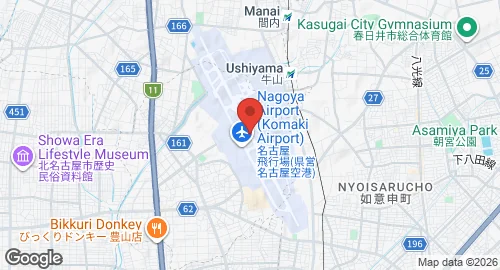
| Coordinates | 35.2550°N, 136.9244°E |
| Elevation | 14 m (46 ft) |
| IATA code | NKM |
| ICAO code | RJNA |
| Runways |
|
Description
Nagoya Airfield, also known as Komaki Airport, is located within the municipalities of Toyoyama, Komaki, Kasugai, and Nagoya in Aichi Prefecture. Established on February 1, 1944, as Kamake Airfield, it served as a base for the 55th Sentai of the Imperial Japanese Army Air Service. During the Pacific War, the site was targeted by USAAF B-29 bombing raids. Following the conflict, the facility was renamed Nagoya Air Base under U.S. occupation. Between 1946 and 1957, it functioned as the headquarters for the Fifth Air Force and hosted units including the 347th Fighter Group, operating P-61 Black Widows, and the 49th Fighter Group, operating F-84 Thunderjets. The United States returned the airfield to Japanese control in June 1958.
The facility is currently owned by the Aichi Prefectural Government and operates as a joint civil-military airfield. The military component is designated as Japan Air Self-Defense Force (JASDF) Komaki Base. Stationed units include the 401st Tactical Airlift Squadron, which operates Lockheed C-130H and KC-130H aircraft. In 2009, the JASDF established its first dedicated air-to-air refueling unit at the base, the 404th Tactical Airlift Tanker Squadron, which operates Boeing KC-767J aircraft.
Infrastructure includes a main terminal building that serves as the headquarters for Mitsubishi Aircraft Corporation. Mitsubishi Heavy Industries maintains an adjacent factory where the Mitsubishi Regional Jet was produced. The Aichi Museum of Flight opened at the airfield in November 2017. Civil operations are restricted to general aviation and domestic scheduled services operated by Fuji Dream Airlines.
The airfield transitioned from an international airport to a secondary domestic and military facility in February 2005 following the opening of Chubu Centrair International Airport. In May 2015, the airfield served as a diversion point for the experimental Solar Impulse 2 during its trans-Pacific flight. Historical flight operations have also been marked by accidents, including the 1994 crash of China Airlines Flight 140 and a 2007 Mitsubishi F-2 crash during a test flight.