F-84 Thunderjet
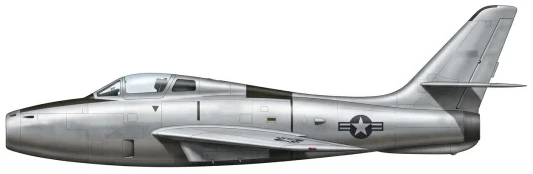
American fighter-bomber of the 1940s–1950s era, notable in the Korean War for close air support and strategic bombing missions. Key figures: top speed 1,001 km/h, range 3,218 km, service ceiling 12,344 m, max takeoff weight 10,590 kg, unit price $1.4M, built 7,524.
| Crew | 1 |
| Length | 11.6 m (38.1 ft) |
| Wingspan | 11.1 m (36.4 ft) |
| Height | 3.8 m (12.6 ft) |
| Wing area | 24 m² (258.3 sqft) |
| Empty weight | 5,200 kg (11,464 lbs) |
| Max. takeoff weight | 10,590 kg (23,347 lbs) |
| Powerplant | 1 × turbojet Allison J35-A-29 2,522 kgf each |
| Ejection seat | Republic F-84 |
| Maximum speed | 1001 km/h (622 mph) |
| Operational range | 3,218 km (2,000 mi) |
| Service ceiling | 12,344 m (40,499 ft) |
| Climb rate | 19.1 m/s (62.7 ft/s) |
Description
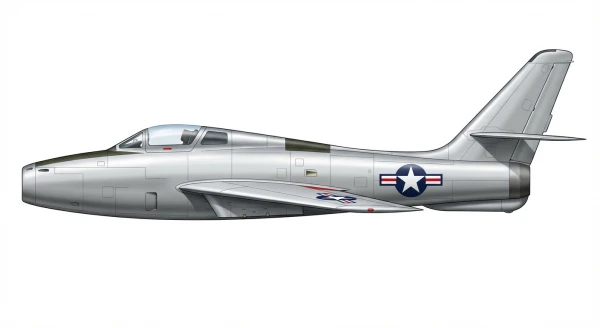
Originating as a 1944 United States Army Air Forces (USAAF) proposal for a "day fighter", the F-84 was designed by Republic Aviation as a turbojet-powered replacement for the P-47 Thunderbolt. Initial attempts to convert the P-47 proved impractical due to the Thunderbolt's large fuselage cross-section. Consequently, Alexander Kartveli and his team created a new design featuring a slim fuselage, housing an axial compressor turbojet engine in the rear, with a nose-mounted air intake and ducts running along the fuselage. The thick wings, utilizing a laminar flow airfoil, primarily housed fuel tanks. In November 1944, Republic received an order for three prototypes of the XP-84, later named "Thunderjet", followed on 4 January 1945, by an order for 25 YP-84A service test aircraft and 75 production P-84Bs. Early wind tunnel testing revealed longitudinal instability and stabilizer skin buckling at high speeds, leading to modifications in the third prototype, designated XP-84A, which was fitted with a more powerful J35-GE-15 engine producing 4,000 lbf of thrust. The first prototype XP-84 first flew on 28 February 1946.
Armament
The F-84 Thunderjet's armament centered around six .50 in (12.7 mm) M3 Browning machine guns, with 300 rounds of ammunition per gun. Additionally, the aircraft could carry up to 32 five-inch High Velocity Aircraft Rockets (HVAR), enhancing its ground attack potential. For bombing missions, the F-84 could be outfitted with up to 4,000 lb (1,800 kg) of conventional bombs. The F-84G variant was the first single-seat aircraft capable of carrying a Mark 7 nuclear bomb.
Operational History
The Thunderjet distinguished itself during the Korean War, becoming the USAF's primary strike aircraft and flying 86,408 sorties, reportedly destroying 60% of ground targets in the conflict, as well as eight Soviet-built MiG fighters. It was during this conflict that the F-84 became the first USAF fighter to utilize aerial refueling. Over half of the 7,524 F-84s produced served with NATO nations. Portugal deployed the F-84G to Angola in 1961 for ground attacks against separatist forces, with a detachment later sent to Mozambique in 1966. The Republic of China Air Force operated F-84Gs acquired from the United States Air Force in 1953, employing them in both ground-attack and interceptor roles.
Variants
Main Variants:
-
XP-84: The initial prototype, powered by a 3,750 lbf J-35-GE-7 engine and armed with four .50 in machine guns, served as the basis for further development.
-
F-84B: As the first production version, it was equipped with a J35-A-15 engine.
-
F-84D: Featuring a J35-A-17 engine and various structural improvements, this variant corrected many of the faults found in earlier models, enhancing its operational capabilities.
-
F-84E: This improved model incorporated a J35-A-17D engine, wing reinforcement, fuselage extensions, and an A-1B gunsight with ranging radar, significantly boosting its combat radius and avionics.
-
F-84G: This final straight-wing variant introduced a refueling boom receptacle, autopilot, the ability to carry a nuclear bomb, and a framed canopy, later retrofitted to earlier types.
Frequently Asked Questions
What type of aircraft is the F-84 Thunderjet?
What is the maximum speed of the F-84 Thunderjet?
What is the range of the F-84 Thunderjet?
When did the F-84 Thunderjet first fly?
How many F-84 Thunderjet have been built?
Which countries operate the F-84 Thunderjet?
How much does a F-84 Thunderjet cost?
What is the service ceiling of the F-84 Thunderjet?
- AUG 122026 Updated Range corrected to the ferry range with external tanks
- JUL 232026 Updated Sources and cross-references refreshed
- APR 72026 Updated Sources and cross-references refreshed
- JAN 122026 Updated Range updated in a site-wide editorial pass