Tijuana International Airport (General Abelardo L. Rodríguez International Airport)
Summary
| Operating Country | 🇲🇽 Mexico |
| Location | 🇲🇽 Mexico |
| Status | ◉ Active |
| Usage | Dual |
| Year built | 1951 |
| Operating Organization | Mexican Air Force |
| Units |
|
Location & Details
| Coordinates | 32.5411°N, -116.9700°E |
| Elevation | 149 m (489 ft) |
| IATA code | TIJ |
| ICAO code | MMTJ |
| Runways |
|
Description
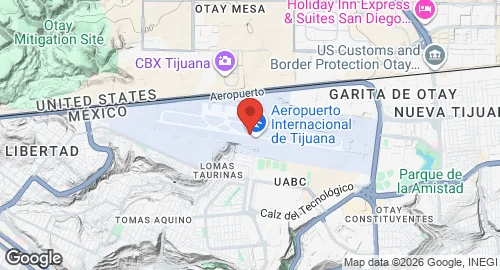
Tijuana International Airport is located 5 km northeast of downtown Tijuana, Baja California, Mexico, adjacent to the Mexico–United States border. Inaugurated as the Aeropuerto Federal de Tijuana on May 1, 1951, it replaced a previous facility on Agua Caliente Boulevard. In 1965, the airport was incorporated into the state-owned Aeropuertos y Servicios Auxiliares. Following the construction of a new terminal and runway in 1970 to mitigate incursions into United States airspace, the original terminal building was converted for military use. The facility was privatized in 1999 and is currently managed by Grupo Aeroportuario del Pacífico. In 2015, the Cross Border Xpress (CBX) opened, providing a pedestrian bridge connection between the Mexican terminal and a processing facility in San Diego, California.
The airport serves as a domestic hub for Volaris and Viva. It also functions as a refueling point for China Southern Airlines and hosts operations for the state-owned Mexicana de Aviación. Beyond commercial aviation, the site supports cargo operations, flight training, and general aviation. It houses Mexican Air Force Base No. 12 (B.A.M. No. 12), which provides facilities for personnel and transient aircraft.
The infrastructure comprises a main passenger terminal with two pier concourses and the New Transit Processing Building for international and cross-border arrivals. Airside facilities include an apron with contact stands and remote positions, a parallel taxiway, and a control tower. The military section, located at the "Aeropuerto Viejo" terminal, includes an aviation platform and a hangar. While no air squadron is currently assigned to B.A.M. No. 12, the facility supports Mexican Air Force Boeing 737 aircraft operated by the state carrier. The General Aviation Building (GAB) contains hangars, maintenance facilities, and hosts two aviation schools. Cargo infrastructure includes remote stands and a dedicated taxiway. The airport accommodates wide-body aircraft, including the Boeing 787, Boeing 747, and Airbus A350, alongside narrow-body types such as the Airbus A320 family, Boeing 737, Embraer E175, and CRJ-700.