Boeing 747
American wide-body commercial jet airliner, conceived in the 1960s and renowned for transcontinental and transatlantic flights. Key figures: top speed 1,014 km/h, range 12,150 km, service ceiling 13,746 m, max takeoff weight 377,842 kg, unit price $285M, built 1,574. In service with 2 air forces as of 2026 — Iran (6), United States (4).
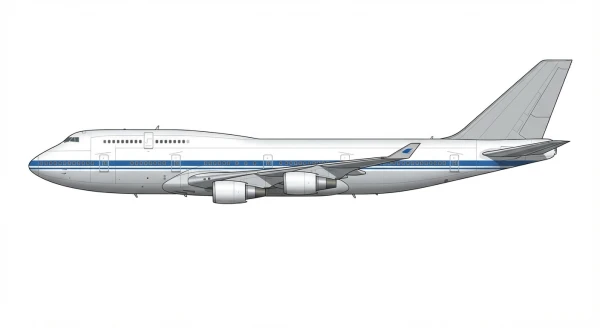
| Crew | 4 |
| Length | 70.6 m (231.6 ft) |
| Wingspan | 59.6 m (195.5 ft) |
| Height | 19.3 m (63.3 ft) |
| Wing area | 511.0 m² (5499.8 sqft) |
| Empty weight | 173,726 kg (383,000 lbs) |
| Max. takeoff weight | 377,842 kg (832,998 lbs) |
| Powerplant | 4 × turbofans General Electric CF6-80C2B1 25,719 kgf each |
| Maximum speed | 1014 km/h (Mach 1.01) |
| Operational range | 12,150 km (7,550 mi) |
| Endurance | 16 hours |
| Service ceiling | 13,746 m (45,098 ft) |


Recent Events — Boeing 747
1 event →
Description
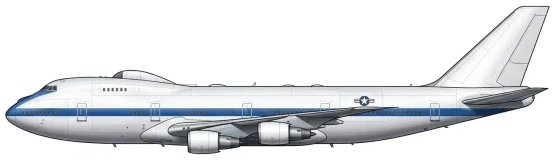
The Boeing 747 is a long-range wide-body airliner manufactured by Boeing Commercial Airplanes in the United States. Designed primarily as a high-capacity transport aircraft, it entered commercial service on January 22, 1970, with Pan American World Airways and became known as the first wide-body airliner, designated the "Jumbo Jet."
Development
Development began in the mid-1960s following a request from Pan American World Airways for an aircraft two-and-a-half times the size of the Boeing 707. Led by chief designer Joe Sutter, Boeing incorporated concepts from its bid for the U.S. Air Force Heavy Logistics System project, including a raised cockpit and front-loading door capability. The aircraft made its first flight on February 9, 1969, and received FAA certification in December 1969. Production ran from 1968 to 2023, totaling 1,574 airframes delivered.
Design
The 747 features a 37.5° swept wing enabling cruise speeds of Mach 0.84 to 0.88, supported by four main landing gear legs with four-wheel bogies. Power is provided by four turbofan engines, including Pratt & Whitney JT9D, General Electric CF6, Rolls-Royce RB211, or General Electric GEnx models depending on the variant. Redundant systems include four independent hydraulic systems, dual control surfaces, and triple-slotted trailing-edge flaps. Cockpit technology transitioned from analog electro-mechanical instruments with an inertial navigation system on early models to a two-crew glass cockpit on the 747-400.
Armament
Though designed as a transport, military study concepts evaluated armed configurations for the airframe. The proposed 747 Cruise Missile Carrier Aircraft was designed to carry between 50 and 100 AGM-86 ALCM cruise missiles on internal rotary launchers. The MC-747 study evaluated carrying Peacekeeper or Minuteman ballistic missiles, as well as up to 32 JDAM-equipped missiles launched through internal doors.
Operational History
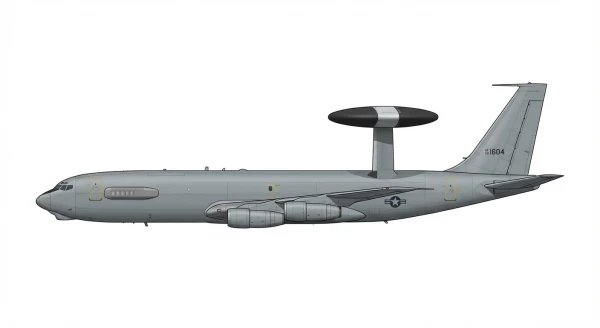
The 747 entered commercial operations on Pan Am's New York–London route in January 1970 and served as the primary long-haul airliner for international carriers worldwide. Government and military operations include the U.S. Air Force VC-25 presidential transport, the E-4B National Airborne Operations Center, and modified NASA Shuttle Carrier Aircraft. In May 1991, an Israeli Air Force El Al 747-200C set a record by airlifting 1,087 passengers during Operation Solomon.
Variants
-
747-100: The initial production variant launched in 1966 and powered by Pratt & Whitney JT9D engines with a range of 4,620 nautical miles.
-
747-200: Introduced in 1971 featuring uprated engines, higher takeoff weight, and available passenger, freighter, convertible, and combi configurations.
-
747-300: Entering service in 1983, this model featured a stretched upper deck, a straight internal staircase, and increased seating capacity.
-
747-400: Introduced in 1989 with a two-crew glass cockpit, winglets, revised engines, and tail fuel tanks for extended range.
-
747-8: A stretched variant announced in 2005 incorporating General Electric GEnx engines and systems derived from the Boeing 787.
Frequently Asked Questions
What type of aircraft is the Boeing 747?
What is the maximum speed of the Boeing 747?
What is the range of the Boeing 747?
When did the Boeing 747 first fly?
How many Boeing 747 have been built?
Which countries operate the Boeing 747?
How much does a Boeing 747 cost?
What is the service ceiling of the Boeing 747?
- AUG 62026 Updated Description updated
- AUG 52026 Updated Powerplant updated in a site-wide editorial pass
- JUL 272026 Updated Name updated
- APR 72026 Updated Picture credits updated in a site-wide editorial pass
- FEB 72026 Updated Endurance added
- JAN 122026 Updated Range updated in a site-wide editorial pass