Kazan Helicopters Ansat
Summary
| Category | Military Training Aircraft |
| Origin country | 🇷🇺 Russia |
| Manufacturer | Kazan Helicopters |
| First flight | 17 August 1999 |
| Year introduced | 2013 |
| Number produced | 50 units |
| Average unit price | $8 million |
Technical specifications
| Version: Ansat | |
|---|---|
| Crew | 1–2 |
| Operational range | 505 km (314 mi) |
| Endurance | 3 hours |
| Maximum speed | 275 km/h (171 mph) |
| Wing area | 103.9 m² (1118.0 sqft) |
| Wingspan | 11.5 m (37.7 ft) |
| Height | 3.4 m (11.2 ft) |
| Length | 13.8 m (45.1 ft) |
| Service ceiling | 5,500 m (18,045 ft) |
| Empty weight | 2,365 kg (5,214 lbs) |
| Max. takeoff weight | 3,600 kg (7,937 lbs) |
| Climb rate | 14.0 m/s (45.9 ft/s) |
| Powerplant | 2 x 2 × Pratt & Whitney Canada PW207K turboshaft engines delivering 470 kW each |
Current operating countries
| Country | Units | ||
|---|---|---|---|

|
Russia | 50 | |
All operators
Description
Kazan Helicopters established its own design bureau in 1993, officially certified in January 1997, under designer Valery Dvoeglazov, to create a new helicopter named Ansat. This initiative arose from the recognized need for light helicopters in Russia following the aging of the Mi-2 fleet. Efforts to collaborate with Eurocopter on a helicopter based on the AS 350 Ecureuil were not successful. The first prototype for ground static tests was completed in 1998. The second prototype performed its first flight on August 17, 1999, powered by two Pratt & Whitney Canada PW206 engines. A subsequent prototype, featuring a longer, slimmer fuselage and PW207K engines, flew on December 27, 2001, and underwent certification from 2002. In September 2001, the Ansat-U was selected to become the new trainer for the Russian Air Force.
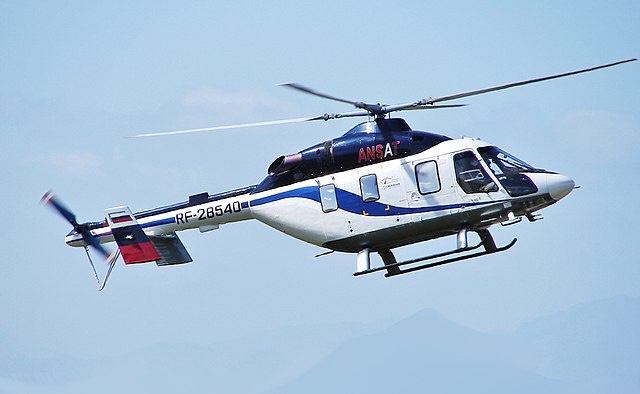
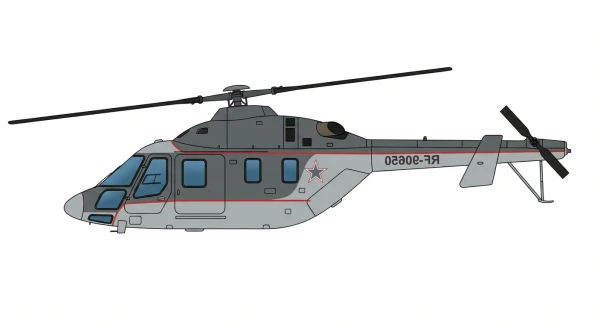
The Kazan Ansat features a classic helicopter layout designed to accommodate a pilot and up to 10 passengers. The fuselage is equipped with a pair of doors in the pilot's cab and a pair of side doors in the transport compartment that open upwards and downwards. The design allows for the interior to be reconfigured for cargo transport, accommodating up to 1,000 kg of internal cargo or 1,300 kg on an external hook. It is powered by two PW207K turboshaft engines, each producing 630 shp, and incorporates a four-blade main rotor and a two-blade tail rotor. The VIP version includes a ventilation and air conditioning system and energy-absorbing passenger seats.
The Kazan Ansat in its baseline configuration is unarmed and carries 1,000 kg of cargo internally or 1,300 kg on an external hook. A derivative, designated the Kazan Ansat-2RC, can be equipped with a 12.7mm machine gun above the front skid support, along with four hardpoints distributed across two stub wings. This armed variant can carry a mixture of rocket launcher tubes, bombs, and anti-aircraft missiles.
The Ansat has been deployed in various roles. The Russian Air Force adopted the Ansat-U as a trainer, with the Syzran Military Pilot Flying Training School being the primary operator. Civilian variants are used for passenger transport, emergency medical services, and cargo operations within Russia and internationally. Operators include the Ministry of Emergency Situations, Ministry of Internal Affairs, other state structures within Russia, as well as commercial operators such as Tulpar Helicopters and Russian Helicopter Systems. Orders have been placed by Eritrea for two Ansat-U helicopters and the Interior Ministry of the Serbian Republic for three for police duties. The Ansat-SK medical version has been used in EMS operations. Its operational capabilities include certification for extreme temperature conditions and high-altitude operations.
Main Variants:
-
Ansat: The basic version, which served as the foundation for subsequent developments.
-
Ansat-M: A modernized variant featuring a reduced empty weight and increased fuel capacity.
-
Ansat-NT: A proposed next-generation version potentially powered by two VK-800V or Klimov VK-650V turboshaft engines and equipped with a new four- or five-bladed main rotor.
-
Ansat-U: A specialized military-training version characterized by a three-wheel chassis and double-winged cargo doors.
-
Ansat-SK: A dedicated version tailored for emergency medical service operations, equipped with specialized medical equipment.