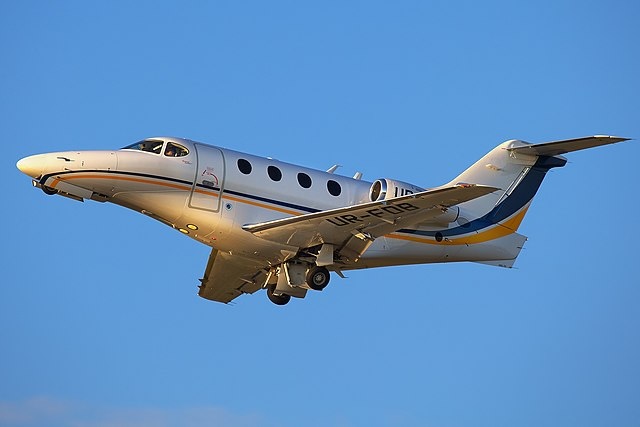
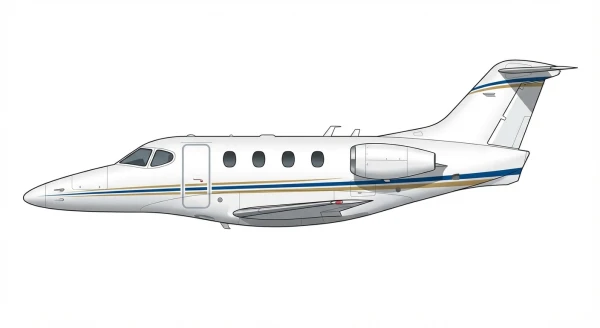
Beechcraft 390 Premier I
Summary
| Category | Military Transport Aircraft |
| Origin country | 🇺🇸 United States |
| Manufacturer | Beechcraft |
| First flight | 22 December 1998 |
| Year introduced | 2001 |
| Number produced | 292 units |
| Average unit price | $5 million |
Technical specifications
| Version: Premier I | |
|---|---|
| Operational range | 2,519 km (1,565 mi) |
| Maximum speed | 841 km/h (523 mph) |
| Wing area | 23 m² (247.6 sqft) |
| Wingspan | 13.6 m (44.5 ft) |
| Height | 4.7 m (15.3 ft) |
| Length | 14 m (45.9 ft) |
| Service ceiling | 12,497 m (41,001 ft) |
| Empty weight | 3,627 kg (7,996 lbs) |
| Max. takeoff weight | 5,670 kg (12,500 lbs) |
| Powerplant | 2 x turbofans Williams FJ44-2A delivering 1043 kgf each |
Current operating countries
| Country | Units | ||
|---|---|---|---|

|
Indonesia | 1 | |
All operators
Description
The Beechcraft Premier I was conceived in early 1994 as the PD-374 (Preliminary Design), with development officially authorized the following year. Officially launched at the National Business Aviation Association Convention in September 1995, construction of the first prototype began in late 1996. The Premier I prototype was rolled out on 19 August 1998, with its first flight occurring on 22 December 1998, utilizing four prototypes for the flight test program. The FAA Type Certificate was issued on 23 March 2001, and the aircraft entered service in 2001. The aircraft was later upgraded to the Premier IA, which was certified on 22 September 2005 and introduced in 2006. Following the bankruptcy of Hawker Beechcraft, the production of business jets ceased in 2013.
The Premier I is notable for its high-strength composite fuselage, constructed from carbon fiber and epoxy honeycomb, contributing to its light weight. The aircraft is powered by two Williams International FJ44-2A engines. The cabin, while similar in width to a Citation Excel, offers less headroom but provides a seating area of 11.2 feet, comparable to a CJ2, and typically includes a four-seat club arrangement, two aft chairs, and an enclosed lavatory. Avionics include the Collins Pro Line 21.
Following its entry into service in 2001, the Premier I experienced operational challenges, including runway performance issues, problems with its lift dump and braking systems, and a cabin considered noisy, along with a cockpit viewed as substandard. These shortcomings were addressed with the upgraded Premier IA, which featured improved brakes, avionics, and enhanced cabin comfort. On August 17, 2023, a Raytheon 390 Premier I was involved in a fatal accident during its final approach to Kuala Lumpur-Subang-Sultan Abdul Aziz Shah Airport.
Main Variants:
-
Premier I - This is the basic version of the aircraft, which was first introduced in 2001.
-
Premier IA - This variant features a new cabin interior and improved systems compared to the original Premier I.