EC-135 / EC-18 ARIA
Summary
| Category | Military Special Mission Aircraft |
| Origin country | 🇺🇸 United States |
| Manufacturer | Boeing |
| First flight | 1 January 1961 |
| Year introduced | 1968 |
| Number produced | 45 units |
| Average unit price | $150 million |
Technical specifications
| Version: EC-135E | |
|---|---|
| Crew | At least 11 |
| Operational range | 8,300 km (5,157 mi) |
| Endurance | 11 hours |
| Maximum speed | 927 km/h (576 mph) |
| Wing area | 223 m² (2400.3 sqft) |
| Wingspan | 31.6 m (103.8 ft) |
| Height | 12.7 m (41.7 ft) |
| Length | 43.1 m (141.5 ft) |
| Service ceiling | 10,058 m (32,999 ft) |
| Max. takeoff weight | 136,304 kg (300,499 lbs) |
| Powerplant | 4 x turbojets Pratt & Whitney TF33-PW-102 delivering 8165 kgf each |
Current operating countries
All operators
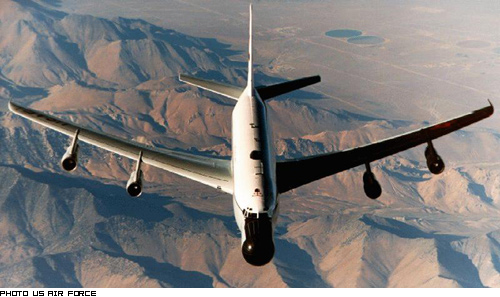
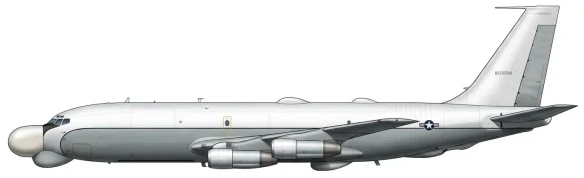
Description
The Boeing C-137 Stratoliner series encompasses variants of the Boeing 707 jet airliner used by the United States Air Force and other nations, primarily for VIP transport. Initial procurement by the US Air Force comprised three Model 707-153 aircraft designated VC-137A. When delivered in 1959, these were powered by four 13,500 lb (6,100 kg) dry thrust Pratt & Whitney J57 (JT3C6) turbojets. When subsequently re-engined with 18,000 lbf (80 kN) dry thrust TF33-P-5 (JT3D) turbofans, they were redesignated VC-137B.
The VC-137C variant served as Air Force One Presidential transports. These two examples were Model 707-320B Intercontinentals equipped with specialized interior furnishings and advanced communications equipment. Two additional C-137C aircraft without presidential transport modifications were acquired later. Beyond VIP transport, variants derived from the 707-320B series, designated C-18, were converted for various military roles, including crew training and support for systems like the Military Strategic and Tactical Relay System (MILSTAR). Other 707 models were adapted for specialized missions such as Advanced Range Instrumentation Aircraft (ARIA) support for the Apollo space program and as Cruise Missile Mission Control Aircraft (CMMCA).
The C-137 series, primarily designed for VIP transport, was not equipped with offensive or defensive armament. Its primary role was to provide secure and comfortable transportation for high-ranking officials, including the President of the United States. Certain military variants of the Boeing 707 platform used by other operators, such as the KE-3A aerial refueling tankers used by the Royal Saudi Air Force and the 707 Re’em operated by the Israeli Air Force, were equipped with aerial refueling systems. The 707 Re’em could also be adapted to carry passengers and cargo, including military equipment and ammunition, with additional fuel tanks.
The Boeing C-137 Stratoliner and its variants served in diverse roles and theaters. The initial VC-137A models were deployed as VIP transports and airborne command posts, later being re-engined and redesignated as VC-137B. The VC-137C aircraft, including the presidential transports SAM 26000 and SAM 27000, fulfilled critical roles in support of presidential travel and diplomacy until their retirement in 1998 and 2001, respectively. Other C-137 variants found use in specialized applications such as airborne early warning and control, exemplified by the EC-137D prototypes that evolved into the E-3 Sentry AWACS aircraft. Outside of the United States, the 707 platform, including variants directly related to the C-137, were operated by countries such as Canada (CC-137 Husky), Brazil (KC-137), and Israel (707 Re’em), often modified for tanker, transport, or airborne early warning roles.
Main Variants:
-
VC-137A: The initial variant, these three aircraft were Model 707-153s equipped with a VIP interior, provision for use as an airborne command post, and powered by four Pratt & Whitney JT3C-6 engines.
-
VC-137B: The three VC-137As were re-engined with four Pratt & Whitney TF33-P-5 (JT3D) turbofan engines and redesignated VC-137B.
-
VC-137C: Two 707-320B aircraft were purchased by the USAF and served as presidential transports, featuring specialized interior furnishings and advanced communications equipment.
-
EC-137D: Two aircraft were built as Early Warning and Control System prototypes.
-
C-18A: Eight second-hand 707-323Cs were bought as crew trainers for the EC-18Bs.