Boeing 707
American jet airliner from the mid-20th century, notably used in civil aviation and military transport missions worldwide. Key figures: top speed 1,010 km/h, range 5,400 km, service ceiling 13,000 m, max takeoff weight 151,318 kg, unit price $35M, built 865. In service with 4 air forces as of 2026 — Israel (9), Saudi Arabia (8), Iran (3) and 1 other.
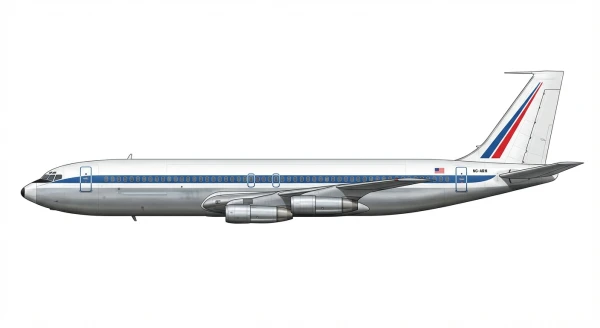
| Length | 46.4 m (152.1 ft) |
| Wingspan | 44.5 m (145.9 ft) |
| Height | 13.0 m (42.5 ft) |
| Empty weight | 66,406 kg (146,400 lbs) |
| Max. takeoff weight | 151,318 kg (333,599 lbs) |
| Powerplant | 4 × turbojets Pratt & Whitney JT3D-7 8,618 kgf each |
| Maximum speed | 1010 km/h (Mach 1.01) |
| Operational range | 5,400 km (3,355 mi) |
| Endurance | 10 hours |
| Service ceiling | 13,000 m (42,651 ft) |
| Takeoff distance | 3,304 m (10,840 ft) |



Recent Events — Boeing 707
2 events →
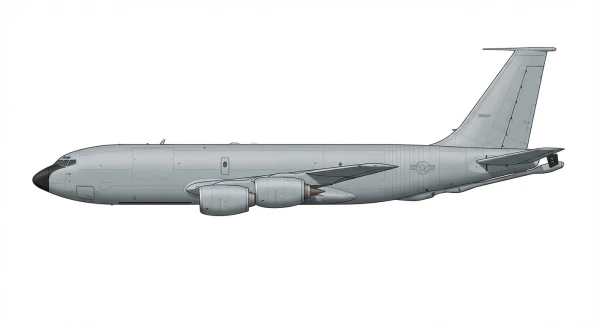
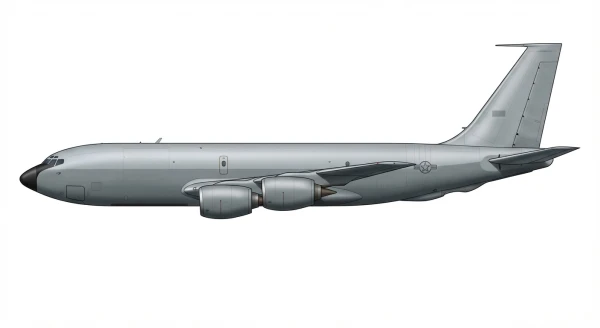
Description
The Boeing 707's development originated from Boeing's strategy to expand its market beyond military procurement following World War II. Despite substantial success with bomber aircraft, the company's position in the commercial sector lagged behind competitors like Douglas. Exploratory studies for a new jet transport aircraft commenced in 1949, encompassing potential applications for both civil air travel and military roles, specifically aerial refueling. These studies culminated in the Model 367-80, commonly known as the "Dash 80" prototype. The development timeline for this prototype was less than two years, from the project's initiation in 1952 to its inaugural flight on July 15, 1954. A critical technological element enabling this development was the Pratt & Whitney JT3C turbojet engine, which provided a significant increase in power output compared to contemporary engines. The United States Air Force became the initial customer for the platform, developing it into the KC-135 Stratotanker aerial refueling aircraft. The first flight of the baseline production model, the 707-120, took place on December 20, 1957, followed by its Federal Aviation Administration (FAA) type certification on September 18, 1958.
Design
The structural design of the Boeing 707 incorporated wings swept aft at an angle of 35 degrees. While this design contributed to its cruising speed performance, it concurrently introduced a lateral-directional instability characteristic known as "Dutch roll." To mitigate this aerodynamic phenomenon and enhance stability, Boeing integrated a yaw damper system, adapted from the technology originally developed for the B-47 bomber aircraft. Early variants, such as the 707-120, were propelled by Pratt & Whitney JT3C turbojet engines. Subsequent variants introduced turbofan engines, specifically the Pratt & Whitney JT3D, distinguishable externally by their prominent gray secondary-air inlet doors. The 707 was the first commercial jet transport aircraft to incorporate clamshell-type thrust reversers, augmenting its landing deceleration capabilities. Cabin pressurization was facilitated by turbocompressors driven by the engines, a system which underwent modifications and variations in the number of compressors fitted to engines across different 707 models throughout its production history.
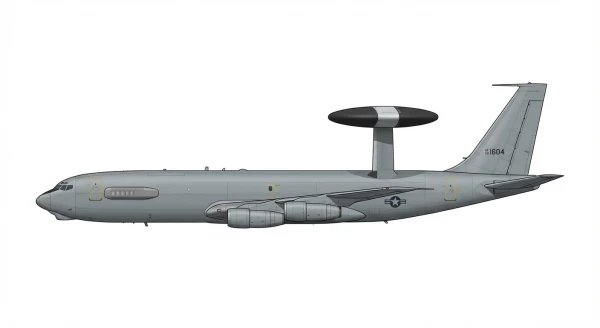
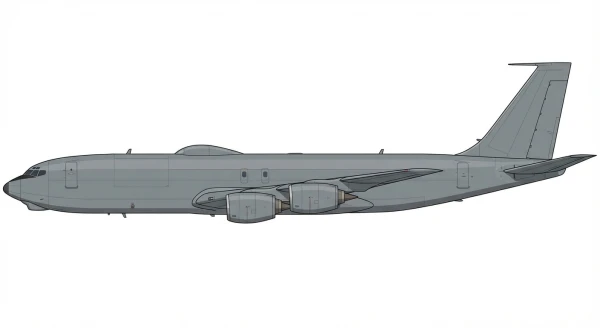
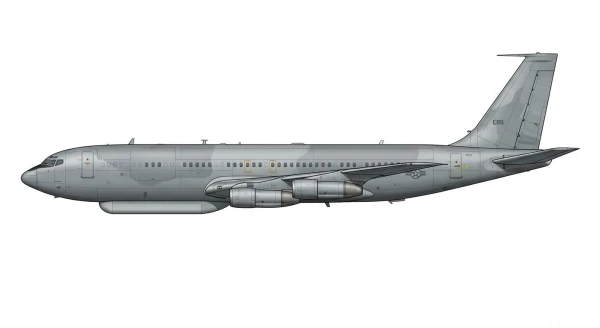
While primarily designed and utilized for civilian passenger and cargo air transportation, military adaptations of the Boeing 707 were developed for specialized operational roles. The 707-3J9C variant, procured by the Iranian Government, incorporated provisions for conducting in-flight refueling operations. The E-3 Sentry airborne warning and control system (AWACS) aircraft is based on the 707 airframe. The E-8 Joint STARS aircraft is a military platform derived from the Boeing 707-300 series commercial airliner, equipped with specialized radar, communications, and command and control subsystems.
Operational History
The Boeing 707 rapidly established itself on international air routes, initiating scheduled passenger service with Pan American World Airways in October 1958 on the route from New York to Paris, which required a refueling stop in Gander, Newfoundland. As the pioneering widely operated jet airliner, the 707 marked the beginning of the commercial Jet Age, necessitating significant and rapid infrastructure upgrades at airports worldwide. Trans World Airlines commenced its scheduled domestic jet service using the 707 between New York and San Francisco in January 1959. American Airlines followed later the same month, becoming the first U.S. domestic airline to operate its own jet aircraft within the continental United States. By the 1960s, the expanding demand for air travel resulted in passenger loads that began to exceed the capacity offered by the 707. By the 1980s, increasing aircraft noise abatement regulations presented operational restrictions for the type. The development and implementation of "Quiet 707" hush kits provided a technical solution that extended the operational service life of the airframe. Commercial passenger service of the Boeing 707 concluded in April 2013 with Saha Airlines of Iran. As of 2019, some military derivatives of the 707 continued to operate in various roles, including aerial refueling, strategic transport, and airborne command and control missions.
Variants
Main Variants:
-
707-120: The initial production version designed for transcontinental routes, powered by Pratt & Whitney JT3C-6 turbojets and capable of seating up to 189 passengers.
-
707-138: A shorter-bodied variant of the -120, produced for Qantas with increased range due to its reduced weight.
-
707-120B: An upgraded version of the -120 featuring Pratt & Whitney JT3D-1 turbofan engines, offering quieter operation, increased power, and improved fuel efficiency.
-
707-320 Intercontinental: A stretched version of the 707-120, designed for transoceanic routes with a longer wing and fuselage, and initially powered by JT4A-3 or JT4A-5 turbojets.
-
707-320C: A convertible passenger-freight configuration that became the most widely produced variant, featuring a strengthened floor, a new cargo door, and three-section leading-edge flaps on the wing.
Frequently Asked Questions
What type of aircraft is the Boeing 707?
What is the maximum speed of the Boeing 707?
What is the range of the Boeing 707?
When did the Boeing 707 first fly?
How many Boeing 707 have been built?
Which countries operate the Boeing 707?
How much does a Boeing 707 cost?
What is the service ceiling of the Boeing 707?
- JUL 272026 Updated Name updated
- APR 72026 Updated Sources and cross-references refreshed
- FEB 72026 Updated 707: top speed added; 707: ceiling added; 707: endurance added
- JAN 122026 Updated Range updated in a site-wide editorial pass