Étendard IVM
French carrier-borne transonic strike fighter, developed in the 1950s and operated by the French Navy from the 1960s until the late 20th century. Key figures: top speed 1,099 km/h, range 3,300 km, service ceiling 15,500 m, max takeoff weight 10,200 kg, built 90.
| Crew | 1 |
| Length | 14.4 m (47.1 ft) |
| Wingspan | 9.6 m (31.5 ft) |
| Height | 3.9 m (12.8 ft) |
| Wing area | 28.4 m² (305.7 sqft) |
| Empty weight | 5,897 kg (13,001 lbs) |
| Max. takeoff weight | 10,200 kg (22,487 lbs) |
| Powerplant | 1 × SNECMA ATAR 08B 43 kN each |
| Maximum speed | 1099 km/h (683 mph) |
| Operational range | 3,300 km (2,051 mi) |
| Service ceiling | 15,500 m (50,853 ft) |
| Climb rate | 100.0 m/s (328.1 ft/s) |
- Air-to-Air Short-Range AIM-9 Sidewinder
- Air-to-Air Short-Range Matra Magic
- Air-to-Surface Nord AS.30
- Air-to-Surface Nord AS.20
- Rocket Pod Matra rocket pods with 18× SNEB 68 mm rockets each
- Unguided Bomb variety of bombs
Description
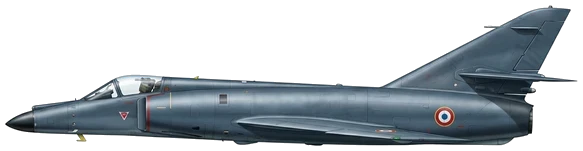
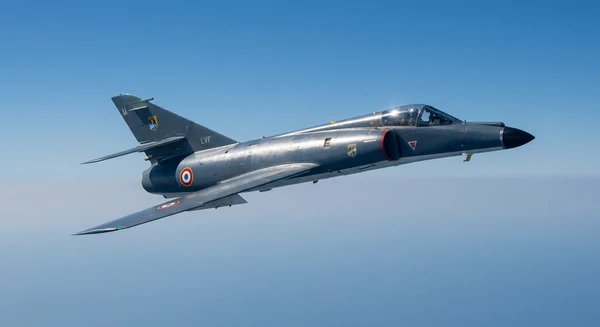
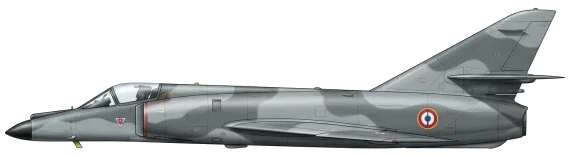
The Dassault Étendard IV is a transonic carrier-borne strike fighter developed by French manufacturer Dassault Aviation. Originating in the 1950s from Korean War lessons, the design evolved from proposals for French Air Force and NATO specifications. Following low interest in these initial designs, Dassault privately developed a larger version, designated Mystère XXIV, which attracted French Navy interest. A navalized prototype made its first flight on 24 July 1956. After evaluations of five pre-production aircraft, the French Navy ordered the type, receiving 69 Étendard IVM fighters and 21 Étendard IVP reconnaissance aircraft. Plans to replace the type with the SEPECAT Jaguar M were canceled in favor of the Super Étendard.
Design
The Étendard IVM features a highly swept, folding wing designed for carrier storage, equipped with double-slotted flaps, spoilers, powered ailerons, and leading-edge droop flaps. It is powered by a single SNECMA Atar 08B turbojet engine delivering 43.16 kN (9,700 lbf) of thrust, which lacks an afterburner. The aircraft is transonic, exceeding Mach 1 only in a dive. Systems include a retractable nose-mounted refueling probe, a TACAN receiver, and a braking drogue parachute. Avionics consist of a nose-mounted Dassault Aida radar, an infrared sensor, and a SAAB bombing computer.
Armament
Standard armament consists of two internal 30 mm DEFA 552 cannons with 150 rounds per gun. The aircraft features four wing-mounted external hardpoints with a total payload capacity of 1,360 kg (3,000 lb). It carries AIM-9 Sidewinder and Matra Magic air-to-air missiles, Nord AS.20 and AS.30 air-to-surface missiles, Matra rocket pods with 18 SNEB 68 mm rockets, bombs, and drop tanks.
Operational History
The French Navy was the sole operator of the type, receiving its first aircraft in December 1961. The aircraft deployed in 1962 aboard the Clemenceau-class carriers Clemenceau and Foch. The type was phased out of active combat roles in 1987. The final Étendard IVM fighters were retired in July 1991 from Squadron 59S, having accumulated 180,000 flight hours and 25,300 carrier landings. The Étendard IVP reconnaissance variant remained active until 27 July 2000, bringing the type's total service to over 200,000 flight hours.
Variants
- Étendard IV: The initial prototype powered by a SNECMA ATAR 101E3 engine, which made its first flight on 24 July 1956.
- Étendard IVB: A single prototype variant fitted with a Rolls-Royce Avon engine and blown flaps.
- Étendard IVM: The production single-seat maritime strike fighter variant built for the French Navy.
- Étendard IVP: The production single-seat photo-reconnaissance variant featuring a non-retractable refueling probe and nose-mounted OMERA cameras.
Frequently Asked Questions
What type of aircraft is the Étendard IVM?
What is the maximum speed of the Étendard IVM?
What is the range of the Étendard IVM?
When did the Étendard IVM first fly?
How many Étendard IVM have been built?
Which countries operate the Étendard IVM?
What is the service ceiling of the Étendard IVM?
- JUL 12026 Created Page created: Étendard IVM