Fuji T-1
Japanese jet-powered trainer aircraft, developed in the mid-20th century, utilized for military flight training. Key figures: top speed 925 km/h, range 1,300 km, service ceiling 14,400 m, max takeoff weight 5,000 kg, built 66.
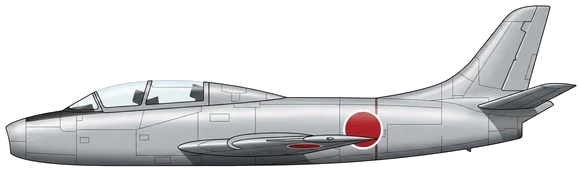
| Crew | 2 |
| Length | 12.1 m (39.8 ft) |
| Wingspan | 10.5 m (34.4 ft) |
| Height | 4.1 m (13.4 ft) |
| Wing area | 22.2 m² (239.2 sqft) |
| Empty weight | 2,420 kg (5,335 lbs) |
| Max. takeoff weight | 5,000 kg (11,023 lbs) |
| Powerplant | 1 × Bristol Siddeley Orpheus Mk 805 18 kN each |
| Maximum speed | 925 km/h (575 mph) |
| Operational range | 1,300 km (808 mi) |
| Service ceiling | 14,400 m (47,244 ft) |
| Climb rate | 33.0 m/s (108.3 ft/s) |
- Air-to-Air Short-Range AIM-9 Sidewinder
- Unguided Bomb 750 lb bomb
Description
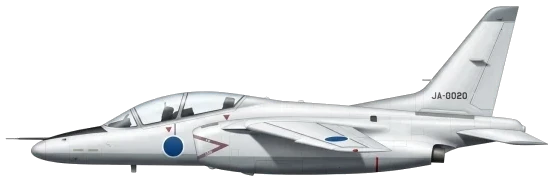
The Fuji T-1, designed and produced by Fuji Heavy Industries, was Japan's first indigenous jet-powered trainer and its first aircraft to feature a swept wing. The Japanese Defense Agency announced the initiative to develop a domestic jet trainer in early 1954, selecting Fuji's design over competing submissions. Although the Nippon Jet-Engine Company was tasked in 1955 to develop the Ishikawajima-Harima J3 turbojet engine for the aircraft, development delays led to initial airframes using imported Bristol Siddeley Orpheus engines. An Orpheus-powered aircraft conducted the type's maiden flight in January 1958. While the Japan Air Self Defense Force (JASDF) originally planned to procure over 200 T-1s, the acquisition of the American-designed Lockheed T-33A and changing training requirements limited production. A total of 66 aircraft were completed, and no export sales were secured despite marketing efforts to the Royal Australian Air Force.
Design
The T-1 features a swept wing with a K-561/K-569 airfoil, a wing area of 22.22 m², a length of 12.12 m, and a wingspan of 10.50 m. The aircraft has an empty weight of 2,420 kg and a maximum takeoff weight of 5,000 kg when carrying external tanks. Internal fuel capacity is 1,400 liters. Powerplants varied by variant, consisting of either the 18 kN Bristol Siddeley Orpheus Mk 805 turbojet or the 11.77 kN Ishikawajima-Harima J3-IHI-3 turbojet.
Armament
Armament configurations include provisions for a single 12.7 mm Browning M53-2 machine gun in the nose. The aircraft is equipped with two hardpoints capable of carrying combinations of two AIM-9 Sidewinder air-to-air missiles, two 750 lb (340 kg) bombs, or two 455-liter drop tanks.
Operational History
The T-1 was operated exclusively by the JASDF. It served in training roles until December 2000, when it was replaced by the Kawasaki T-4. The final T-1 aircraft was retired from service on 3 March 2006.
Variants
- T-1A: Powered by a 17.79 kN Bristol Siddeley Orpheus Mk 805 turbojet engine, with 46 aircraft constructed.
- T-1B: Powered by an 11.77 kN Ishikawajima-Harima J3-IHI-3 turbojet engine, with 20 aircraft constructed.
- T-1C: Converted to use 13.72 kN Ishikawajima-Harima J3-IHI-7 engines.
- T1F1: A single prototype powered by a Nippon J3 engine.
- T1F2: Two prototypes powered by 11,800 N Bristol BOr.1 Orpheus engines.
Frequently Asked Questions
What type of aircraft is the Fuji T-1?
What is the maximum speed of the Fuji T-1?
What is the range of the Fuji T-1?
When did the Fuji T-1 first fly?
How many Fuji T-1 have been built?
Which countries operate the Fuji T-1?
What is the service ceiling of the Fuji T-1?
- JUL 12026 Created Page created: Fuji T-1