Ajeet
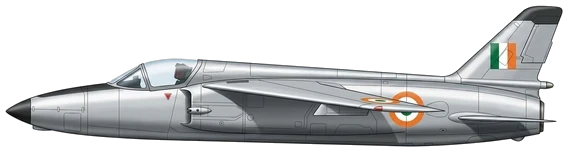
Indian jet-powered light fighter and interceptor, developed in the 1970s and operated by the Indian Air Force between 1977 and 1991. Key figures: top speed 1,152 km/h, range 172 km, service ceiling 13,720 m, max takeoff weight 4,173 kg, built 89.
| Crew | 1 |
| Length | 9.0 m (29.7 ft) |
| Wingspan | 6.7 m (22.1 ft) |
| Height | 2.5 m (8.1 ft) |
| Wing area | 12.7 m² (136.6 sqft) |
| Empty weight | 2,307 kg (5,086 lbs) |
| Max. takeoff weight | 4,173 kg (9,200 lbs) |
| Powerplant | 1 × HAL/Bristol Siddeley Orpheus 701-01 20 kN each |
| Maximum speed | 1152 km/h (716 mph) |
| Operational range | 172 km (107 mi) |
| Service ceiling | 13,720 m (45,013 ft) |
| Climb rate | 33.15 m/s (108.8 ft/s) |
- Rocket Pod rocket pods
- Unguided Bomb 250 kg bombs
Description
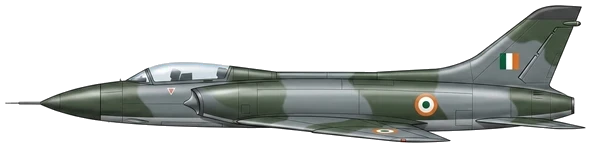
The HAL Ajeet was a jet-propelled light fighter developed and manufactured by the Indian aerospace company Hindustan Aeronautics Limited (HAL). Derived from the British Folland Gnat, which HAL had produced under license, the Ajeet was designed in response to a 1972 Indian Air Force (IAF) requirement for an upgraded variant with improved reliability and a secondary ground-attack role. HAL modified the final two Gnat production airframes to serve as prototypes; the first conducted its maiden flight on 6 March 1975, followed by the second on 5 November 1975. The first production aircraft flew on 30 September 1976. Fewer than 100 Ajeets were procured before production was terminated. HAL also developed a two-seat trainer variant, with prototypes flying in 1982 and 1983, but the program was canceled due to a lack of government interest.
Design
The Ajeet utilized a wet wing design that housed internal fuel, increasing fuel capacity and freeing up underwing hardpoints. Compared to the Gnat, the aircraft featured redesigned hydraulic systems, an improved landing gear arrangement, and an all-moving tail plane configuration. It was equipped with Martin-Baker GF4 ejection seats. While less agile than the Gnat, the Ajeet possessed a low radar cross-section. Power was provided by a single HAL/Bristol Siddeley Orpheus 701-01 turbojet engine producing 20 kN of thrust. Avionics and onboard systems included a Ferranti F195R/3 ISIS weapons sight, a Ferranti navigation system, a Vinten G90 gun camera, Bendix VHF transceivers (later V/UHF), a Bendix DFA-73 ADF, and an IFF Mk.10.
Armament
The aircraft was armed with two 30 mm ADEN Mk.4 cannons with 90 rounds per gun. It featured four underwing hardpoints with a total payload capacity of 900 kg (2,000 lb). The hardpoints carried combinations of rocket pods, two 250 kg bombs, and two 136.5-liter drop tanks.
Operational History
The IAF accepted the Ajeet into service in 1977, where it only equipped No. 2 Squadron. The type had a brief service career, was never deployed in active combat, and was retired from service in 1991.
Variants
- Gnat Mk 2: The original Indian Air Force designation for the Ajeet Mk 1.
- Ajeet Mk 1: A single-seat lightweight ground-attack and interceptor fighter aircraft.
- Ajeet Mk 2 Trainer: A two-seat advanced jet training prototype.
Frequently Asked Questions
What type of aircraft is the Ajeet?
What is the maximum speed of the Ajeet?
What is the range of the Ajeet?
When did the Ajeet first fly?
How many Ajeet have been built?
Which countries operate the Ajeet?
What is the service ceiling of the Ajeet?
- JUL 12026 Created Page created: Ajeet