Jetstream 41
Summary
| Category | Military Transport Aircraft |
| Origin country | 🇬🇧 United Kingdom |
| Manufacturer | British Aerospace |
| First flight | 25 September 1991 |
| Year introduced | 1992 |
| Number produced | 100 units |
| Average unit price | $8 million |
Technical specifications
| Version: Jetstream 41 | |
|---|---|
| Operational range | 1,433 km (890 mi) |
| Maximum speed | 547 km/h (340 mph) |
| Wing area | 32 m² (344.4 sqft) |
| Wingspan | 18.4 m (60.5 ft) |
| Height | 5.5 m (18.1 ft) |
| Length | 19.3 m (63.2 ft) |
| Service ceiling | 7,925 m (26,001 ft) |
| Empty weight | 6,416 kg (14,145 lbs) |
| Max. takeoff weight | 10,886 kg (23,999 lbs) |
| Climb rate | 11.2 m/s (36.7 ft/s) |
| Powerplant | 2 x turboprops AlliedSignal TPE331-14 delivering 1230 kW each |
Current operating countries
| Country | Units | ||
|---|---|---|---|

|
France | 2 | |
All operators
Description
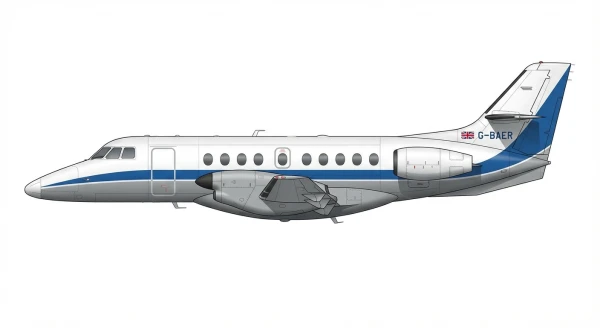
The British Aerospace Jetstream 41 evolved from the Jetstream 31 as a turboprop-powered feederliner and regional airliner. British Aerospace designed it to compete with 30-seat aircraft. The design included a fuselage stretch of 16 feet (4.9 m), achieved by adding an 8-foot-3-inch plug forward of the wing and a 7-foot-9-inch plug to the rear. The fuselage design was entirely new. The wing was redesigned with an increased span, modified ailerons, and flaps. To maximize passenger space and increase baggage capacity within larger wing-root fairings, the wing was mounted below the fuselage. Power was provided by Allied Signal TPE331-14 engines, initially delivering 1,500 shp (1,120 kW) and later 1,650 shp (1,232 kW), mounted in nacelles designed with increased ground clearance. The flightdeck was modernized with an EFIS setup and a new windscreen arrangement. The Jetstream 41 became the first turboprop certified to both JAR25 and FAR25 standards.
The first flight occurred on 25 September 1991. Certification was granted on 23 November 1992 in Europe, followed by 9 April 1993 in the United States. First delivery was to Manx Airlines on 25 November 1992. Production was terminated in May 1997 after 100 aircraft were delivered.
The Jetstream 41 entered service with Manx Airlines in November 1992. The type saw service with a variety of civil operators across the globe, including use under the American Connection, Delta Connection, and United Express brands in the United States. The Hong Kong Government Flying Service operated two examples for search-and-rescue missions. A small number have seen military service with the Royal Thai Army.
Main Variants:
- Jetstream 41: The initial and primary production variant, featuring a stretched fuselage to accommodate 29 passengers.