KZO
German stealth unmanned aerial vehicle, developed in the late 20th century, used for target acquisition and artillery support. Key figures: unit price $2.5M. In service with 1 air force as of 2026 — Germany (44).
| Length | 2.3 m (7.5 ft) |
| Wingspan | 3.4 m (11.2 ft) |
| Powerplant | 1 × Two-stroke engine |
| Endurance | 4 hours |
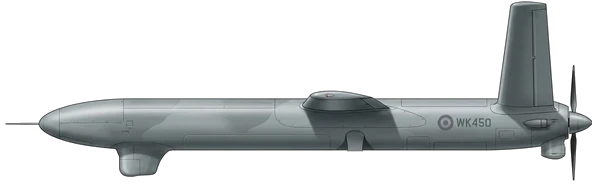
Description
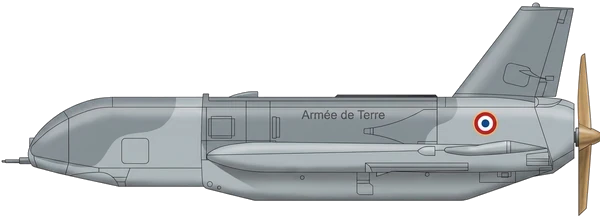
The KZO (Kleinflugzeug für Zielortung) is a German unmanned aerial vehicle (UAV) developed for target acquisition and locating mobile threats. Manufactured by Airbus Defence and Space Airborne Solutions GmbH—a joint venture of Airbus Defence and Space and Rheinmetall—the KZO replaced the Drohne CL 289 in German Army service.
Design
A standard operational system comprises 10 UAVs and two ground units, which contain a control station, a radio vehicle, a launch vehicle, a maintenance vehicle with a refueling facility, and a recovery vehicle. The UAV launches directly from a container using a booster rocket and recovers via parachute.
The KZO airframe has a wingspan of 3.42 meters, a length of 2.28 meters, and a body diameter of 0.36 meters. It incorporates design features to reduce its visual, acoustic, radar, and infrared signatures. Propulsion is provided by a noise-reduced two-stroke engine driving a two-blade propeller, allowing a cruise speed of 220 km/h and an endurance of four hours. The onboard sensor payload consists of a stabilized forward-looking infrared sensor, a digital data recorder with a 10-minute video capacity, and a real-time datalink. Navigation is conducted via inertial guidance and datalink-based positioning, with GPS available as an auxiliary system.
Operational History
The initial production system was exported to China.
Variants
- Taifun: A conceptual armed variant designed with an intelligent millimeter-wave radar seeker for autonomous search and destroy missions utilizing a hollow-charge warhead.
- Mücke: An electronic warfare variant.
- Fledermaus: An electronic warfare variant.
Frequently Asked Questions
What type of aircraft is the KZO?
Which countries operate the KZO?
How much does a KZO cost?
- AUG 202026 Updated Unit price filled (2.5 $M, estimate) for the UAV inventory weighting.
- JUL 232026 Updated Sources and cross-references refreshed
- JUL 62026 Created Page created: KZO