Bombardier Learjet 45
Summary
| Category | Military Transport Aircraft |
| Origin country | 🇨🇦 Canada |
| Manufacturer | Bombardier |
| First flight | 7 October 1995 |
| Year introduced | 1998 |
| Number produced | 642 units |
| Average unit price | $3.2 million |
Technical specifications
| Version: Learjet 45 | |
|---|---|
| Operational range | 3,167 km (1,968 mi) |
| Maximum speed | 858 km/h (533 mph) |
| Wing area | 29.0 m² (311.6 sqft) |
| Wingspan | 14.6 m (47.8 ft) |
| Height | 4.3 m (14.1 ft) |
| Length | 17.6 m (57.6 ft) |
| Service ceiling | 15,545 m (51,001 ft) |
| Empty weight | 5,829 kg (12,851 lbs) |
| Max. takeoff weight | 9,163 kg (20,201 lbs) |
| Climb rate | 14.5 m/s (47.6 ft/s) |
| Takeoff distance | 1,536 m (5,039 ft) |
| Powerplant | 2 x turbojets Honeywell TFE731-20 delivering 1588 kgf each |


Description
The Model 45 was developed in the 1990s as a competitor in the "super-light" business jet category, intended as a rival to the Cessna Citation Excel / XLS, trading stand-up room for the Learjet family's high-speed performance. It was Learjet's first completely new design since its initial aircraft, developed to enhance competitiveness against newer designs and built to more rigorous FAR Part 25 rules. Development began in 1989 but was not announced until September 1992. The prototype first flew on October 7, 1995. FAA certification was delayed until September 1997, and the first customer aircraft was delivered in mid-1998. Initial production delays affected customer orders.
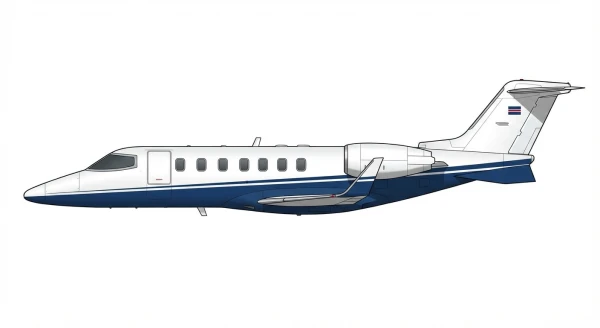
The LJ45 and LJ45XR models are positioned between the Learjet 31/40 and the Learjet 60, offering light business jet operating economics with mid-size business jet performance and comfort. The cabin features a flat-floor design with a non-circular cross-section to enhance headroom, typically configured with eight passenger seats in a double-club arrangement, alongside a fully enclosed toilet (which can serve as a ninth seat) and a 15-cubic-foot baggage area, complemented by an additional external 50-cubic-foot baggage area. Departing from extensive fail-safe structures, the Model 45 uses a lighter structure. While retaining the traditional Learjet aesthetic including a semi-swept wing, T-tail, sharp nose, and wrap-around windshield, it integrates engines and avionics similar to those in the Model 60, and features the delta fins and winglets seen in earlier Learjets. The cockpit is equipped with a four-screen Honeywell Primus 1000 EFIS avionics system using CRT screens. The aircraft is powered by two DEEC-controlled Honeywell TFE731-20-AR turbofan engines. The wing, optimized for cruise at Mach 0.78, incorporates vortilons and small metal triangles on the leading edge to manage airflow. The Learjet 45 also has dual-wheel, trailing link main landing gear, digital nosewheel steering, and single-point pressure refueling. The wings are built by De Havilland Canada, and the fuselage and empennage are built by Bombardier subsidiary Short Brothers.
As a business jet, the Learjet 45 is not designed for military operations and lacks any specific armament or hardpoints for carrying weapons. Its primary purpose is passenger transport, with payload capacity geared towards accommodating passengers, baggage, and necessary flight equipment. The standard configuration includes seating for up to nine passengers, along with dedicated space for baggage. The aircraft’s maximum takeoff weight is 21,500 lb (9,752 kg), which accounts for the combined weight of the aircraft, fuel, passengers, and cargo.
The Learjet 45 has seen service across various sectors, including governmental, military, and civilian operators. The Irish Air Corps and the Peru Air Force employ the aircraft for military transport or training purposes. Civilian operators include private charter services and governmental transport in countries such as Argentina, El Salvador, Luxembourg, and Montenegro. The aircraft experienced early difficulties. In August 2003, a faulty fastener on the horizontal stabilizer led to an FAA-mandated grounding of all Learjet 45s for a month while a fix was devised. By 2007, some operators reported issues with maintenance and product support. However, a 2017 report indicated an improved perception of reliability among owners.
Main Variants:
-
Model 45: The original Learjet 45 was a mid-size business jet, marking the first all-new design in the Learjet series in decades.
-
Model 45XR: An upgraded version of the Model 45, the 45XR offered higher takeoff weights, faster cruise speeds, and improved climb rates due to engine modifications.
-
Model 40: A shorter variant of the Model 45, the Model 40 featured a reduced passenger cabin but maintained comparable performance characteristics.
-
Model 40XR: This higher-performance variant of the Model 40 incorporated the same enhancements as the Model 45XR, boosting its capabilities.
-
Model 75: Essentially a Model 45XR with modern engines, systems, and avionics, the Model 75 delivered improved performance and efficiency.