QH-50 DASH
American drone anti-submarine helicopter, developed in the late 1950s, used as a stand-off weapon on naval ships. Key figures: top speed 148 km/h, range 132 km, service ceiling 5,000 m, max takeoff weight 1,036 kg, built 746.
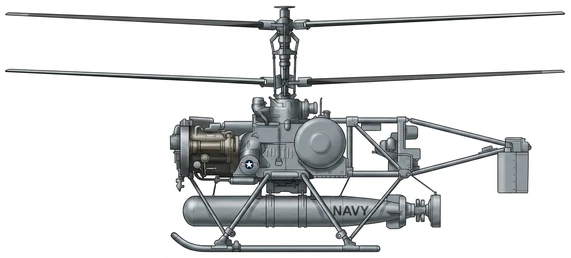
| Length | 3.9 m (12.9 ft) |
| Wingspan | 6.1 m (20.0 ft) |
| Height | 3.0 m (9.7 ft) |
| Empty weight | 523 kg (1,153 lbs) |
| Max. takeoff weight | 1,036 kg (2,284 lbs) |
| Powerplant | 1 × Boeing T50-BO-8A turboshaft 220 kW each |
| Maximum speed | 148 km/h (92 mph) |
| Operational range | 132 km (82 mi) |
| Endurance | 1 hours |
| Service ceiling | 5,000 m (16,404 ft) |
| Climb rate | 9.6 m/s (31.5 ft/s) |
- [Unguided Bomb] Mark 44 torpedo
- [Unguided Bomb] Mark 46 torpedo
Description
The Gyrodyne QH-50 DASH (Drone Anti-Submarine Helicopter) is a small, remote-controlled co-axial helicopter developed by the Gyrodyne Company of America. Originating from the mid-1950s manned Rotorcycle program, the DASH was developed as a stand-off weapon for the United States Navy’s Fleet Rehabilitation and Modernization (FRAM) program to counter Soviet submarines. The aircraft utilized contrarotating main rotors to control torque, eliminating the tail rotor and reducing the overall footprint for shipboard deployment. The control system split operations between a flight-deck controller for takeoff and landing, and a Combat Information Center (CIC) controller who guided the drone using radar and analog FM controls. Because the aircraft was considered expendable, it was built with off-the-shelf industrial electronics without backups. Over 80% of operational losses resulted from single-point electronics failures.
Armament
The QH-50 was designed to carry weapons up to 22 miles (35 km) from its host vessel. The early DSN-1 and DSN-2 versions carried a single Mark 43 homing torpedo. The production QH-50C increased payload capacity to carry either two Mark 44 torpedoes or a single Mark 46 torpedo.
Operational History
The US Navy acquired 746 DASH drones but withdrew them from service between 1968 and 1973 after losing over half the fleet at sea. During the Vietnam War, the US Navy operated modified variants equipped with television cameras for naval gunfire spotting and reconnaissance. The United States Army also utilized modified QH-50Ds for target towing and radar calibration at the White Sands Missile Range until May 2006, and used the QH-50DM variant for reconnaissance in Vietnam. Internationally, the Japan Maritime Self-Defense Force (JMSDF) operated 20 QH-50 drones from Takatsuki-class and Minegumo-class destroyers, retiring them in 1977.
Variants
- QH-50A: Redesignated from DSN-1, this pre-production evaluation variant consisted of nine aircraft powered by a 72 hp Porsche flat-four piston engine.
- QH-50B: Redesignated from DSN-2, this variant comprised three pre-production aircraft powered by two 86 hp Porsche piston engines.
- QH-50C: Redesignated from DSN-3, this turboshaft-powered production variant utilized a 300 shp Boeing T50-8A engine, with 373 units built.
- QH-50D: This production variant featured a 365 shp Boeing T50-12 turboshaft engine, fiberglass rotor blades, increased fuel capacity, and no tail assembly, with 377 units built.
- QH-50DM: This reconnaissance variant consisted of 10 modified QH-50D aircraft powered by a 550 shp Boeing T50-12 engine for US Army operations in the Vietnam War.
Frequently Asked Questions
What type of aircraft is the QH-50 DASH?
What is the maximum speed of the QH-50 DASH?
What is the range of the QH-50 DASH?
How many QH-50 DASH have been built?
What is the service ceiling of the QH-50 DASH?
- JUL 232026 Updated Sources and cross-references refreshed
- JUL 62026 Created Page created: QH-50 DASH