Wing Loong-10
Chinese high-altitude long-endurance unmanned aerial vehicle, developed in the early 21st century, designed for reconnaissance and precision strike missions. Key figures: top speed 620 km/h, service ceiling 15,000 m, max takeoff weight 3,200 kg.
| Length | 9 m (29.5 ft) |
| Wingspan | 20 m (65.6 ft) |
| Height | 3.7 m (12.0 ft) |
| Empty weight | 2,300 kg (5,071 lbs) |
| Max. takeoff weight | 3,200 kg (7,055 lbs) |
| Powerplant | 1 × WP-11C 10 kN each |
| Maximum speed | 620 km/h (385 mph) |
| Endurance | 20 hours |
| Service ceiling | 15,000 m (49,213 ft) |
- Air-to-Surface Blue Arrow air-to-surface missile
- Cruise light cruise missiles
- Guided Bomb CS/BBM3 (YL-12) guided bomb
- Guided Bomb GB-4 guided bomb
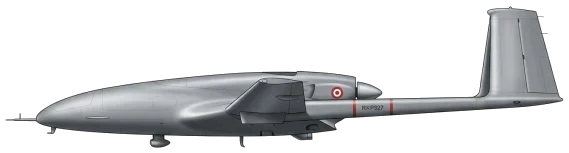
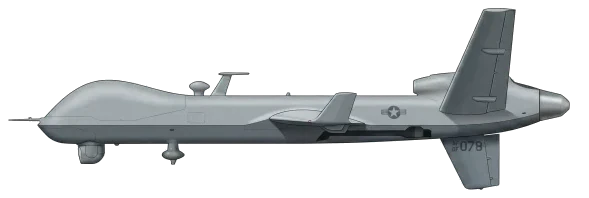
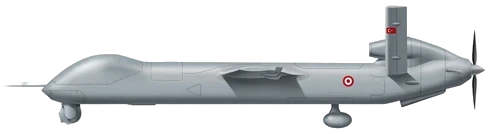
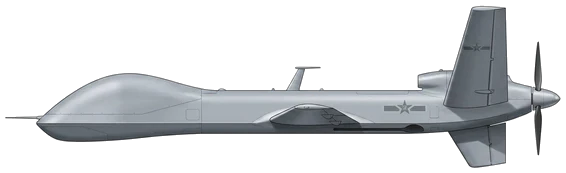
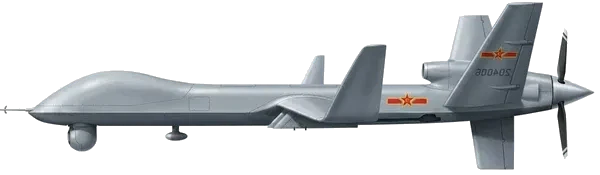
Description
The Wing Loong-10 (military designation WZ-10) is a high-altitude, long-endurance (HALE) unmanned aerial vehicle developed by Chengdu Aircraft Industry Group. The platform originated from the Sky Wing III prototype showcased in 2007. This design was renamed Wind Shadow in 2014, featuring a twin-engine layout, and debuted at the 2014 Zhuhai Air Show. An export-oriented variant, the Cloud Shadow, was subsequently unveiled at the 2016 Zhuhai Air Show. The mass-produced export version of the Wing Loong-10 completed its debut flight on August 2, 2020.
Design
Built using composite materials for the wings, fuselage, and tail, the aircraft has a bulbous nose tapering to the rear, a dorsal air scoop, and outward-canted vertical fins to reduce its radar cross section. It is configured as either a combat variant or an intelligence, surveillance, and reconnaissance (ISR) variant. A single ground control station can operate up to three aircraft simultaneously via data link, though the aircraft is capable of autonomous flight. The domestic Wind Shadow is powered by two WS-500 turbofans with concealed stealth nozzles and a deceleration parachute. The export Cloud Shadow is powered by either a single WP-11C turbojet, a single ZF850 engine, or two AEF-50E turbofans, with an unconcealed nozzle. The aircraft has a cruise speed of 620 km/h, a service ceiling of 15,000 meters, and an endurance of 20 hours.
Armament
The combat variant has a maximum takeoff weight of 3,200 kg and a payload capacity of 400 kg. It features six wing-mounted hardpoints (three per wing) that can carry 50 kg CS/BBM3 (YL-12) GPS-guided bombs, Blue Arrow air-to-surface missiles, 100 kg GB-4 precision-guided bombs, and light cruise missiles.
Operational History
The People's Liberation Army Air Force operated 12 WZ-10 aircraft as of 2018. In May 2024, the aircraft was observed flying over the East China Sea near Okinawa. The China Meteorological Administration utilizes the Wing Loong-10 for typhoon monitoring under the Haiyan Project, launched in 2018. Export customers include the Royal Saudi Air Force, which is believed to operate the Wing Loong-10B variant as of 2024.
Variants
- Sky Wing III: This early tactical prototype was unveiled in 2007 with a 15 km ceiling and a 6-hour endurance.
- Wind Shadow: This domestic military prototype features a twin-engine turbofan configuration with concealed stealth nozzles.
- Cloud Shadow: This export prototype features a single-engine or optional twin-engine layout with an unconcealed nozzle.
- Wing Loong-10: This mass-produced export variant debuted on August 2, 2020, for a typhoon detection flight.
- WZ-10: This Chinese military designation denotes the operational reconnaissance and electronic warfare platform.
Frequently Asked Questions
What type of aircraft is the Wing Loong-10?
What is the maximum speed of the Wing Loong-10?
When did the Wing Loong-10 first fly?
Which countries operate the Wing Loong-10?
What is the service ceiling of the Wing Loong-10?
- AUG 12026 Updated Manufacturer updated
- JUL 12026 Created Page created: Wing Loong-10