Z-20
Chinese medium-lift utility helicopter, developed in the 2010s, utilized for transport, assault, and search and rescue operations by the Chinese military. Key figures: top speed 360 km/h, range 560 km, service ceiling 6,000 m, max takeoff weight 10,000 kg, built 230. In service with 1 air force as of 2026 — China (205).
| Crew | 2 |
| Length | 20 m (65.6 ft) |
| Wingspan | 16 m (52.5 ft) |
| Height | 5.3 m (17.4 ft) |
| Empty weight | 5,000 kg (11,023 lbs) |
| Max. takeoff weight | 10,000 kg (22,046 lbs) |
| Powerplant | 2 × WZ-10 turboshaft 1,600 kW each |
| Maximum speed | 360 km/h (224 mph) |
| Operational range | 560 km (348 mi) |
| Service ceiling | 6,000 m (19,685 ft) |
| Climb rate | 7.1 m/s (23.3 ft/s) |

- Air-to-Surface AKD-9
- Air-to-Surface AKD-10
- Air-to-Surface CM-502KG
- Air-to-Surface CM-502V
- Air-to-Surface CM-501GA
- Air-to-Surface CM-501XA
- Air-to-Air Short-Range TY-90
- Anti-Ship YJ-9
- Rocket Pod Various rocket pods
Description
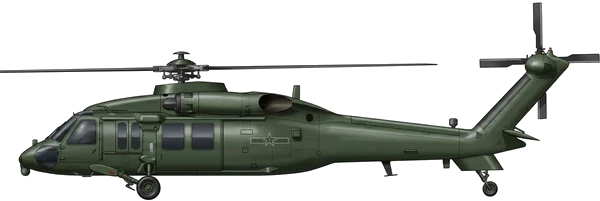
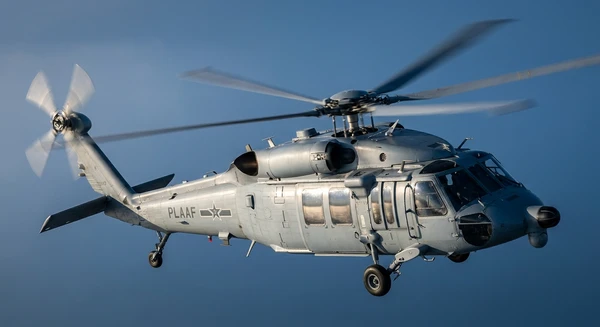
The Harbin Z-20 is a medium-lift utility helicopter produced by the Harbin Aircraft Industry Group (HAIG). Development began under a 10-tonne helicopter project in 2006 to meet a People's Liberation Army Air Force (PLAAF) requirement for a high-altitude utility helicopter. This requirement followed China's inability to purchase additional Sikorsky S-70C-2 aircraft due to the arms embargo enacted after the 1989 Tiananmen Square protests. The Z-20 completed its first flight on 23 December 2013. Production was accelerated following the 2008 Sichuan earthquakes, which emphasized the utility of helicopters in humanitarian operations.
Design
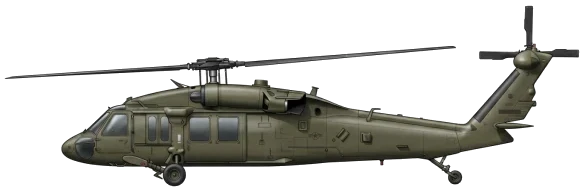
Based on the S-70/UH-60 Black Hawk design, the Z-20 incorporates fly-by-wire controls and a five-bladed main rotor. The angular tail-to-fuselage joint frame increases cabin capacity, lift, and endurance. Power is provided by two WZ-10 turboshaft engines, each rated at 1,600 kW (2,100 shp) with an emergency thrust of 2,000 kW (2,700 shp). The rotor blades feature de-icing technology, permitting operation at altitudes above 4,000 m (13,000 ft). Avionics and sensors include fairings for satellite communications or BeiDou navigation, electro-optical/infrared (EO/IR) sensors, radar warning receivers, a missile approach warning system, and four chaff and flare launchers. The aircraft has a maximum takeoff weight of 10,000 kg, carrying up to 15 passengers, 1,500 kg of internal cargo, or 4,000 kg of external cargo.
Armament
For armed operations, the Z-20 utilizes four hardpoints on two stub wings. Armament options include machine guns, autocannons, rocket pods, AKD-9 and AKD-10 laser-guided air-to-surface missiles, CM-502KG, CM-502V, or CM-501GA non-line-of-sight (NLOS) missiles, CM-501XA loitering munitions, TY-90 air-to-air missiles, and YJ-9 anti-ship missiles.
Operational History
The Z-20 operates from the Liaoning aircraft carrier and high-altitude regions. PLA Ground Force Aviation operates 150 Z-20 and 40 Z-20T units, while the PLA Air Force operates over 30 Z-20S and six Z-20K units. The PLA Naval Air Force operates at least two Z-20F and two Z-20J units. Additional operators include the People's Armed Police and the China Coast Guard.
Variants
- Z-20: Base transport variant used by the PLA Army.
- Z-20T: Armed assault variant featuring stub wings with two hardpoints each for weapons and targeting sensors.
- Z-20S: Search and rescue variant equipped with FLIR, a searchlight, a cabin hoist, and medical equipment.
- Z-20F: Naval anti-submarine warfare variant equipped with under-nose surface radar, torpedo pylons, and a dipping sonar.
- Z-21: Dedicated attack helicopter based on the Z-20 airframe, featuring a tandem cockpit, a 23 mm autocannon, and six wing hardpoints.
Frequently Asked Questions
What type of aircraft is the Z-20?
What is the maximum speed of the Z-20?
What is the range of the Z-20?
When did the Z-20 first fly?
How many Z-20 have been built?
Which countries operate the Z-20?
What is the service ceiling of the Z-20?
- JUN 302026 Created Page created: Z-20; then built and service entry year added; manufacturer updated