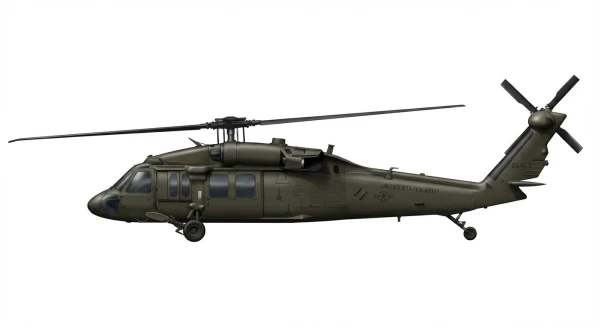
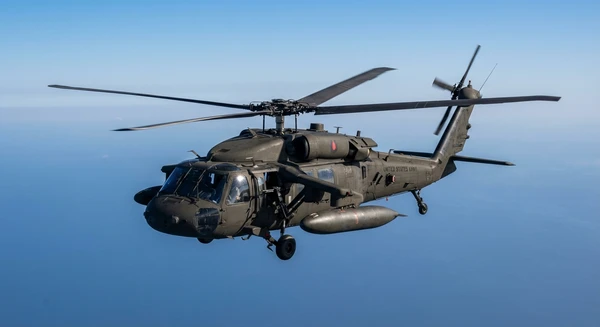
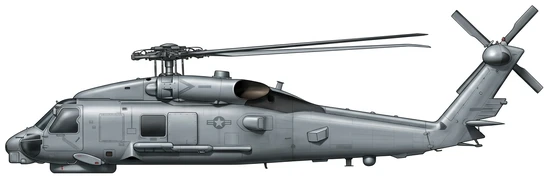
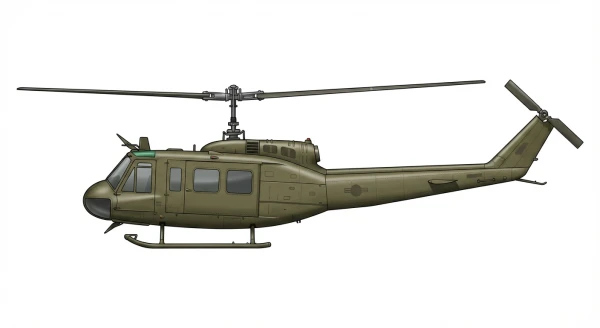
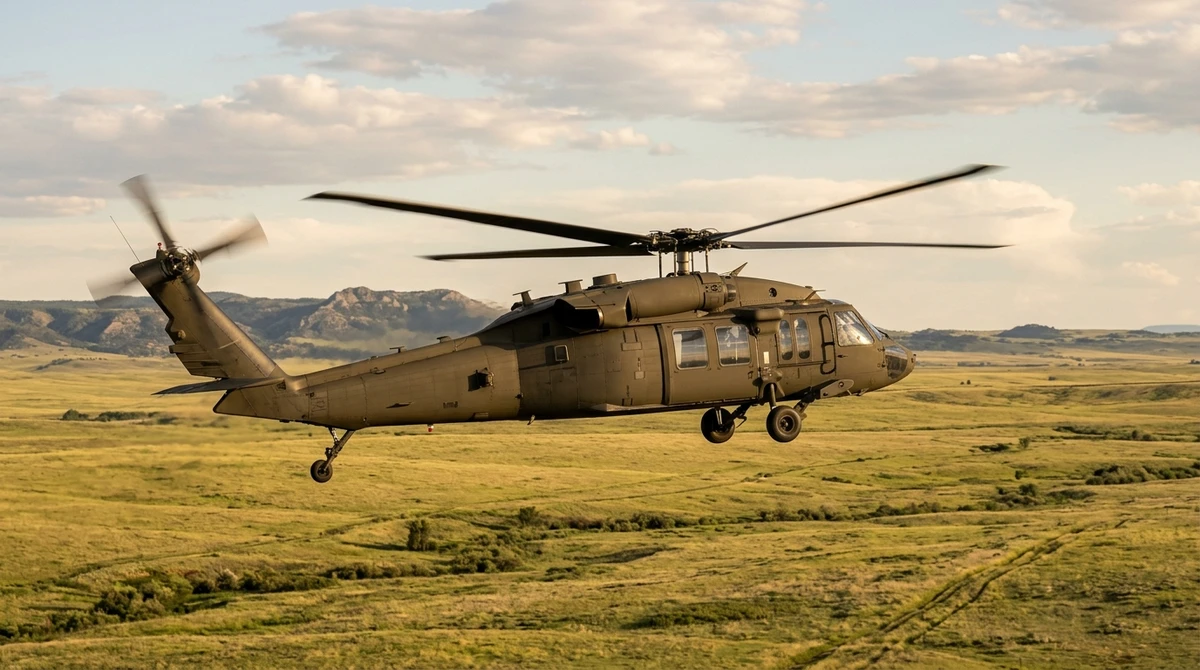
The Sikorsky UH-60 Black Hawk is a twin-engine, four-blade, medium-lift military utility helicopter manufactured by Sikorsky Aircraft in the United States. It entered service with the U.S. Army in June 1979 to replace the Bell UH-1 Iroquois as the service's primary tactical transport helicopter. The aircraft is designed for troop transport, aeromedical evacuation, and electronic warfare missions.
Development
The United States Army initiated the Utility Tactical Transport Aircraft System (UTTAS) program in 1972 to replace the UH-1. Sikorsky constructed four YUH-60A prototypes, with the first flight occurring on 17 October 1974. Following a fly-off evaluation against the Boeing Vertol YUH-61, the Army selected the UH-60A for production in December 1976, and deliveries began in October 1978. In 1987, the Army ordered the upgraded UH-60L featuring General Electric T700-GE-701C engines, with production starting in 1989. Development of the UH-60M was approved in 2001, featuring T700-GE-701D engines; full-rate production of 1,227 aircraft was authorized in December 2007.
Design
The UH-60 features a fully articulated four-blade main rotor and a canted tail rotor powered by two General Electric T700 turboshaft engines. Its low-profile airframe allows transport inside a C-130 Hercules with partial disassembly. Cabin capacity accommodates 11 equipped troops or 2,600 lb (1,200 kg) of internal cargo, while external sling load capacity reaches up to 9,000 lb (4,100 kg) on UH-60L/M models. Stub wings fitted with the External Stores Support System (ESSS) or Crashworthy External Fuel System (CEFS) carry external fuel tanks or weapons systems.
Armament
The UH-60 carries defensive door-mounted weapons, including 7.62 mm M240 machine guns, 7.62 mm M134 miniguns, or 12.7 mm GAU-19 Gatling guns. When equipped with ESSS stub wings, the helicopter provides four hardpoints capable of holding up to 10,000 lb (4,500 kg) of ordnance. Supported armaments include 70 mm Hydra 70 rocket pods, up to 16 AGM-114 Hellfire laser-guided missiles, AIM-92 Stinger air-to-air missiles, 20 mm or 30 mm gun pods, and the VOLCANO minefield dispersal system.
Operational History
The UH-60 made its combat debut during the U.S. invasion of Grenada in 1983, followed by the invasion of Panama in 1989. During the 1991 Gulf War, over 300 Black Hawks participated in the largest air assault mission in U.S. Army history. U.S. forces subsequently deployed the aircraft in Somalia, the Balkans, Haiti, Afghanistan, and Iraq. In May 2011, low-observable stealth variants were used during Operation Neptune Spear in Pakistan. As of 2024, the UH-60 is operated by 35 nations, including Australia, Brazil, Colombia, Japan, South Korea, and Turkey.
Variants
-
UH-60A Black Hawk: Original U.S. Army utility variant powered by General Electric T700-GE-700 engines and produced from 1977 to 1989.
-
UH-60L Black Hawk: Upgraded utility model introduced in 1989 featuring T700-GE-701C engines, an improved gearbox, and an external lift capacity of 9,000 lb.
-
UH-60M Black Hawk: Modernized variant featuring T700-GE-701D engines, wide-chord main rotor blades, an improved durability gearbox, and a digital glass cockpit.
-
MH-60L DAP: Direct Action Penetrator special operations gunship configured with stub-wing hardpoints for cannons, rockets, and missiles without troop transport capacity.
-
SH-60 Seahawk: U.S. Navy maritime variant developed for shipboard multi-mission and anti-submarine operations.