Botswana Military Forces 🇧🇼
Military Strength Overview
| 🛩️ Air Force | 45 active aircraft |
| 🪖 Active Troops | 9,000 personnels |
Global Military Index
| 🪖 Manpower (15%) | 56.5 | Active, reserve & paramilitary: 9000 effective |
| 🛡️ Ground Firepower (20%) | 0.0 | Main battle tanks: 0 |
| ⚓ Naval Power (20%) | 0.0 | Weighted by ship type: carriers, submarines, destroyers... |
| ✈️ Air Power (25%) | 42.5 | Weighted by aircraft type: combat, bombers, helicopters... |
| ☢️ Nuclear Deterrent (10%) | 0.0 | No declared nuclear capability |
| 💰 Defense Budget (10%) | 42.4 | $0.6B annual military spending |
Methodology: Log-scaled composite index using SIPRI, IISS, and GMNET data. Each pillar is normalized to 0-100, then weighted by strategic importance.
Geography
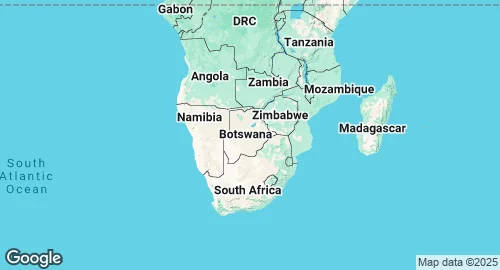
| Capital | Gaborone |
| Land Area | 566,730 km² |
| Coastline Length | 0 km |
National Flag

Defense Statistics & Key Metrics
| Population | 2.5 million (2023) |
| GDP | $19.4 billion (2023) |
| GDP per capita | $7820 (2023) |
| Military Budget | $567.8 million (2024) |
| Share of GDP in Milex | 2.8% (2024) |
| Share of Govt Expenditures | 8.0% (2024) |
| Military spends per capita | $227 (2024) |
| Inflation Rate | 2.82% (2024) |
| Military Personnel | 9,000 (2020) |
Botswanan Military Budget History
Population and Military Personnel Trends
GDP and Inflation Rate Trends
Strategic Overview in 2026
Strategic Position
Botswana is a landlocked nation in Southern Africa, bordered by Namibia, South Africa, Zimbabwe, and Zambia. Its defense posture is defined by its membership in the Southern African Development Community (SADC) and the African Union (AU). The country’s primary security concerns center on border integrity, the management of transnational crime, and regional stability in the SADC zone.
Defense doctrine focuses on territorial sovereignty and collective regional security. Botswana maintains close bilateral security cooperation with the United States and regional partners. Following the conclusion of the SADC Mission in Mozambique (SAMIM), in which Botswana provided personnel and logistical support, the military has refocused on domestic security and border monitoring. Primary non-conventional tasks include anti-poaching operations in the Okavango and Chobe regions to protect the national tourism and conservation sectors. The national leadership underwent a peaceful transition in late 2024, maintaining the established policy of civilian oversight and military restraint.
Military Forces
The Botswana Defence Force (BDF) is a unified military structure under the command of the President as Commander-in-Chief. The force is led by the Commander of the BDF and is organized into the Ground Force, the Air Arm Command, and a riverine patrol contingent.
Personnel The BDF maintains approximately 9,000 active-duty personnel. This is supplemented by a reserve force of approximately 5,000 and a paramilitary component of roughly 7,500, which includes the Botswana Police Service and specialized border patrol units.
Ground Force The Ground Force is the largest branch, structured around an armored brigade, two light infantry brigades, and an artillery brigade.
-
Armor and Reconnaissance: The army operates SK-105 Kürassier light tanks and FV101 Scorpion reconnaissance vehicles. Armored transport is provided by Mowag Piranha III wheeled armored personnel carriers and V-150 Commando vehicles.
-
Artillery: Fire support is provided by ATMOS 2000 155mm self-propelled howitzers and L118 light guns. The branch also operates APRA-40 multiple launch rocket systems.
-
Air Defense: The force utilizes the VL MICA ground-based air defense system and Mistral man-portable surface-to-air missiles.
Air Arm Command The Air Arm is primarily configured for transport, light attack, and surveillance.
-
Combat: The fleet consists of aging CF-5 (designated BF-5) Freedom Fighters.
-
Transport and Utility: Operational capabilities are supported by C-130H Hercules and CN-235 transport aircraft. The helicopter fleet includes Bell 412 and AS350 Ecureuil platforms for troop movement and medical evacuation.
-
Training: The branch utilizes Pilatus PC-7 MkII turboprop trainers.
-
Unmanned Systems: Surveillance is conducted using Elbit Hermes 450 unmanned aerial vehicles.
Riverine Patrol A river-wing contingent attached to the ground forces operates on the Chobe and Okavango rivers. Equipment includes Panther airboats and Boston Whaler Raider-class patrol boats.
Defense Industry
In 2025, the national government initiated a feasibility study to establish a domestic defense industry aimed at reducing reliance on foreign imports and shortening supply chains. Current requirements are met entirely through imports, primarily from suppliers in France, Israel, Switzerland, the United States, and India. There is no existing large-scale domestic manufacturing of heavy arms or aerospace equipment.
Strategic Trends
Modernization efforts in 2025 and 2026 are focused on the long-term replacement of the aging fighter fleet. The BDF is engaged in discussions with India regarding the acquisition of the HAL Tejas light fighter. Previous evaluations have included the Saab Gripen and the KAI FA-50.
Defense spending remains high relative to regional averages, typically ranging between 2.5% and 3% of GDP. Procurement priorities include the acquisition of advanced ground-based radar systems and the expansion of unmanned aerial surveillance to monitor porous borders.
In 2025, the BDF identified cybersecurity as a critical strategic priority. Programs are being implemented to protect government infrastructure and the diamond mining industry from sophisticated social engineering and ransomware threats. Future force structure shifts emphasize the integration of smart surveillance and early detection technologies to manage both conventional security threats and environmental risks such as wildfires.
Frequently Asked Questions
How large is Botswana's military?
What is Botswana's defense budget?
How does Botswana rank militarily in the world?
Does Botswana have nuclear weapons?
How many aircraft does Botswana's air force have?
What percentage of GDP does Botswana spend on defense?
What is Botswana's military personnel per capita?
Military Expenditure: SIPRI Milex. Suggest a change