Tejas
Indian multirole light fighter, developed in the late 20th century, used primarily by the Indian Air Force and Navy. Key figures: top speed 2,220 km/h, range 3,000 km, service ceiling 16,000 m, max takeoff weight 13,500 kg, unit price $26M, built 38. In service with 1 air force as of 2026 — India (37).
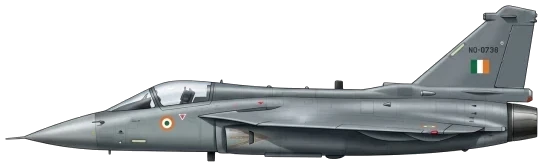
| Crew | 1–2 |
| Length | 13.2 m (43.3 ft) |
| Wingspan | 8.2 m (26.9 ft) |
| Height | 4.4 m (14.4 ft) |
| Wing area | 38.4 m² (413.3 sqft) |
| Empty weight | 6,560 kg (14,462 lbs) |
| Max. takeoff weight | 13,500 kg (29,762 lbs) |
| Powerplant | 1 × General Electric F404-GE-IN20 afterburning turbofan 8,600 kgf each |
| Ejection seat | Martin-Baker Mk 16A |
| Maximum speed | 2220 km/h (Mach 2.1) |
| Operational range | 3,000 km (1,864 mi) |
| Service ceiling | 16,000 m (52,493 ft) |

Recent Events — Tejas
5 events →-
SEP 182026
 India
×2
Final two LCA Tejas FOC twin-seat trainers handed over at Bengaluru, completing the Final Operational Clearance trainer contract.
Delivered
India
×2
Final two LCA Tejas FOC twin-seat trainers handed over at Bengaluru, completing the Final Operational Clearance trainer contract.
Delivered
-
FEB 72026
India
Tejas overshot runway at forward airbase along western front due to suspected brake failure; pilot injured but survived.
Crash
-
NOV 212025
India
An Indian Air Force Tejas crashed during an aerial display at the Dubai Airshow; the pilot was killed.
Crash
Description
The HAL Tejas is an Indian single-engine, delta-wing, 4.5-generation multirole fighter, designed by the Aeronautical Development Agency and produced by Hindustan Aeronautics Limited for the Indian Air Force and the Indian Navy. Its first flight took place on 4 January 2001 and it entered IAF service in 2016. It is the smallest and lightest supersonic fighter of its generation, and the second jet combat aircraft developed by HAL after the HF-24 Marut.
Development
The Light Combat Aircraft programme was launched in 1983 to replace the IAF's MiG-21s, 874 of which had been used since 1963. The ADA was created in 1984 under the DRDO to manage the programme, with HAL as prime contractor. The definition phase began in October 1986 with Dassault-Breguet as consultant, under the direction of Kota Harinarayana. The configuration was frozen in 1990: tailless composite delta wing, relaxed static stability, quadruplex digital fly-by-wire controls developed by the NAL after the failure of the partnership with Lockheed Martin following the American embargo of 1998, which cost around 18 months. The TD-1 flew on 4 January 2001, the PV-1 in 2003, the LSP-1 on 25 April 2007, and the first naval prototype NP-1 on 27 April 2012. IOC-I was granted in January 2011, IOC-II in December 2013 and FOC on 20 February 2019 at Aero India. In 2016 the Mark 1 had an indigenous content of 59.7% by value. In November 2025, the IAF fields around 30 Mark 1s and six two-seaters; 141 Mark 1As and 41 two-seaters are on order, towards a target of 324 aircraft. The assembly lines are located at Bengaluru (two) and Nashik.
Design
The airframe uses aluminium-lithium and titanium alloys, with carbon composites accounting for 45% of the weight and 90% of the surface area. The fin is a monolithic honeycomb structure; the original Kevlar radome was replaced by a quartz radome. The Mark 1 is powered by an 85 kN General Electric F404-GE-IN20 with afterburner and FADEC, the GTRE's Kaveri having failed to materialise. The Mark 1's avionics are built around the Elta EL/M-2032 radar; the Mark 1A receives the EL/M-2052 AESA or the LRDE's Uttam, the DARE's UEWS electronic warfare suite, an Elta ELL-8222WB podded jammer and an OBOGS. The all-glass cockpit comprises a HUD, three multifunction displays and a Martin-Baker 16LG ejection seat. Pilots use the Elbit DASH IV helmet-mounted sight and the Rafael Litening III targeting pod.
Armament
The Tejas has eight hardpoints, three of them wet, and a twin-barrel 23 mm GSh-23 cannon with 220 rounds under the starboard air intake. Air-to-air armament comprises the R-73, Python-5, ASRAAM, I-Derby ER and Astra Mk 1. External load reaches 4,500 to 5,300 kg, including GBU-16 Paveway II laser-guided bombs, Sudarshan, Spice munitions, JDAM and HSLD. The BrahMos-NG and Rudram-1 are in development.
Operational History
The Tejas made its international debut at the Bahrain International Airshow on 21 January 2016. No. 45 Squadron (Flying Daggers) was operational at Sulur in July 2016, followed by No. 18 Squadron (Flying Bullets), based at Naliya. The first operational deployment took place on 18 August 2020 along the Line of Control with Pakistan. The aircraft took part in exercises Gagan Shakti 2018, Desert Flag VIII (United Arab Emirates, 2023) and Tarang Shakti 2024. An Astra Mk-1 was successfully fired on 12 March 2025 at more than 100 km. No export has been concluded; offers to Argentina, Australia, Botswana, Egypt, Malaysia, Nigeria and the Philippines failed. Two aircraft have been lost, including a fatal accident at the Dubai Airshow on 21 November 2025.
Variants
- Tejas Mark 1 IOC: initial single-seater, 16 examples delivered to No. 45 Squadron.
- Tejas Mark 1 FOC: adds the Cobham refuelling probe, the GSh-23 cannon, BVRAAM capability and a +9 g limit.
- Tejas Trainer: two-seat operational conversion aircraft, also used as an advanced trainer and ground-attack aircraft.
- Tejas Mark 1A: improved version with AESA radar, self-protection jammer, radar warning receiver and more than 40 modifications.
- Tejas Mark 2: heavier derivative with F414-INS6 engine, canards, increased payload and internal fuel, and integrated IRST.
Frequently Asked Questions
What type of aircraft is the Tejas?
What is the maximum speed of the Tejas?
What is the range of the Tejas?
When did the Tejas first fly?
How many Tejas have been built?
Which countries operate the Tejas?
How much does a Tejas cost?
What is the service ceiling of the Tejas?
- AUG 302026 Updated Description updated
- AUG 122026 Updated Range corrected to the ferry range
- AUG 62026 Updated Description updated
- APR 72026 Updated Sources and cross-references refreshed