Cyprus Military Forces
Cyprus ranks #80 of 170 militaries worldwide in 2026, with 15,000 active troops. The Cypriot Army fields 134 main battle tanks; the Air Force flies 13 aircraft; the Navy operates 11 warships. Cyprus has no nuclear weapons.
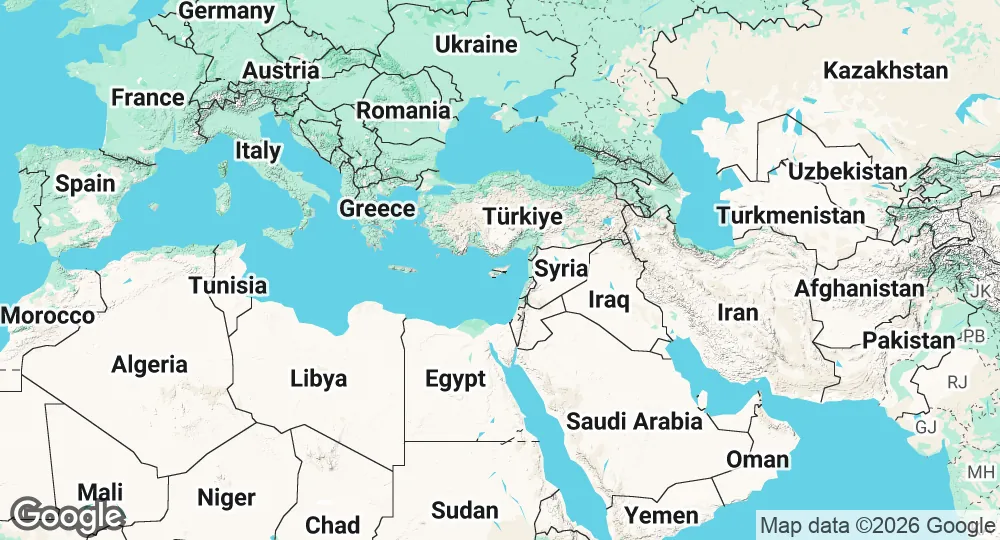
Armed Forces in 2026
| Domain | Strength | Composition |
|---|---|---|
| Air Command of Cyprus | 13 aircraft | 13 helicopters 1 air bases |
| Cyprus Navy | 11 warships | |
| Ground Forces | 134 tanks | |
| Personnel | 15,000 active | 60,000 reserve |
ATLAS Index (Aggregate Total of Land, Air and Sea strength)
Full ranking →| Pillar | Weight | Score | Basis |
|---|---|---|---|
| Manpower | 10% | 33.6 | Active, reserve & paramilitary personnel |
| Ground forces | 20% | 31.6 | ARMS inventory power: armour & artillery by type and era, attack helicopters, armament |
| Naval power | 20% | 19.0 | SEAS inventory power: hulls by type, size and era, air wing, sustainment, armament |
| Air power | 25% | 15.3 | AIRS inventory power: aircraft by type and generation, enablers, armament |
| Nuclear deterrent | 10% | 0.0 | No declared nuclear capability |
| Defense budget | 15% | 19.4 | Annual spending, purchasing-power adjusted |
| Availability | modifier | ground ×0.89 · naval ×1.05 · air ×1.16 | Budget per point of each force, from the branch indexes |
Country File
| Population | 1.4M (2024) |
| GDP | $37.6 billion (2024) |
| GDP per capita | $27,707 |
| Military budget | $640M (2024) |
| Share of GDP | 1.7% (2024) |
| Military spending per capita | $471 (2024) |
| Inflation rate | 1.8% (2024) |
| Capital | Nicosia |
| Region | Europe |
| Land area | 9,241 km² |
| Coastline | 648 km |
| Land borders | 152 km |
| Bordering countries | 1 |
| Currency | EUR |
Strategic Overview in 2026
Strategic Position
The Republic of Cyprus maintains a defensive posture centered on the partition of the island and the presence of the Turkish Armed Forces (TSK) in the northern territory. The primary security concern is the maintenance of the Green Line buffer zone and the protection of the sovereign Exclusive Economic Zone (EEZ) against maritime territorial claims.
Cyprus is a member of the European Union and participates in the Permanent Structured Cooperation (PESCO) framework. It is not a member of NATO, but it has intensified its alignment with Western security structures following the 1987 U.S. arms embargo's permanent lifting. Bilateral and trilateral defense agreements are central to its strategy, specifically the 1993 Joint Defense Space Doctrine with Greece. In 2025 and 2026, Cyprus operates under trilateral military work plans with Greece and Israel, and separate cooperation programs with Armenia, focusing on joint special forces training and maritime security.
The presence of the British Sovereign Base Areas at Akrotiri and Dhekelia provides additional regional infrastructure, while the Greek Contingent in Cyprus (ELDYK) remains stationed on the island under the 1960 Treaty of Alliance.
Military Forces
The Cypriot National Guard (GGEE) is an integrated, multi-branch force overseen by the Ministry of Defense. It consists of approximately 12,000 active personnel and 50,000 reserves. National service is mandatory for males, with a duration of 14 months.
Land Command The army fields armored and mechanized units equipped with T-80U and AMX-30 main battle tanks. Mechanized infantry operates BMP-3 and VAB armored personnel carriers. Artillery capabilities include Nora B-52 self-propelled howitzers and Tamnava multiple-launch rocket systems (MLRS) acquired from Serbia. Anti-tank inventory includes MILAN, Akeron MP, and Spike LR2 missile systems.
Air Command The air branch is primarily focused on rotary-wing and air defense operations. It operates AW139 and H145M helicopters, the latter replacing the Soviet-origin Mi-35 fleet sold to Serbia. Fixed-wing assets are limited to light transport and trainer aircraft. Integrated air defense is a priority, utilizing the Israeli-made Barak MX system, alongside Tor-M1 and Buk-M1 units. Short-range defense is provided by Mistral MANPADS and Skyguard (Othellos) systems.
Naval Command The navy operates a fleet of offshore patrol vessels (OPVs), including Sa’ar 62-class ships, and smaller fast patrol boats. Missions focus on coastal defense, EEZ surveillance, and search and rescue (SAR) coordinated by the Joint Rescue Coordination Centre (JRCC) in Larnaca.
Defense Industry
The domestic defense sector is organized under the Cyprus Defense, Security and Space Industry Cluster (CyDSIC), which became an autonomous body in 2026. The industry comprises approximately 30 to 45 companies with annual revenues of roughly €40 million.
Domestic production focuses on high-technology niches rather than heavy platforms. Notable manufacturers include SignalGeneriX, which produces the RF Hunter and counter-unmanned aerial systems (C-UAS), and CyRIC, which focuses on engineering and software for defense applications. Other firms specialize in 3D-printed micro-drones, maritime monitoring sensors, and electronic warfare components. Cyprus remains heavily dependent on imports for major platforms, sourcing primarily from France, Israel, and recently the United States.
Strategic Trends
Defense spending for 2026 is projected at approximately 1.65% of GDP, with a long-term goal of reaching the 2% benchmark by 2028. The procurement strategy is defined by a transition from Soviet-era hardware to NATO-standard equipment.
The primary modernization priority is the replacement of T-80U tanks and BMP-3 infantry fighting vehicles with Western alternatives, with evaluations of U.S., German, and Israeli platforms ongoing through 2026. Cyprus is increasingly utilizing the U.S. Excess Defense Articles (EDA) and Foreign Military Sales (FMS) programs to acquire transport aircraft, heavy-lift helicopters like the Chinook, and armored vehicles.
Infrastructure upgrades are underway at the Evangelos Florakis Naval Base and the Andreas Papandreou Air Base to support larger naval vessels and enable interoperability with EU and NATO partners. During its 2026 presidency of the Council of the European Union, Cyprus is focused on promoting EU strategic autonomy and the implementation of the Roadmap for Defence Preparedness.
Military Expenditure: CIA World Factbook. Last updated on 4 August 2026. Suggest a change
Frequently Asked Questions
How large is Cyprus's military?
What is Cyprus's defense budget?
How does Cyprus rank militarily in the world?
Does Cyprus have nuclear weapons?
How many aircraft does Cyprus's air force have?
How large is Cyprus's navy?
How many tanks does Cyprus have?
What percentage of GDP does Cyprus spend on defense?
What is Cyprus's military personnel per capita?
- AUG 42026 Updated Global Military Index updated in a site-wide editorial pass
- JUL 162026 Updated Global Military Index updated in a site-wide editorial pass
- JUN 162026 Updated Yearly statistics, military spending and 2 more fields updated
- MAR 172026 Updated Paramilitary personnel removed
- MAR 162026 Updated Reserve personnel updated
- JAN 132026 Updated Description updated