B-52 Stratofortress
American strategic bomber, significant for Cold War role, actively used in conflict zones from Vietnam to the Gulf War. Key figures: top speed 1,000 km/h, range 14,200 km, service ceiling 15,000 m, max takeoff weight 220,000 kg, unit price $9.3M, built 744. In service with 1 air force as of 2026 — United States (76).
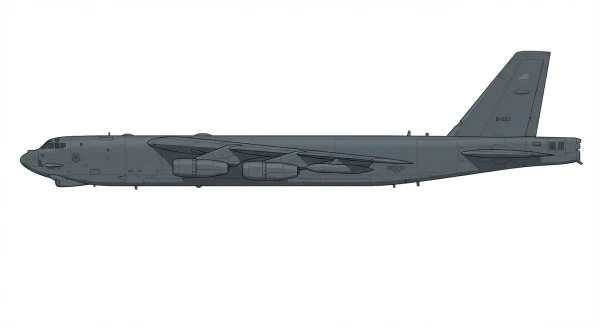
| Crew | 4 |
| Length | 48.5 m (159.1 ft) |
| Wingspan | 56.4 m (185.0 ft) |
| Height | 12.4 m (40.7 ft) |
| Wing area | 370 m² (3982.6 sqft) |
| Empty weight | 83,250 kg (183,535 lbs) |
| Max. takeoff weight | 220,000 kg (485,016 lbs) |
| Powerplant | 8 × turbofans Pratt & Whitney TF33-P-3/103 7,747 kgf each |
| Ejection seat | Weber M-3 |
| Maximum speed | 1000 km/h (Mach 1.0) |
| Operational range | 14,200 km (8,823 mi) |
| Endurance | 20 hours |
| Service ceiling | 15,000 m (49,213 ft) |
| Climb rate | 31.9 m/s (104.7 ft/s) |

- Cruise Missiles Boeing AGM-86 ALCM
- Air-to-Surface AGM-158 JASSM
- Air-to-Surface AGM-84 Harpoon
Recent Events — B-52 Stratofortress
1 event →

Description
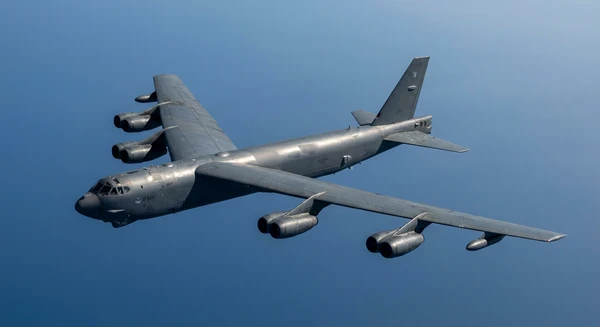
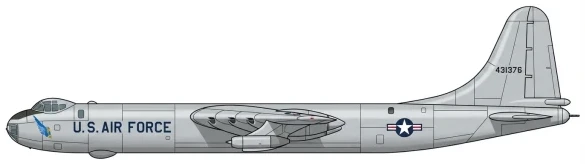
The Boeing B-52 Stratofortress is an American nuclear-capable subsonic jet-powered strategic bomber operated by the United States Air Force since 1955. Designed and built by Boeing to replace the Convair B-36 Peacemaker, the bomber was also flown by NASA for research from 1959 to 2007. Informally known as the "BUFF," the aircraft carries up to 70,000 pounds (32,000 kg) of weapons and has an unrefueled combat range of approximately 8,800 miles (14,200 km).
Development
Boeing won the initial development contract in June 1946, evolving the design from a straight-wing turboprop concept to a swept-wing layout powered by eight turbojets. The YB-52 prototype made its maiden flight on 15 April 1952, followed by the XB-52 on 2 October 1952. Production was split between Boeing facilities in Seattle, Washington, and Wichita, Kansas, yielding a total of 742 production aircraft and two prototypes before manufacturing concluded in 1962.
Design
The aircraft features 35-degree swept wings that flex up to 32 feet (9.8 m) during flight to relieve stress, along with main landing gear that pivots 20 degrees for crosswind landings. Roll control relies primarily on wing spoilerons rather than conventional ailerons. Early variants were powered by Pratt & Whitney J57 turbojets, whereas the B-52H introduced TF33-P-3 turbofans. Avionics include the IBM AP-101 main computer, AN/ASQ-151 Electro-Optical Viewing System, and LITENING targeting pods.
Armament
The B-52 accommodates up to 70,000 pounds (32,000 kg) of weapons in an internal bay and on underwing pylons. In the nuclear role, the B-52H is assigned the AGM-86B air-launched cruise missile. Conventional weapons include Joint Direct Attack Munitions, AGM-154 glide bombs, AGM-158 JASSM missiles, Harpoon anti-ship missiles, and Quickstrike naval mines. Tail gun armaments—originally quad .50-caliber machine guns or a 20 mm Vulcan cannon—were deactivated across the fleet in 1991.
Operational History
Entering service with Strategic Air Command in 1955, the B-52 maintained continuous airborne nuclear alert patrols during the Cold War. The bomber saw combat during the Vietnam War, executing carpet-bombing sorties during Operations Arc Light and Linebacker II, during which tail gunners downed two North Vietnamese MiG-21 fighters. It subsequently flew combat missions during Operation Desert Storm, Operation Allied Force, Operation Enduring Freedom, Operation Iraqi Freedom, and operations in Syria and Iran. As of 2024, the United States Air Force operates 76 B-52H aircraft, which are planned to remain active into the 2050s.
Variants
-
XB-52: The initial prototype featuring tandem seating and powered by eight Pratt & Whitney YJ57 turbojet engines.
-
B-52A: The first production variant, consisting of three aircraft used exclusively by Boeing and the Air Force for flight testing.
-
B-52B: The initial operational variant, entering active service in 1955 with the 93rd Heavy Bombardment Wing.
-
B-52G: A strategic bomber variant equipped with modified wings, revised electronic countermeasures, and capability for AGM-86 cruise missiles.
-
B-52H: The final production model and sole operational variant, introduced in 1961 with TF33 turbofan engines and modernized avionics.
Frequently Asked Questions
What type of aircraft is the B-52 Stratofortress?
What is the maximum speed of the B-52 Stratofortress?
What is the range of the B-52 Stratofortress?
When did the B-52 Stratofortress first fly?
How many B-52 Stratofortress have been built?
Which countries operate the B-52 Stratofortress?
How much does a B-52 Stratofortress cost?
What is the service ceiling of the B-52 Stratofortress?
- AUG 272026 Updated Unit price re-based (flyaway cost of the most-produced variant, then-year USD convention)
- AUG 62026 Updated Description updated
- AUG 52026 Updated Climb rate added; powerplant updated
- JUN 262026 Updated Bombs and missiles added
- APR 72026 Updated Sources and cross-references refreshed
- FEB 72026 Updated Endurance added
- JAN 122026 Updated Range updated in a site-wide editorial pass