CH-47 Chinook
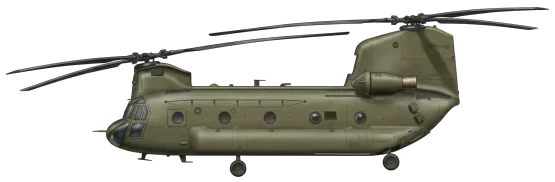
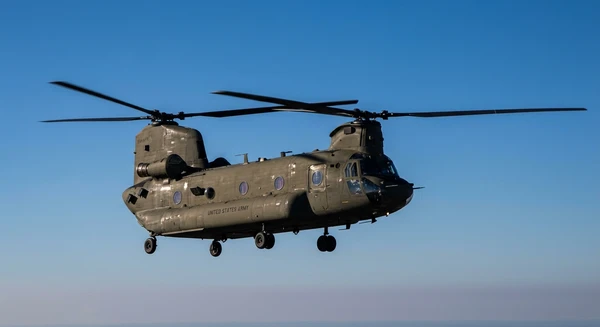
American tandem rotor helicopter, synonymous with heavy-lift operations, crucial in conflicts including Vietnam and Afghanistan. Key figures: top speed 315 km/h, range 740 km, service ceiling 5,639 m, max takeoff weight 22,680 kg, unit price $38M, built 1,200. In service with 19 air forces as of 2026 — United States (515), Japan (66), United Kingdom (45) and 16 others.
| Crew | 4–5 |
| Length | 30.1 m (98.8 ft) |
| Wingspan | 18.3 m (60.0 ft) |
| Height | 5.7 m (18.7 ft) |
| Empty weight | 10,614 kg (23,400 lbs) |
| Max. takeoff weight | 22,680 kg (50,001 lbs) |
| Powerplant | 2 × turboshafts Lycoming T55-GA-712 2,796 kW each |
| Maximum speed | 315 km/h (196 mph) |
| Operational range | 740 km (460 mi) |
| Service ceiling | 5,639 m (18,501 ft) |
| Climb rate | 10.1 m/s (33.1 ft/s) |
-
 United States
515 +57
United States
515 +57
-
 Japan
66 +17
Japan
66 +17
-
 United Kingdom
45 +14
United Kingdom
45 +14
-
 South Korea
43 +18
South Korea
43 +18
-
 Iran
43
Iran
43
-
 United Arab Emirates
28
United Arab Emirates
28
-
 Singapore
26
Singapore
26
-
 Egypt
24 +7
Egypt
24 +7
-
 Italy
21
Italy
21
-
 Greece
20
Greece
20
-
 Netherlands
20
Netherlands
20
-
 Spain
17 +1
Spain
17 +1
-
 India
15
India
15
-
 Australia
14
Australia
14
-
 Canada
14
Canada
14
-
 Morocco
10
Morocco
10
-
 Turkey
10
Turkey
10
-
 Taiwan
9
Taiwan
9
-
 Saudi Arabia
2 +46
Saudi Arabia
2 +46
-
 Germany
0 +60
Germany
0 +60
Recent Events — CH-47 Chinook
8 events →-
SEP 82026
 Egypt
×5
First five of 12 CH-47F Chinooks handed over during the El Alamein air show, starting the replacement of the CH-47D fleet.
Delivered
Egypt
×5
First five of 12 CH-47F Chinooks handed over during the El Alamein air show, starting the replacement of the CH-47D fleet.
Delivered
-
APR 222026
 Turkey
CH-47F crashed during night training flight near Temelli, Ankara; all 5 crew survived with no serious injuries, aircraft sustained substantial damage.
Crash
Turkey
CH-47F crashed during night training flight near Temelli, Ankara; all 5 crew survived with no serious injuries, aircraft sustained substantial damage.
Crash
-
APR 32026
 United States
CH-47F destroyed by Iranian Shahed-136 drone strike at Camp Buehring, Kuwait; no crew casualties reported.
Destroyed
United States
CH-47F destroyed by Iranian Shahed-136 drone strike at Camp Buehring, Kuwait; no crew casualties reported.
Destroyed
-
OCT 292025
United States
×9
US Army contracts Boeing for nine more CH-47F Block II Chinooks.
Ordered
Description
The Boeing CH-47 Chinook is an American tandem-rotor heavy-lift helicopter originally developed by Vertol and manufactured by Boeing Defense, Space & Security. Entering U.S. Army service in 1962, the aircraft performs troop transport, artillery placement, cargo resupply, and casualty evacuation. It is the second-heaviest lifting Western helicopter and remains in continuous production and frontline service over 60 years after its introduction.
Development
In late 1956, the U.S. Department of the Army initiated a program to replace the piston-engined Sikorsky CH-37 Mojave with a gas turbine-powered helicopter. Vertol began developing the tandem-rotor Model 107 in 1957, leading to an initial Army contract for the YHC-1A in June 1958. After evaluation deemed the YHC-1A unsuitable for heavy transport duties, the Army ordered an enlarged derivative designated the Model 114 (YHC-1B). The YHC-1B made its initial hovering flight on September 21, 1961, and received the CH-47A designation in 1962. Production transitioned to Boeing Defense, Space & Security, with additional license manufacturing conducted by Agusta in Italy and Kawasaki Heavy Industries in Japan.
Design
The CH-47 uses a tandem counter-rotating rotor configuration powered by two pylon-mounted turboshaft engines, eliminating the requirement for an antitorque tail rotor. Cargo loading is conducted via fuselage doors, a rear loading ramp, and three ventral cargo hooks capable of carrying external loads up to 26,000 lb (12,000 kg). Modernized variants feature composite rotor blades, redundant electrical systems, and a milled airframe structure to reduce flight vibration. Avionics on current models like the CH-47F include the Rockwell Collins Common Avionics Architecture System glass cockpit and digital flight controls.
Armament
Standard defensive armament consists of up to three pintle-mounted 7.62 mm M240, M60D, or M134 Minigun machine guns fitted at the shoulder windows and rear cargo ramp. The specialized ACH-47A gunship derivative carried two 20 mm M24A1 cannons, an XM5 40 mm nose grenade launcher, five .50-caliber machine guns, and two side pods for 70 mm rocket launchers or gun pods. Special operations variants, such as the MH-47G, mount two 7.62 mm M134 Miniguns and two M240 machine guns. The aircraft possesses an internal payload capacity of up to 24,000 lb (10,886 kg).
Operational History
The U.S. Army first deployed CH-47s to Vietnam in 1965 for logistics, mountain artillery placement, and recovering over 12,000 downed aircraft. International operators used the type during the Iran–Iraq War, Chadian conflicts, and the 1982 Falklands War. Large fleets served during Operation Desert Storm, Operation Enduring Freedom, and Operation Iraqi Freedom for air assault and resupply duties. The helicopter has also supported disaster relief missions following Hurricane Andrew, the 2004 Asian tsunami, and the 2011 Fukushima nuclear accident. Major export users include the United Kingdom, Japan, Australia, Canada, the Netherlands and India, as well as Egypt, which ordered 12 CH-47F helicopters to succeed its CH-47D fleet and received the first five at the El Alamein International Airshow in September 2026.
Variants
-
CH-47A: The initial production transport variant delivered to the U.S. Army in 1962, powered by Lycoming T55 turboshaft engines.
-
CH-47D: An upgraded variant introduced in 1979 featuring upgraded engines, composite rotor blades, integrated avionics, and a triple-hook cargo system.
-
MH-47E: A U.S. Army special operations variant equipped with inflight refueling capability, enlarged fuel tanks, and terrain-following radar.
-
CH-47F: A modernized production variant featuring a reinforced airframe, 4,733-horsepower Honeywell engines, and digitized flight controls.
-
CH-47J: A transport variant license-built in Japan by Kawasaki Heavy Industries for the Japan Self-Defense Forces.
Frequently Asked Questions
What type of aircraft is the CH-47 Chinook?
What is the maximum speed of the CH-47 Chinook?
What is the range of the CH-47 Chinook?
When did the CH-47 Chinook first fly?
How many CH-47 Chinook have been built?
Which countries operate the CH-47 Chinook?
How much does a CH-47 Chinook cost?
What is the service ceiling of the CH-47 Chinook?
- SEP 122026 Updated Egypt added to the export operators with its CH-47F order and first deliveries
- AUG 62026 Updated Description updated
- AUG 52026 Updated Powerplant updated in a site-wide editorial pass
- JUL 232026 Updated Sources and cross-references refreshed
- APR 72026 Updated Sources and cross-references refreshed
- JAN 122026 Updated Range updated in a site-wide editorial pass