Ghana Military Forces
Ghana ranks #140 of 170 militaries worldwide in 2026, with 15,500 active troops. The Air Force flies 20 aircraft, including 4 combat aircraft. Ghana has no nuclear weapons.
Armed Forces in 2026
| Domain | Strength | Composition |
|---|---|---|
| Air Force | 20 aircraft | 4 combat 11 helicopters +15 on order |
| Personnel | 15,500 active |
ATLAS Index (Aggregate Total of Land, Air and Sea strength)
Full ranking →| Pillar | Weight | Score | Basis |
|---|---|---|---|
| Manpower | 10% | 25.4 | Active, reserve & paramilitary personnel |
| Ground forces | 20% | 0.0 | ARMS inventory power: armour & artillery by type and era, attack helicopters, armament |
| Naval power | 20% | 0.0 | SEAS inventory power: hulls by type, size and era, air wing, sustainment, armament |
| Air power | 25% | 14.4 | AIRS inventory power: aircraft by type and generation, enablers, armament |
| Nuclear deterrent | 10% | 0.0 | No declared nuclear capability |
| Defense budget | 15% | 13.8 | Annual spending, purchasing-power adjusted |
| Availability | modifier | ground ×0.84 · naval ×1.00 · air ×0.97 | Budget per point of each force, from the branch indexes |
Country File
| Population | 34.4M (2024) |
| GDP | $82.3 billion (2024) |
| GDP per capita | $2,391 |
| Military budget | $329M (2024) |
| Share of GDP | 0.4% (2024) |
| Military spending per capita | $10 (2024) |
| Inflation rate | 22.85% (2024) |
| Capital | Accra |
| Region | Africa |
| Land area | 227,533 km² |
| Coastline | 539 km |
| Land borders | 2,094 km |
| Bordering countries | 3 |
| Currency | GHS |
Strategic Overview in 2026
Strategic Position
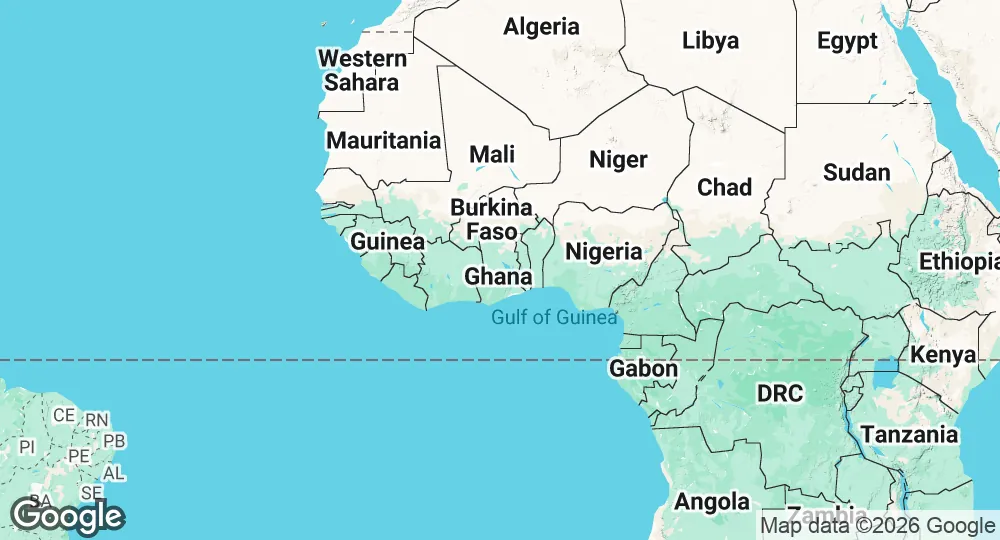
The defense posture of Ghana is increasingly defined by the spillover of extremist violence from the Sahel region, specifically along the northern border with Burkina Faso. Areas such as Bawku have experienced heightened security concern due to the proximity of groups including Jama'at Nusrat al-Islam wal-Muslimin (JNIM) and Islamic State in the Sahel (IS-Sahel). These organizations utilize northern Ghana for logistics, medical transit, and recruitment within marginalized communities.
Ghana participates in the Accra Initiative, a regional security framework designed for intelligence sharing and cross-border military cooperation among coastal West African states and Sahelian neighbors. As a member of the Economic Community of West African States (ECOWAS), the country maintains a commitment to regional stability, though the withdrawal of Mali, Burkina Faso, and Niger from the bloc has complicated collective security arrangements.
The military maintains long-standing bilateral partnerships with the United States and European nations, focusing on counter-terrorism training and maritime security. Maritime priorities are centered on the Gulf of Guinea, where the military addresses piracy, illegal, unreported, and unregulated (IUU) fishing, and the protection of offshore oil and gas infrastructure. Ghana is also a contributor of personnel to United Nations peacekeeping operations, including missions in Lebanon and South Sudan.
Military Forces
The Ghana Armed Forces (GAF) consist of the Army, Navy, and Air Force, overseen by the Ministry of Defence. In 2025, the government initiated a recruitment program to enlist 12,000 additional personnel over a three-year period to expand the force.
Ghana Army
The Army is organized into three regional commands (Northern, Central, and Southern) and specialized formations, including the Special Operations Brigade, the 153 Armoured Regiment, and the 66 Artillery Regiment. Ground forces operate wheeled armored vehicles, including the VN-22 6x6 armored infantry fighting vehicle, Otokar Cobra, and BTR-80. Reconnaissance capabilities are supported by EE-9 Cascavel and Ratel vehicles. Artillery assets include Type 81 multiple rocket launchers and various towed howitzers.
Ghana Navy
The Navy focuses on littoral defense and Exclusive Economic Zone (EEZ) monitoring. The fleet includes Boundary-class and Defender-class patrol boats, alongside Snake-class and Albatros-class vessels. In 2025, the Navy integrated GNS Achimota, a Japanese-built vessel, for fisheries protection and training. Procurement for 2026 includes two 72-meter Offshore Patrol Vessels (OPVs) equipped with helipads and combat systems to enhance long-endurance maritime surveillance.
Ghana Air Force
The Air Force operates from bases in Accra, Tamale, and Takoradi. Current inventory includes K-8 light attack/trainer aircraft, C-295 transport aircraft, and Mi-17 helicopters. Following a review of flight safety and fleet age in 2025, the government approved the acquisition of one Dassault Falcon 6X for strategic transport and a rotorcraft package comprising one Airbus H160 and three Airbus H175 helicopters. Further procurement planned for 2026 includes four additional helicopters and two fixed-wing aircraft for patrol and emergency response.
Defense Industry
The Defense Industries Holding Company Limited (DIHOC) serves as the industrial arm of the GAF. Reconstituted with a new governing board in 2025, DIHOC is tasked with developing a Defense Industrial Complex to increase self-reliance in munitions, vehicle assembly, and logistics. The company operates through joint ventures with private and state partners to manufacture tactical equipment and sustain military infrastructure. Current initiatives focus on reducing reliance on external suppliers for basic hardware and establishing a domestic maintenance, repair, and overhaul (MRO) capability for the Air Force and Navy.
Strategic Trends
Defense spending in the 2026 budget was increased by 69% over the previous year, totaling GH¢10.77 billion. This funding supports a comprehensive "Retooling of the Ghana Armed Forces" program aimed at modernizing aging equipment and improving infrastructure.
Key doctrinal shifts include a focus on "Forward Operating Bases" (FOBs). Construction is underway for 12 FOBs and two logistics bases in Wa and Bolgatanga to facilitate rapid response to northern border incursions. A Central Command Centre is being established in Tamale to coordinate multi-service operations in the northern sectors.
Constraints facing the military include the financial burden of rapid expansion and the operational demands of simultaneous internal security duties, such as "Operation Koudanlgou" (border security) and efforts to curb illegal mining. The government is also renegotiating stalled procurement contracts, including a credit agreement for 19 armored personnel carriers, to ensure the delivery of hardware fits current requirements.
Military Expenditure: CIA World Factbook. Last updated on 4 August 2026. Suggest a change
Frequently Asked Questions
How large is Ghana's military?
What is Ghana's defense budget?
How does Ghana rank militarily in the world?
Does Ghana have nuclear weapons?
How many aircraft does Ghana's air force have?
What percentage of GDP does Ghana spend on defense?
What is Ghana's military personnel per capita?
- AUG 42026 Updated Global Military Index updated in a site-wide editorial pass
- AUG 32026 Updated Global Military Index updated
- JUL 162026 Updated Global Military Index updated in a site-wide editorial pass
- JUN 162026 Updated Yearly statistics, military spending and 2 more fields updated
- JAN 132026 Updated Description added