H175
European super-medium utility helicopter, developed in the early 21st century, utilized for oil and gas industry support, search and rescue, and corporate transportation. Key figures: top speed 315 km/h, range 1,259 km, service ceiling 6,000 m, max takeoff weight 7,800 kg. In service with 1 air force as of 2026 — Ghana (1).
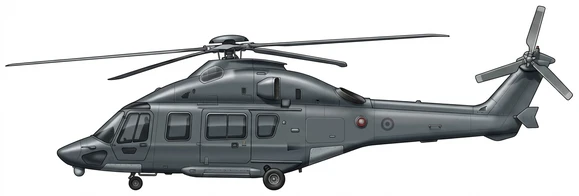
| Crew | 2 |
| Length | 18.1 m (59.3 ft) |
| Wingspan | 14.8 m (48.6 ft) |
| Height | 5.3 m (17.5 ft) |
| Wing area | 172 m² (1851.4 sqft) |
| Empty weight | 4,603 kg (10,148 lbs) |
| Max. takeoff weight | 7,800 kg (17,196 lbs) |
| Powerplant | 2 × Pratt & Whitney Canada PT6C-67E 1,324 kW each |
| Maximum speed | 315 km/h (196 mph) |
| Operational range | 1,259 km (782 mi) |
| Service ceiling | 6,000 m (19,685 ft) |
| Climb rate | 18.288 m/s (60.0 ft/s) |

Recent Events — H175
1 event →
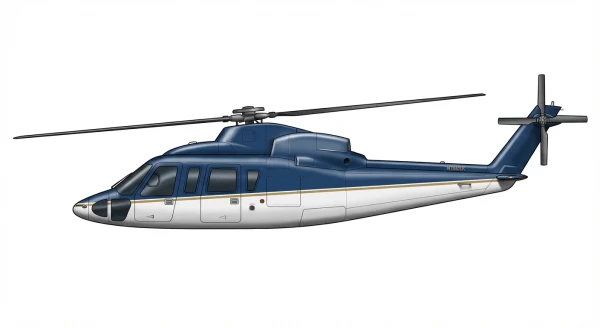
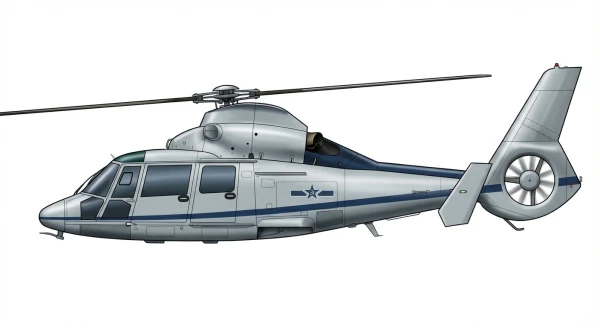
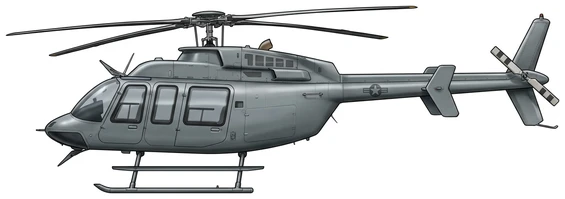
Description
The Airbus H175 is a 7-ton class super-medium utility helicopter developed through a joint venture between Airbus Helicopters and the Aviation Industry Corporation of China (AVIC). Formally launched in February 2008, the program was a co-development effort where Harbin Aircraft Industry Group (HAIG), an AVIC subsidiary, produced the airframe, gearboxes, and rotor systems, while Airbus served as the technical lead and systems integrator. The prototype conducted its official first flight on December 17, 2009, in Marignane, France. EASA type certification was received in January 2014, and the aircraft entered service in December 2014. Under a 20-year agreement signed in 2014, production is split between assembly lines in France and China, with a projected production of 1,000 units.
Design
The H175 uses a five-blade Spheriflex main rotor and a three-blade tail rotor. Airbus-produced units are powered by two 1,325 kW Pratt & Whitney Canada PT6C-67E turboshaft engines equipped with dual-channel FADEC. The Chinese AC352 variant utilizes two 1,800 shp class Turbomeca Ardiden 3C/WZ16 engines. The helicopter is fitted with the Helionix avionics suite, which includes a 4-axis dual-duplex autopilot and four 6x8-inch multi-function LCD displays. The cockpit is night vision goggles-compatible and supports single-pilot operations under visual flight rules. Designed for Sea State 6 conditions, the H175 can be equipped with an emergency flotation system and two 18-passenger life rafts. The cabin features a flat floor and can be configured for 18 passengers in oil and gas transport, 9 to 12 in executive layouts, or 6 to 8 in VIP configurations. Optional equipment includes a chin-mounted electro-optical sensor and a sensor operator's console in the cabin.
Operational History
Operational service began in 2014 with Noordzee Helikopters Vlaanderen (NHV) for North Sea oil and gas missions. By August 2015, the first two aircraft in the NHV fleet had accumulated 1,000 flight hours. The Hong Kong Government Flying Service is the launch customer for the search and rescue (SAR) variant. Other operators include the Royal Thai Police, the Spanish Air and Space Force, and the Guangdong Provincial Public Security Department. Commercial orders and letters of intent have been issued by Milestone Aviation Group (28 units), Transportes Aereos Pegaso (9 units), and SKYCO Leasing (6 units).
Variants
- EC175: The original designation for the helicopter prior to the 2015 corporate rebranding of Eurocopter as Airbus Helicopters.
- H175: The standard production model powered by PT6C-67E engines, utilized for offshore transport, SAR, and VIP roles.
- H175M: A military variant offered to the Royal Air Force for the United Kingdom's New Medium Helicopter (NMH) programme.
- Z-15: The original Chinese designation for the medium utility helicopter program.
- AC352: The Chinese-manufactured version of the aircraft equipped with Turbomeca Ardiden 3C/WZ16 engines.
Frequently Asked Questions
What type of aircraft is the H175?
What is the maximum speed of the H175?
What is the range of the H175?
When did the H175 first fly?
Which countries operate the H175?
What is the service ceiling of the H175?
- MAR 142026 Created Page created: Airbus H175; then name updated