Greenland Military Forces 🇬🇱
Military Strength Overview
Geography
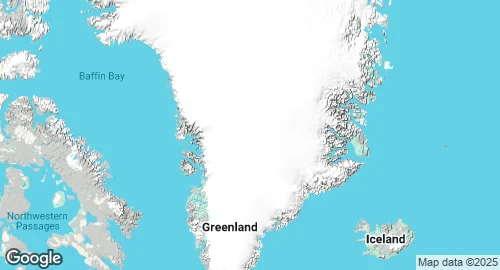
| Capital | Nuuk |
| Land Area | 2,166,086 km² |
| Coastline Length | 44,087 km |
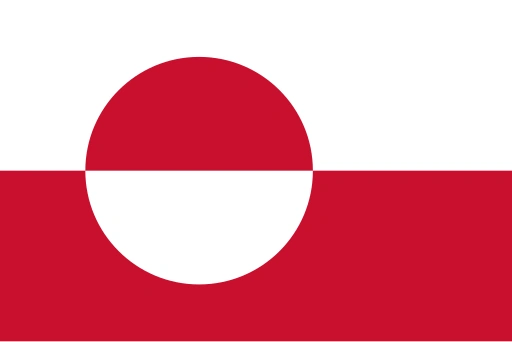
National Flag
Defense Statistics & Key Metrics
| Population | 56653 (2021) |
| GDP | $3.2 billion (2021) |
| GDP per capita | $57116 (2021) |
Population and Military Personnel Trends
GDP and Inflation Rate Trends
Strategic Overview in 2026
Strategic Position
Greenland is an autonomous territory within the Kingdom of Denmark, which retains responsibility for the island's defense and foreign policy. Its location between the Arctic Ocean and the North Atlantic makes it a primary component of the Greenland-Iceland-United Kingdom (GIUK) gap, a naval chokepoint for access to the Atlantic. Under the 1951 Defense Agreement between Denmark and the United States, the U.S. maintains military facilities on the island within the NATO framework. In June 2025, the United States Department of Defense shifted geographic responsibility for Greenland from European Command (EUCOM) to Northern Command (NORTHCOM) to align with North American continental defense priorities.
Primary security concerns involve the monitoring of increased Russian and Chinese activity in the Arctic and the security of emerging trans-polar shipping routes. Greenland participates in defense policy through the Naalakkersuisut (Greenlandic Government), which is consulted by Copenhagen on Arctic security matters under the 2024–2033 Defense Agreement. As of 2026, diplomatic tensions exist regarding U.S. rhetoric concerning the territory's sovereignty, prompting European allies including the United Kingdom and Germany to propose an "Arctic Sentry" NATO mission to bolster regional surveillance.
Military Forces
The defense of Greenland is managed by the Danish Armed Forces through the Joint Arctic Command (Arktisk Kommando), headquartered in Nuuk. There is no independent Greenlandic military. Personnel include a mix of Danish regular forces, special operations units, and local trainees.
Joint Arctic Command (JAC): Coordinates sovereignty patrols, search and rescue (SAR), and environmental monitoring. Facilities in Nuuk are undergoing expansion as of 2026 to serve as a reinforced headquarters. A new ground-based military unit, specialized in Arctic light infantry operations, is being established to provide a permanent, locally rooted presence.
Slædepatruljen Sirius (Sirius Dog Sled Patrol): A specialized unit of approximately 15 personnel responsible for long-range sovereignty patrolling in North and Northeast Greenland.
Naval Assets: The Royal Danish Navy operates Thetis-class frigates and Knud Rasmussen-class offshore patrol vessels in Greenlandic waters. Procurement is underway for two additional Arctic-capable vessels and a new class of modular patrol ships (MPV80) to replace aging hulls.
Air Assets: Maritime patrol and surveillance are conducted by CL-604 Challenger aircraft. Following the October 2025 defense agreement, Denmark is acquiring P-8A Poseidon aircraft for enhanced long-range ISR. F-16 fighter jets have been deployed to Kangerlussuaq for seasonal patrolling, with transition to F-35 Lightning II aircraft continuing.
U.S. Forces: Pituffik Space Base (formerly Thule Air Base) hosts approximately 150 to 200 U.S. Space Force personnel. The base operates an Upgraded Early Warning Radar (UEWR) as part of the Ballistic Missile Early Warning System (BMEWS) and integrates into the NORAD and "Golden Dome" missile defense architectures.
Strategic Trends
Defense policy for Greenland is currently governed by the Second Agreement on the Arctic and North Atlantic, finalized in October 2025. This agreement allocates approximately DKK 27.4 billion for regional security initiatives.
Modernization priorities include: - Surveillance Infrastructure: The installation of a new air surveillance radar in East Greenland and the laying of a North Atlantic undersea cable to improve secure communications between Nuuk and Copenhagen. - Drone Integration: Procurement of long-range Unmanned Aerial Systems (UAS) for persistent Arctic ISR, intended to supplement manned patrols. - Local Capacity Building: Expansion of the Arctic Basic Training Program (Arktisk Basisuddannelse) to increase the number of Greenlandic residents trained for emergency response and defense tasks. - Deterrence Posture: Increased frequency of multi-national exercises, such as Arctic Light 2025, which included personnel from France, Germany, Sweden, and Norway.
Economic constraints and procurement delays remain challenges; while funding has been increased, operational capability for some new systems, such as the P-8A aircraft and certain drone platforms, is not projected until late in the decade.
Frequently Asked Questions
Does Greenland have nuclear weapons?
Military Expenditure: SIPRI Milex. Suggest a change