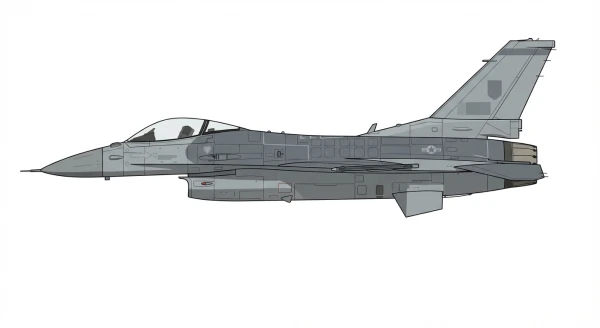
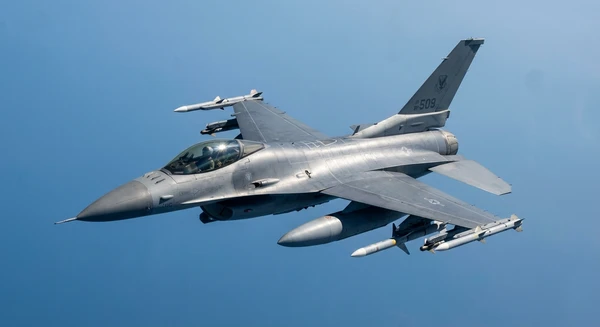
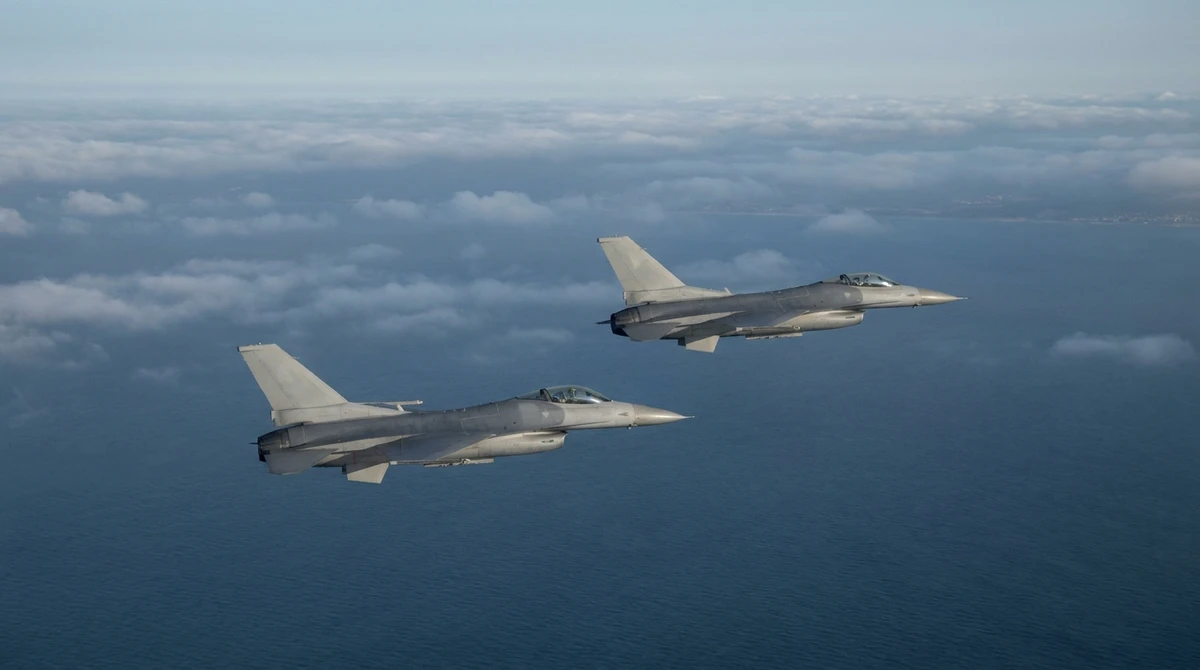
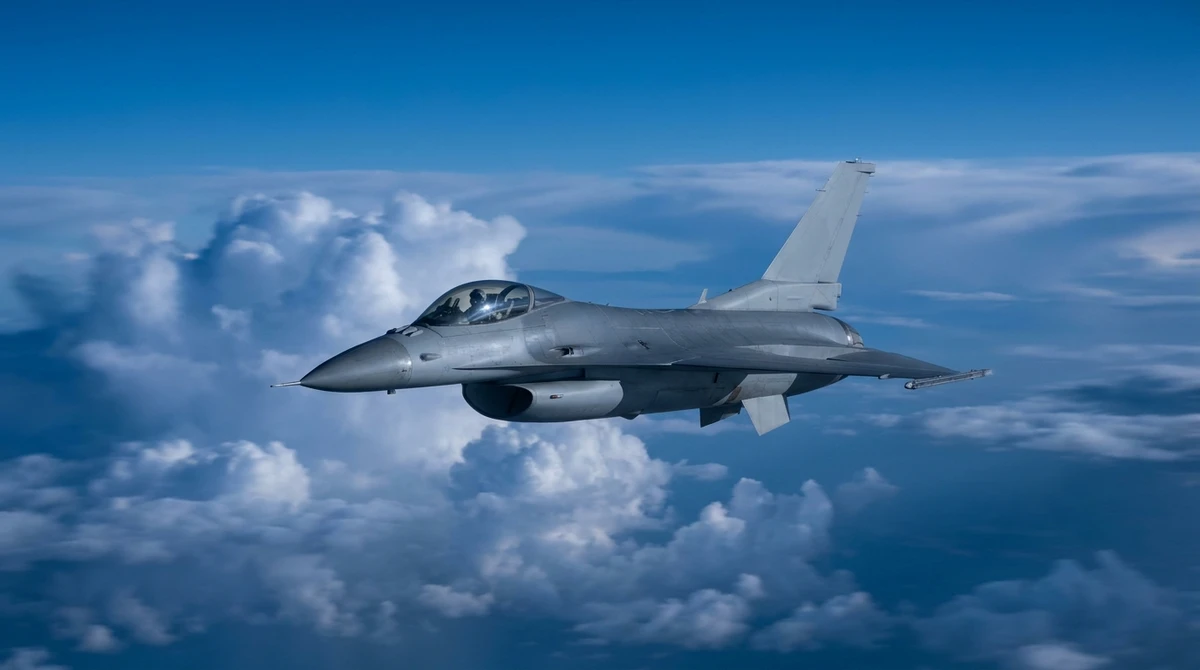
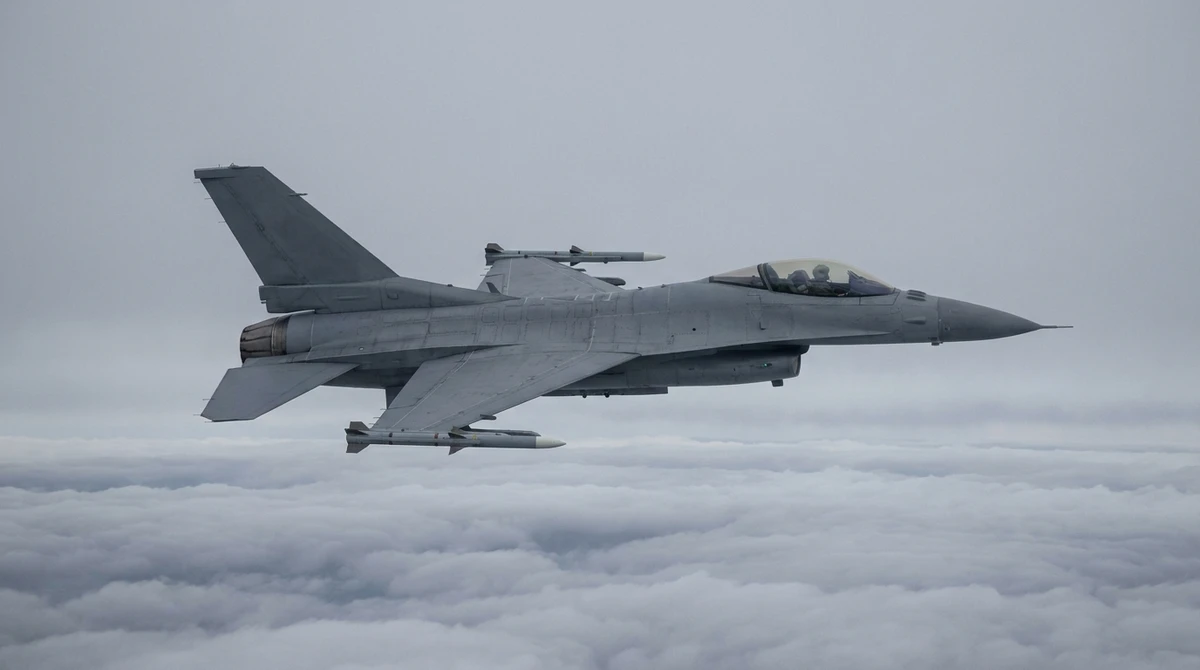
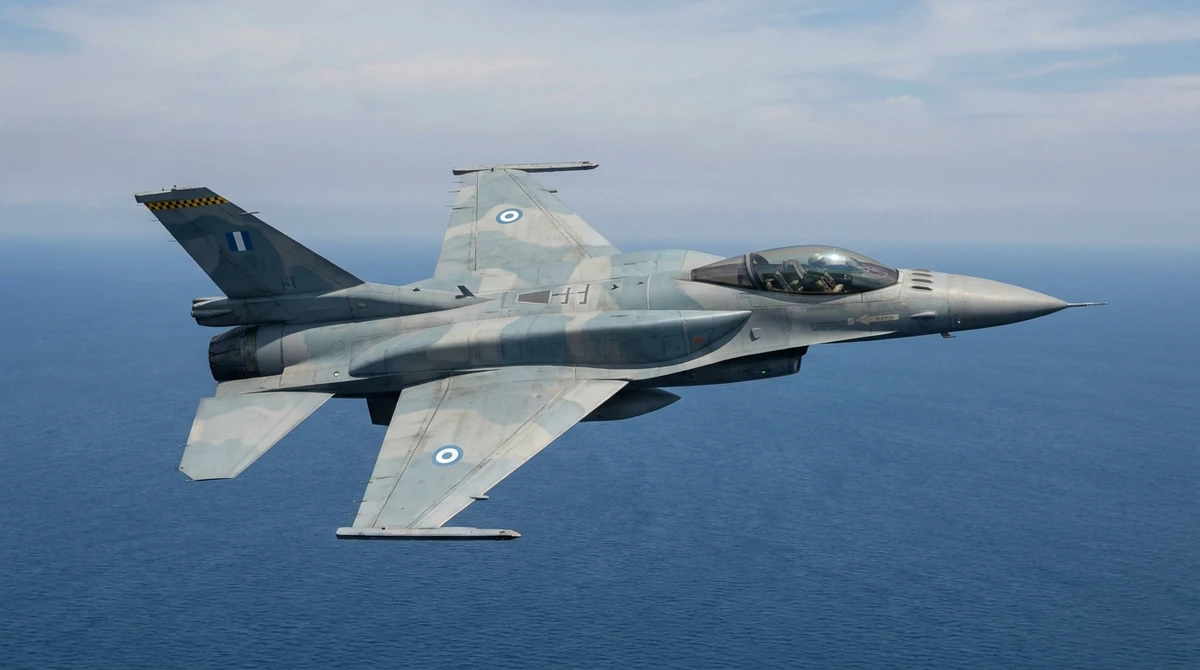
The General Dynamics F-16 Fighting Falcon is an American single-engine supersonic multirole fourth-generation fighter aircraft manufactured by General Dynamics and Lockheed Martin. Entering service in 1978, it evolved from a day air-superiority fighter into an all-weather multirole platform. It is known for fly-by-wire flight controls, a bubble canopy, and widespread military adoption.
Development
Originating from the U.S. Air Force's 1972 Lightweight Fighter program, the YF-16 prototype first flew in 1974. It won the Air Combat Fighter competition in 1975 over the YF-17 due to lower operating costs and engine commonality with the F-15. Over 4,600 F-16s have been produced across assembly lines in the United States, Belgium, the Netherlands, Turkey, and South Korea, with current manufacturing centered in Greenville, South Carolina.
Design
The F-16 features a cropped-delta wing, blended wing-body construction, forebody strakes, and an underslung air intake. It was the first production fighter designed with relaxed static stability and quadruplex fly-by-wire flight controls to perform 9-g maneuvers. The cockpit incorporates a 360-degree visibility bubble canopy, a side-stick controller, and a 30-degree reclined seat. Power is supplied by Pratt & Whitney F100 or General Electric F110 turbofan engines.
Armament
Internal armament consists of a 20 mm M61A1 Vulcan cannon. The airframe features 11 mounting locations, including nine hardpoints capable of carrying up to 17,000 pounds of payload. Compatible munitions include AIM-9 Sidewinder, AIM-120 AMRAAM, AGM-65 Maverick, AGM-88 HARM, laser-guided bombs, JDAMs, and B61 nuclear gravity bombs.
Operational History
Entering USAF service in 1978, the F-16 saw combat in the Gulf War, Yugoslavia, Afghanistan, Iraq, and Libya. The Israeli Air Force logged the type's first air combat kill in 1981 and executed Operation Opera against Iraq's Osirak reactor. F-16s have served with 26 nations, seeing combat with Pakistan, Turkey, Israel, and Ukraine, as well as acting as NATO dual-capable nuclear delivery platforms.
Variants
- F-16A/B: Initial single-seat (A) and two-seat (B) production models equipped with the AN/APG-66 radar, built as Blocks 1 to 20.
- F-16C/D: Upgraded single-seat (C) and two-seat (D) multirole variants introduced in 1984 with the AN/APG-68 radar and beyond-visual-range missile capability. Blocks 40/42 added night and precision-attack systems; Blocks 50/52 brought the F110-GE-129 or F100-PW-229 engines and the HARM targeting system for the SEAD role.
- F-16AM/BM: Mid-Life Update of the European A/B fleets (Belgium, Denmark, Netherlands, Norway, Portugal), bringing avionics and weapons to the Block 50/52 standard.
- F-16E/F: Block 60 variant built for the United Arab Emirates featuring the AN/APG-80 AESA radar and conformal fuel tanks.
- F-16I Sufa: Two-seat Block 52+ derivative built for Israel, with conformal fuel tanks, an enlarged dorsal avionics spine and Israeli mission systems and weapons; 102 were delivered between 2004 and 2009.
- F-16N: Unarmed adversary training variant operated by the United States Navy between 1988 and 1998.
- F-16V Viper: Modernized variant featuring the AN/APG-83 AESA radar, an updated mission computer, and an automated ground collision avoidance system, available as an upgrade or as new-build Block 70/72 aircraft.
- QF-16: Full-scale aerial target converted from retired F-16A/C airframes for the USAF.