Guatemala Military Forces
Guatemala ranks #103 of 170 militaries worldwide in 2026, with 18,050 active troops. The Guatemalan Army fields 5 main battle tanks; the Air Force flies 37 aircraft, including 3 combat aircraft. Guatemala has no nuclear weapons.
Armed Forces in 2026
| Domain | Strength | Composition |
|---|---|---|
| Air Force | 37 aircraft | 3 combat 20 helicopters 2 air bases |
| Ground Forces | 5 tanks | |
| Personnel | 18,050 active | 63,850 reserve 25,000 paramilitary |
ATLAS Index (Aggregate Total of Land, Air and Sea strength)
Full ranking →| Pillar | Weight | Score | Basis |
|---|---|---|---|
| Manpower | 10% | 37.0 | Active, reserve & paramilitary personnel |
| Ground forces | 20% | 14.4 | ARMS inventory power: armour & artillery by type and era, attack helicopters, armament |
| Naval power | 20% | 0.0 | SEAS inventory power: hulls by type, size and era, air wing, sustainment, armament |
| Air power | 25% | 17.5 | AIRS inventory power: aircraft by type and generation, enablers, armament |
| Nuclear deterrent | 10% | 0.0 | No declared nuclear capability |
| Defense budget | 15% | 21.2 | Annual spending, purchasing-power adjusted |
| Availability | modifier | ground ×1.02 · naval ×1.00 · air ×1.13 | Budget per point of each force, from the branch indexes |
Country File
| Population | 18.4M (2024) |
| GDP | $113.2 billion (2024) |
| GDP per capita | $6,150 |
| Military budget | $453M (2024) |
| Share of GDP | 0.4% (2024) |
| Military spending per capita | $25 (2024) |
| Inflation rate | 2.87% (2024) |
| Capital | Guatemala City |
| Region | America |
| Land area | 107,159 km² |
| Coastline | 400 km |
| Land borders | 1,687 km |
| Bordering countries | 4 |
| Currency | GTQ |
Strategic Overview in 2026
Strategic Position
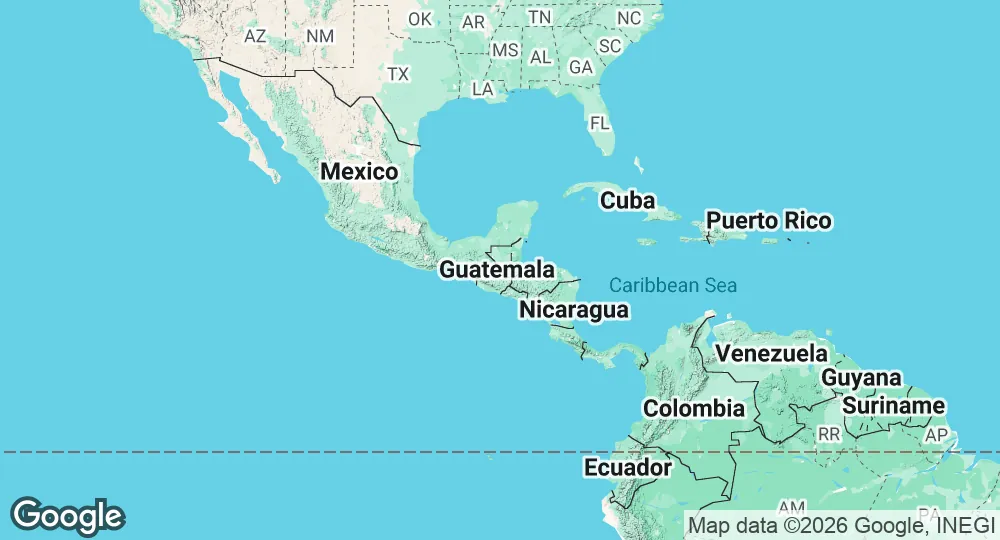
Guatemala occupies a central position on the Central American land bridge, bordering Mexico, Belize, Honduras, and El Salvador. Primary security concerns involve the activities of transnational criminal organizations (TCOs) and the transit of narcotics through the "Northern Triangle" region. The state maintains a long-standing territorial dispute with Belize, currently under adjudication by the International Court of Justice (ICJ), which remains a factor in border security planning.
Guatemala is a member of the Inter-American Treaty of Reciprocal Assistance (Rio Pact) and the Conference of Central American Armed Forces (CFAC). Defense doctrine focuses on internal security, counter-narcotics operations, and border control. Bilateral relations with the United States are characterized by cooperation in maritime and aerial interdiction, exemplified by the CENTAM Guardian 2025 multinational exercises hosted at the Mariscal Zavala military base. The 1996 Peace Accords redefined the military's mandate, restricting its role to external defense and civil support, although current policy frequently employs military assets for domestic public safety in support of the National Civil Police (PNC).
Military Forces
The Armed Forces of Guatemala (Fuerzas Armadas de Guatemala) operate under a unified command structure directed by the Ministry of National Defense. Total active personnel are approximately 20,000, supported by a reserve force of 10,000 and paramilitary elements including the Presidential Honor Guard.
Army The Army is the largest branch, organized into regional infantry, mountain, and jungle brigades. Specialized units include the Brigada de Fuerzas Especiales "Kaibil", which focuses on unconventional and jungle warfare, and the Brigada de Paracaidistas "General Felipe Cruz". The Cuerpo de Ingenieros (Engineers Corps) manages civil works and disaster response. Ground equipment consists of light armored vehicles, including V-150 Commando and M113 armored personnel carriers. The utility fleet relies on HMMWVs and Jeep J8 vehicles.
Air Force The Fuerza Aérea Guatemalteca (FAG) focuses on air mobility, reconnaissance, and humanitarian assistance. It operates from three primary air bases: La Aurora, Retalhuleu, and Flores. The fixed-wing inventory includes Cessna A-37 Dragonfly attack aircraft, Basler BT-67 and Cessna 208 Caravan transports, and T-35 Pillán trainers. In 2025 and 2026, modernization efforts focused on the helicopter fleet, which includes Bell 212, 412, and 429 models. The FAG recently integrated digital flight displays into its Bell 212 assets to enhance night and all-weather operational capability.
Navy The Marina de la Defensa Nacional operates Pacific and Atlantic naval commands. The fleet is composed of coastal patrol vessels and interceptors. In 2025, the Navy received Custom-designed Coastal Fast Response Boats (CFRBs) built in the United States to enhance littoral patrol and law enforcement. The branch also maintains a Marine infantry brigade and the Fuerzas Especiales Navales (FEN) for maritime interdiction. The Quetzal, a multipurpose landing craft built in Colombia, supports logistics and disaster relief.
Defense Industry
Guatemala maintains a limited domestic defense industry. The Fábrica de Municiones del Ejército produces small-arms ammunition, specifically 5.56mm and 7.62mm rounds, intended for internal consumption. The military remains reliant on foreign imports for specialized equipment, heavy weaponry, and aviation platforms, with primary suppliers including the United States, Israel, Brazil, and Colombia. Maintenance and repair facilities exist for both ground vehicles and rotary-wing aircraft to sustain operational readiness.
Strategic Trends
Defense spending in Guatemala is approximately 0.4% to 0.5% of GDP. The 2026 budget proposal requested an allocation of $616 million for the Ministry of National Defense, representing an increase over 2025 intended for equipment acquisition and infrastructure projects. A notable trend is the expanding role of the military in civilian administration; the Army Corps of Engineers has been tasked with managing large-scale infrastructure projects, such as port expansions and road construction, to mitigate corruption risks in the civilian sector.
Procurement priorities in 2025 and 2026 include the acquisition of light utility and fire-fighting aircraft, such as the Turbo Thrush 710, and the continued expansion of the naval patrol fleet. Operational challenges include the persistent infiltration of state institutions by narcotics networks and limited readiness among aging fixed-wing combat assets. Regional cooperation via the Unit for Humanitarian and Rescue (UHR) of the CFAC remains a priority for addressing natural disasters and border-security contingencies.
Military Expenditure: CIA World Factbook. Last updated on 4 August 2026. Suggest a change
Frequently Asked Questions
How large is Guatemala's military?
What is Guatemala's defense budget?
How does Guatemala rank militarily in the world?
Does Guatemala have nuclear weapons?
How many aircraft does Guatemala's air force have?
How many tanks does Guatemala have?
What percentage of GDP does Guatemala spend on defense?
What is Guatemala's military personnel per capita?
Does Guatemala have paramilitary forces?
- AUG 42026 Updated Global Military Index updated in a site-wide editorial pass
- AUG 32026 Updated Global Military Index updated
- JUL 162026 Updated Global Military Index updated in a site-wide editorial pass
- JUN 162026 Updated Yearly statistics, military spending and 2 more fields updated
- JAN 172026 Updated Main battle tank count and Global Military Index updated
- JAN 132026 Updated Description added