T-35 Pillan
Chilean trainer aircraft, popular in the late 20th century, extensively utilized for military pilot training worldwide. Key figures: top speed 311 km/h, range 1,093 km, service ceiling 5,840 m, max takeoff weight 1,338 kg, built 154. In service with 5 air forces as of 2026 — Chile (36), Paraguay (12), Dominican Republic (10) and 2 others.
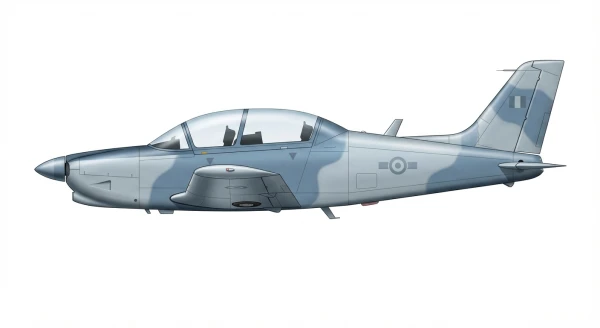
| Crew | 2 |
| Length | 8 m (26.2 ft) |
| Wingspan | 8.8 m (29.0 ft) |
| Height | 2.6 m (8.7 ft) |
| Wing area | 13.7 m² (147.4 sqft) |
| Empty weight | 930 kg (2,050 lbs) |
| Max. takeoff weight | 1,338 kg (2,950 lbs) |
| Powerplant | 1 × Avco Lycoming AEIO-540-K1K5 6-cylinder pistons engine 224 kW each |
| Maximum speed | 311 km/h (193 mph) |
| Operational range | 1,093 km (679 mi) |
| Service ceiling | 5,840 m (19,160 ft) |
| Climb rate | 7.75 m/s (25.4 ft/s) |
| Takeoff distance | 287 m (942 ft) |


Recent Events — T-35 Pillan
1 event →
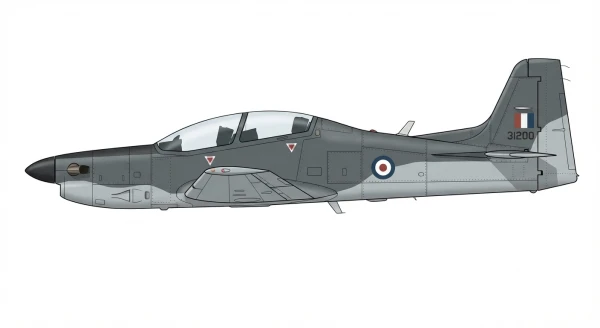
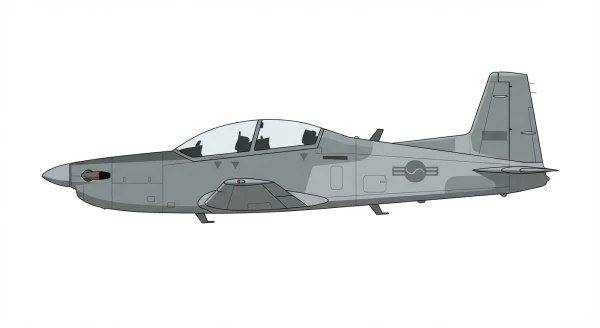
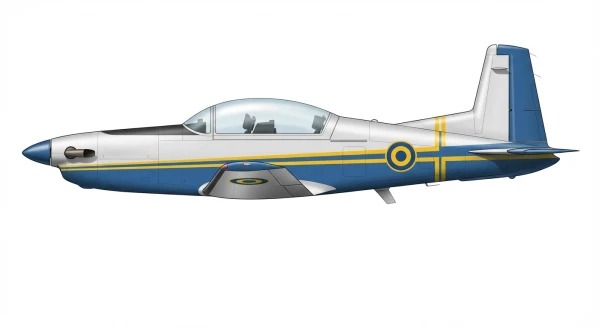
Description
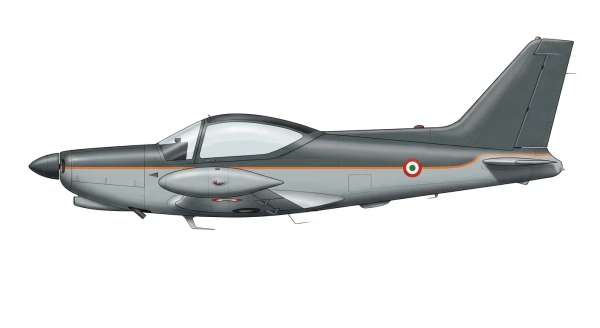
The ENAER T-35 Pillán is a Chilean two-seat, propeller-driven basic trainer aircraft manufactured by ENAER. Developed in conjunction with Piper Aircraft, the T-35 entered military service with the Chilean Air Force Air Academy in August 1985. The aircraft was developed to replace Chile's older military trainer fleet following a 1976 United States arms embargo.
Development
Prior to the 1980s, Chile operated military trainers obtained under the Mutual Defense Assistance Act, which became difficult to maintain following a 1976 US arms embargo. Piper Aircraft designed the PA-28R-300 Pillán using a PA-32R fuselage combined with a new center-section and aerobatic wing. The first prototype, designated XBT, made its initial flight on 6 March 1981 at Lakeland, Florida, followed by the YBT prototype on 31 August 1981. Piper produced 120 assembly kits at Vero Beach, Florida, for final assembly by ENAER in Chile and CASA in Spain. Initial serial production ceased in 1991 and resumed briefly in 1998. ENAER also developed a turboprop variant, sending a pre-production aircraft to Soloy Aviation Solutions in 1986 to fit a 420 shp Allison 250B-17D engine.
Design
The T-35 features a low-wing layout with tandem seating for a student and an instructor. Its airframe utilizes a modified PA-32R fuselage with a center-section and wing stressed for aerobatic maneuvers, rated for g-limits of +6 to -3. Most production models are powered by a 300 hp (224 kW) Textron Lycoming AEIO-540-K1K5 six-cylinder horizontally-opposed air-cooled engine driving a three-bladed Hartzell constant-speed propeller. Installed avionics include Collins VHF radios, Collins VOR, Collins ADF, Collins IFF, King KTR 908 radios, and King ADF units. The T-35B variant includes blind-flying instruments to support full IFR instruction.
Operational History
The Chilean Air Force received 60 T-35A primary trainers and 20 T-35B instrument trainers by 1990. Spain assembled and operated 41 T-35C trainers under the designation E.26 Tamiz, which were later retired and replaced by the Pilatus PC-21, with seven transferred to the Dominican Republic. Export deliveries of the T-35D were made to Panama and Paraguay. As of 2017, active military operators included Chile (31 aircraft), Paraguay (9), the Dominican Republic (4), Guatemala (4), Panama (4), Ecuador (3), and El Salvador (3).
Variants
- T-35A: Two-seat primary training aircraft developed for the Chilean Air Force, which received 60 units by 1990.
- T-35B: Two-seat instrument training variant for the Chilean Air Force equipped with blind-flying instruments for full IFR capability.
- T-35C: Two-seat primary trainer built for the Spanish Air and Space Force under the designation E.26 Tamiz.
- T-35D: Two-seat primary and instrument training variant produced for Panama and Paraguay.
- T-35DT: Turboprop-powered variant fitted with a 420-ehp Allison 250-B17D turboprop engine, originally designated T-35XT.
Frequently Asked Questions
What type of aircraft is the T-35 Pillan?
What is the maximum speed of the T-35 Pillan?
What is the range of the T-35 Pillan?
When did the T-35 Pillan first fly?
How many T-35 Pillan have been built?
Which countries operate the T-35 Pillan?
What is the service ceiling of the T-35 Pillan?
- AUG 62026 Updated Description updated
- AUG 12026 Updated Manufacturer updated
- APR 72026 Updated Picture credits updated in a site-wide editorial pass
- JAN 122026 Updated Range updated in a site-wide editorial pass