Kyrgyzstan Military Forces
Kyrgyzstan ranks #101 of 170 militaries worldwide in 2026, with 10,900 active troops. The Kyrgyz Army fields 215 main battle tanks; the Air Force flies 9 aircraft. Landlocked, Kyrgyzstan has no navy and no nuclear weapons.
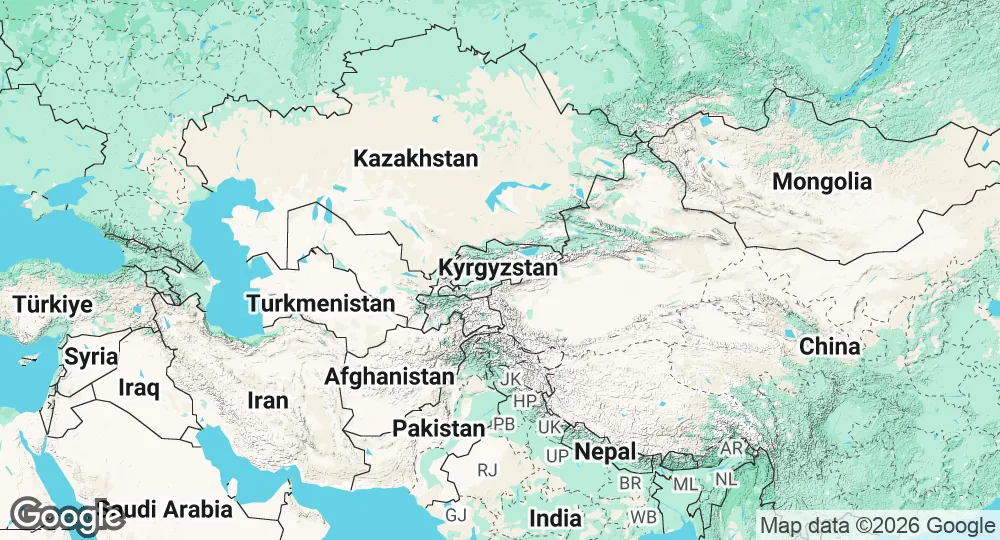
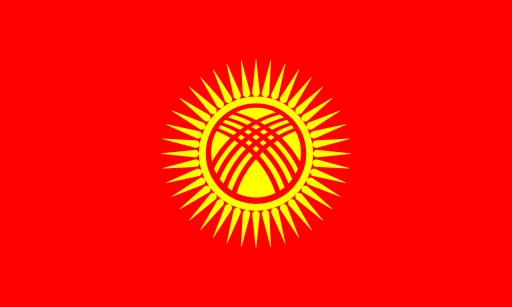
Armed Forces in 2026
| Domain | Strength | Composition |
|---|---|---|
| Air Force | 9 aircraft | 7 helicopters |
| Ground Forces | 215 tanks | |
| Personnel | 10,900 active | 9,500 paramilitary |
ATLAS Index (Aggregate Total of Land, Air and Sea strength)
Full ranking →| Pillar | Weight | Score | Basis |
|---|---|---|---|
| Manpower | 10% | 24.3 | Active, reserve & paramilitary personnel |
| Ground forces | 20% | 34.6 | ARMS inventory power: armour & artillery by type and era, attack helicopters, armament |
| Naval power | 20% | 0.0 | SEAS inventory power: hulls by type, size and era, air wing, sustainment, armament |
| Air power | 25% | 11.4 | AIRS inventory power: aircraft by type and generation, enablers, armament |
| Nuclear deterrent | 10% | 0.0 | No declared nuclear capability |
| Defense budget | 15% | 15.5 | Annual spending, purchasing-power adjusted |
| Availability | modifier | ground ×0.80 · naval ×1.00 · air ×1.20 | Budget per point of each force, from the branch indexes |
Country File
| Population | 7.2M (2024) |
| GDP | $17.5 billion (2024) |
| GDP per capita | $2,420 |
| Military budget | $524M (2024) |
| Share of GDP | 3.0% (2024) |
| Military spending per capita | $73 (2024) |
| Inflation rate | 5% (2024) |
| Capital | Bishkek |
| Region | Asia |
| Land area | 191,801 km² |
| Land borders | 3,878 km |
| Bordering countries | 4 |
| Currency | KGS |
Strategic Overview in 2026
Strategic Position
Kyrgyzstan maintains a defensive military posture centered on territorial integrity, border security, and regional counter-terrorism. A landlocked state in Central Asia, its security environment is defined by mountainous geography and proximity to regional powers. In March 2025, Kyrgyzstan and Tajikistan reached a definitive border settlement, ending a century-long territorial dispute through a series of land swaps, including the transfer of the Kyrgyz village of Dostuk to Tajikistan in exchange for equivalent territory. This agreement includes a commitment to demilitarize the immediate border zone by withdrawing heavy equipment and restricting the use of unmanned aerial vehicles (UAVs).
The country is a founding member of the Collective Security Treaty Organization (CSTO) and the Shanghai Cooperation Organization (SCO). Its defense doctrine relies heavily on its bilateral alliance with Russia, which operates the 917th Air Base at Kant. In November 2025, Kyrgyzstan and Russia approved a Joint Military Cooperation Plan for 2026, focusing on personnel training and the integration of a regional air defense system. Additionally, Kyrgyzstan maintains defense ties with Turkey, which has become a primary supplier of tactical aviation assets.
Military Forces
The Armed Forces of the Kyrgyz Republic are structured under the Ministry of Defense and the General Staff. The State Committee for National Security (GKNB) maintains independent control over the Border Guard Service, which serves as a frontline force. Total active personnel are estimated between 20,000 and 23,000, supported by approximately 10,000 paramilitary forces.
The Land Forces are organized into motorized rifle and mountain infantry brigades. Primary ground equipment consists of T-72 main battle tanks, BMP-2 infantry fighting vehicles, and BTR-80 armored personnel carriers. Specialized mountain warfare units, such as the "Scorpion" and "Irbis" special forces, are trained for high-altitude operations and counter-insurgency.
The Air Force and Air Defense Forces focus on transport, close air support, and airspace monitoring. In April 2025, Kyrgyzstan unveiled a modernization of its surface-to-air missile (SAM) inventory, deploying Russian-supplied S-300PS long-range systems and Tor-M2KM short-range systems. It also operates modernized S-125-2BM Pechora systems obtained from Belarus. The rotary-wing fleet includes Mi-24 attack helicopters and Mi-8 transport variants. Kyrgyzstan has integrated an extensive UAV fleet within its Border Guard Service, including Turkish-manufactured Bayraktar TB2, Akıncı, and Aksungur platforms, alongside Orlan-10 reconnaissance systems.
Defense Industry
Kyrgyzstan possesses a limited domestic defense industry and relies on foreign procurement for heavy equipment and advanced electronics. The government has initiated the "Kyrgyz Kural" program, a state initiative designed to revive the national military-industrial complex through 2026. This program aims to increase domestic maintenance capabilities and the production of small arms and specialized mountain equipment. The Dastan plant in Bishkek remains the only major manufacturer of specialized military hardware, producing torpedoes and related naval components primarily for export to Russia and India.
Strategic Trends
Defense spending is approximately 1.5% to 2.5% of GDP. In 2025, the national budget saw a significant reallocation of funds toward the procurement of modern air defense systems and the expansion of border infrastructure. A primary strategic priority is the creation of a "Joint Regional Air Defense System" with Russia, aimed at integrating Central Asian airspace monitoring into a unified architecture.
Modernization efforts are shifting away from legacy Soviet armored formations toward light, mobile units equipped with electronic warfare and surveillance technology. The 2025 "Rubezh" CSTO military exercises held in Kyrgyzstan emphasized the integration of UAV data with rapid-response mountain units. Despite these advancements, the military faces constraints including a high dependence on Russian military-technical assistance and the logistical challenges of maintaining high-altitude border outposts. Future force development is expected to prioritize domestic drone production and cyber-defense capabilities.
Military Expenditure: CIA World Factbook. Last updated on 4 August 2026. Suggest a change
Frequently Asked Questions
How large is Kyrgyzstan's military?
What is Kyrgyzstan's defense budget?
How does Kyrgyzstan rank militarily in the world?
Does Kyrgyzstan have nuclear weapons?
How many aircraft does Kyrgyzstan's air force have?
How many tanks does Kyrgyzstan have?
What percentage of GDP does Kyrgyzstan spend on defense?
What is Kyrgyzstan's military personnel per capita?
Does Kyrgyzstan have paramilitary forces?
- AUG 42026 Updated Global Military Index updated in a site-wide editorial pass
- JUL 162026 Updated Global Military Index updated in a site-wide editorial pass
- JUN 162026 Updated Yearly statistics, military spending and 2 more fields updated
- JAN 132026 Updated Description updated