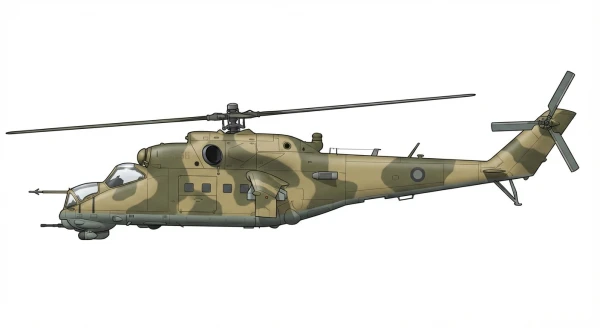
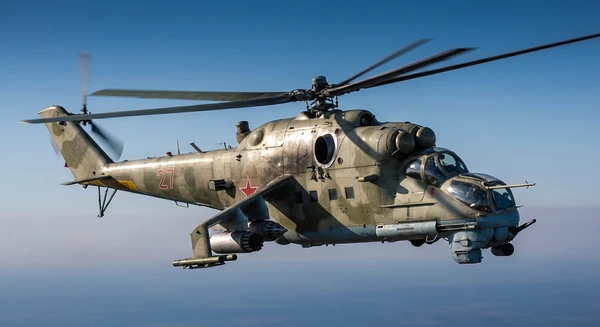
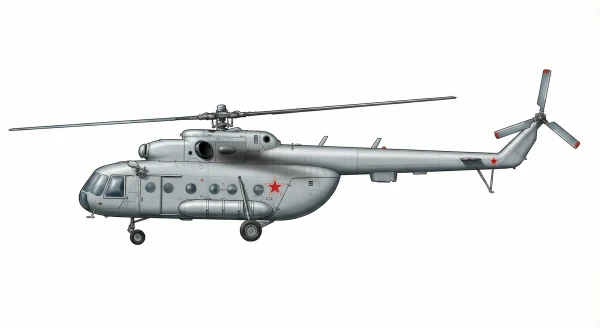
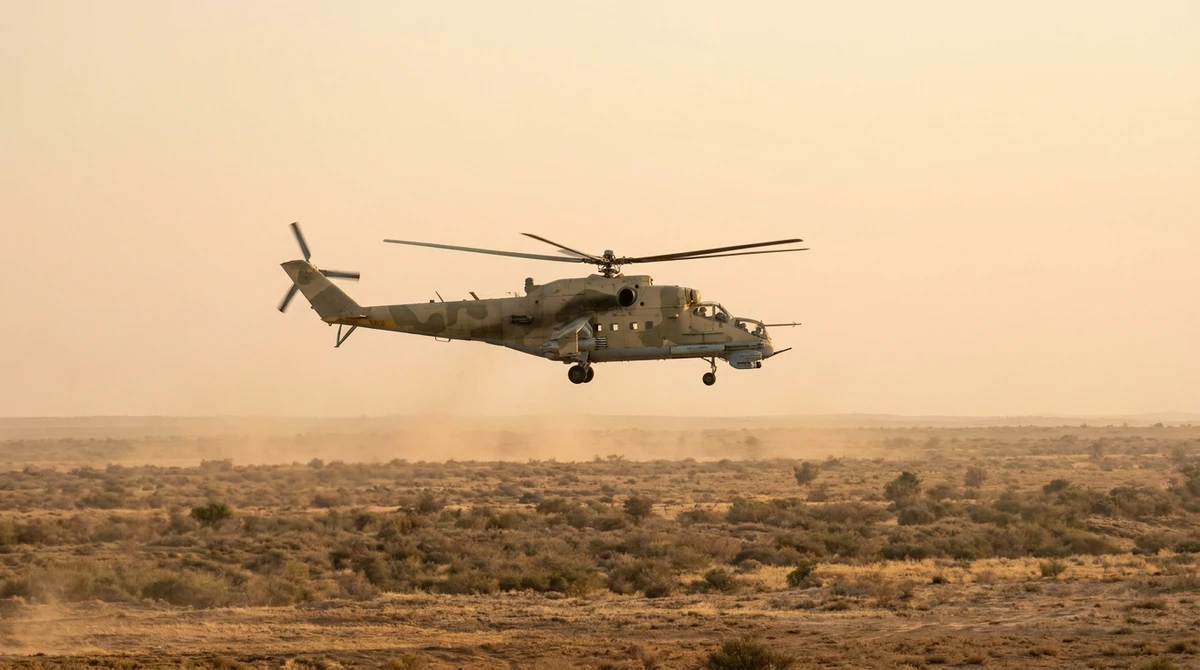
The Mil Mi-24 (NATO reporting name "Hind") is a Soviet helicopter gunship, attack helicopter, and troop transport manufactured by Mil Moscow Helicopter Plant. Introduced into Soviet Air Force service in 1972, the aircraft performs close air support, anti-tank operations, and transport for up to eight infantry passengers. Unofficially named the "flying tank" or "Crocodile" by Soviet crews, export versions designated Mi-25 and Mi-35 are operated by over 50 countries.
Development
Development began in the early 1960s following Mikhail Mil's concept for an armed troop transport vehicle. The V-24 concept mock-up was unveiled in 1966, leading to a Soviet military directive for a twin-engine design on 6 May 1968. The prototype made its first tethered hover on 15 September 1969 and its first free flight four days later. Following 18 months of testing, structural adjustments including wing anhedral and tail rotor relocation were implemented. The initial production model, designated Mi-24A, entered production in 1970 and was officially accepted into service in 1972.
Design
The Mi-24 utilizes dynamic components derived from the Mil Mi-8, powered by two top-mounted Isotov turboshaft engines driving a 17.3-meter main rotor. Early versions featured an angular greenhouse cockpit, replaced on the Model D and later variants by a tandem cockpit with double-bubble canopies. Mid-mounted stub wings provide up to a quarter of total lift at high speeds and carry external weapons. Titanium main rotor blades resist 12.7 mm rounds, and the crew is protected by a titanium-armored cockpit tub and an overpressurized NBC system.
Armament
The aircraft carries up to 2,400 kg of payload across six stub-wing hardpoints. Internal gun armament consists of a nose-mounted 12.7 mm Yak-B machine gun, a twin 23 mm GSh-23L cannon, or a fixed twin 30 mm GSh-30K autocannon. External stores include 57 mm S-5, 80 mm S-8, and 240 mm S-24 rockets, iron bombs up to 500 kg, GUV and UPK gun pods, 9M17 Falanga and 9K114 Shturm anti-tank missiles, and R-60 air-to-air missiles.
Operational History
The Mi-24 saw initial combat with Ethiopian forces during the 1977–1978 Ogaden War. The Soviet military deployed the type extensively during the Soviet–Afghan War for attack, escort, and anti-insurgent missions. Iraqi Mi-25s engaged in combat during the Iran–Iraq War, including air-to-air engagements against Iranian AH-1J SeaCobras. The helicopter has been used in conflicts in Chad, Sri Lanka, Peru, Chechnya, Syria, and the 2022 Russian invasion of Ukraine.
Variants
- Mi-24A: Initial production version equipped with an angular greenhouse-style cockpit and fuselage missile pylons.
- Mi-24D: Variant introducing a tandem cockpit with double-bubble canopies and a flexible 12.7 mm Yak-B machine gun.
- Mi-24V: Upgraded model integrated with the 9K114 Shturm anti-tank missile complex and B-8V20 rocket launchers.
- Mi-24P: Gunship variant equipped with a fixed side-mounted twin-barrel 30 mm GSh-30K autocannon.
- Mi-35M: Modernized export version fitted with twin-barrel 23 mm GSh-23L autocannons and updated systems.