North Macedonia Military Forces
North Macedonia ranks #121 of 170 militaries worldwide in 2026, with 8,000 active troops. The North Macedonian Army fields 20 main battle tanks; the Air Force flies 20 aircraft. Landlocked, North Macedonia has no navy and no nuclear weapons.
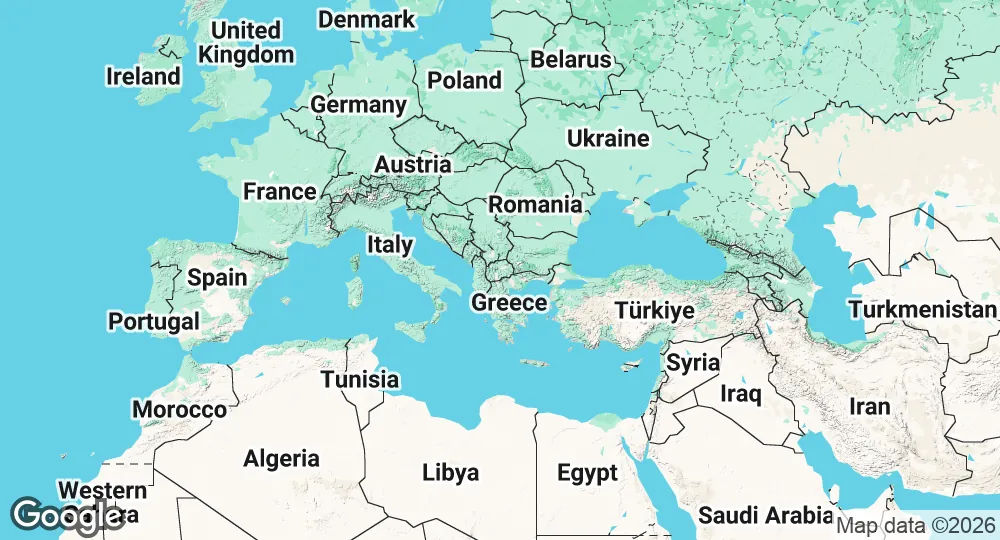
Armed Forces in 2026
| Domain | Strength | Composition |
|---|---|---|
| Air Force of North Macedonia | 20 aircraft | 14 helicopters 1 air bases +8 on order |
| Ground Forces | 20 tanks | |
| Personnel | 8,000 active | 4,850 reserve 5,000 paramilitary |
ATLAS Index (Aggregate Total of Land, Air and Sea strength)
Full ranking →| Pillar | Weight | Score | Basis |
|---|---|---|---|
| Manpower | 10% | 23.8 | Active, reserve & paramilitary personnel |
| Ground forces | 20% | 19.4 | ARMS inventory power: armour & artillery by type and era, attack helicopters, armament |
| Naval power | 20% | 0.0 | SEAS inventory power: hulls by type, size and era, air wing, sustainment, armament |
| Air power | 25% | 10.8 | AIRS inventory power: aircraft by type and generation, enablers, armament |
| Nuclear deterrent | 10% | 0.0 | No declared nuclear capability |
| Defense budget | 15% | 13.9 | Annual spending, purchasing-power adjusted |
| Availability | modifier | ground ×0.85 · naval ×1.00 · air ×1.17 | Budget per point of each force, from the branch indexes |
Country File
| Population | 1.8M (2024) |
| GDP | $17.0 billion (2024) |
| GDP per capita | $9,292 |
| Military budget | $339M (2025) |
| Share of GDP | 2.0% (2025) |
| Military spending per capita | $186 (2025) |
| Inflation rate | 3.49% (2024) |
| Capital | Skopje |
| Region | Europe |
| Land area | 25,433 km² |
| Land borders | 766 km |
| Bordering countries | 5 |
| Currency | MKD |
Strategic Overview in 2026
Strategic Position
North Macedonia is a landlocked state in the central Balkans, situating its defense posture within the context of regional stability and Euro-Atlantic integration. The country became the 30th member of NATO in 2020, which serves as the primary pillar of its security architecture. National defense doctrine emphasizes collective security, territorial integrity, and the maintenance of good relations with neighboring states to mitigate historical regional tensions.
Primary security concerns involve hybrid warfare, cyber threats, and the potential for regional instability in the Western Balkans. North Macedonia maintains a Strategic Partnership with the United States and has strengthened bilateral defense ties with the United Kingdom through a revised defense strategy agreement signed in 2025. Additionally, the country maintains close military-technical cooperation with Turkey, formalized through a 2025 memorandum on industrial collaboration.
Military personnel are regularly deployed to NATO missions, including the Kosovo Force (KFOR) and multinational battlegroups along the alliance's eastern flank in Bulgaria, Latvia, and Romania. The national strategy prioritizes transitioning from a legacy of territorial defense based on conscription to a fully professionalized force capable of high interoperability within NATO frameworks.
Military Forces
The Army of the Republic of North Macedonia (ARSM) is a professionalized force organized under a General Staff reporting to the Ministry of Defence. The Commander-in-Chief is the President of the Republic. The force structure is centered on the Operations Command, which oversees the primary combat units, and the Training and Doctrine Command.
Personnel The active force consists of approximately 10,000 personnel, supported by a reserve component of roughly 60,000. Since the abolition of compulsory service, the military has operated as an all-volunteer force.
Ground Forces The Ground Forces are organized around the 1st Infantry Brigade, which includes the Light Infantry Battalion Group—the country's primary unit declared for NATO operations. Following the donation of all remaining main battle tanks to Ukraine, the army has transitioned exclusively to wheeled mechanized and motorized formations.
The inventory is undergoing a shift from Soviet-era platforms to Western equipment. The army operates Oshkosh Joint Light Tactical Vehicles (JLTV) and is in the process of inducting Stryker 8x8 armored fighting vehicles. Legacy equipment includes BTR-70 and BTR-80 armored personnel carriers, alongside M113 variants. Artillery capabilities are based on towed 105mm howitzers, including the Boran system.
Air Force The Air Force (Air Force WING) primarily provides transport, surveillance, and rotary-wing support. It does not operate fixed-wing fighter aircraft, relying instead on NATO Air Policing for sovereign airspace protection. The helicopter fleet consists of Mi-8/17 transport helicopters and Bell 206 training aircraft. North Macedonia has contracted for the delivery of AgustaWestland AW149 and AW169M multirole helicopters to replace its aging Soviet-era rotary assets, with deliveries scheduled between 2026 and 2028.
Special Forces The Special Operations Regiment is the army's elite component, comprising the "Wolves" Special Forces Battalion and a Rangers Battalion. These units are trained for unconventional warfare, counter-terrorism, and reconnaissance.
Defense Industry
The domestic defense industry is concentrated in small arms ammunition and ballistic protection. The primary manufacturer is ATS Group, which operates several entities including ATS Ammunition and ATS Ballistics. The company produces small-caliber ammunition, composite ballistic helmets, and body armor, exporting these products to over 50 countries. In 2025, ATS Group initiated plans for a gunpowder production facility in North Macedonia through a joint venture with the Turkish state-owned company MKE.
While the country is self-sufficient in small arms ammunition and personal protective gear, it remains almost entirely dependent on foreign imports for heavy equipment, aviation, and advanced electronic systems. Recent procurement programs highlight a reliance on American, Italian, and Turkish manufacturers.
Strategic Trends
Defense spending in 2025 and 2026 is approximately 2% to 2.5% of GDP, meeting the NATO baseline. The government has committed to a long-term plan to increase total security and defense-related spending to 5% of GDP by 2035, a target endorsed at the 2025 NATO Summit in The Hague.
Current modernization priorities focus on the "Light Infantry" concept, emphasizing mobility and rapid deployment. Key procurement trends include:
-
Armored Mobility: Completing the delivery of JLTVs and the operationalization of the Stryker fleet.
-
Air Defense: Enhancing short-range air defense (SHORAD) through the procurement of Mistral 3 systems, with deliveries expected in 2026.
-
Aviation: Transitioning the rotary fleet from Soviet platforms to Italian AgustaWestland models.
-
Unmanned Systems: Increasing the integration of reconnaissance and surveillance drones into infantry units.
Fiscal constraints remain a primary challenge as the military attempts to balance high-cost equipment acquisitions with the personnel and infrastructure costs required to sustain a professional force. Global supply chain disruptions have also impacted delivery timelines for advanced systems, such as air defense batteries.
Military Expenditure: CIA World Factbook. Last updated on 4 August 2026. Suggest a change
Frequently Asked Questions
How large is North Macedonia's military?
What is North Macedonia's defense budget?
How does North Macedonia rank militarily in the world?
Does North Macedonia have nuclear weapons?
How many aircraft does North Macedonia's air force have?
How many tanks does North Macedonia have?
What percentage of GDP does North Macedonia spend on defense?
What is North Macedonia's military personnel per capita?
Does North Macedonia have paramilitary forces?
- AUG 42026 Updated Global Military Index updated in a site-wide editorial pass
- JUL 162026 Updated Global Military Index updated in a site-wide editorial pass
- JUN 162026 Updated Yearly statistics, military spending and 2 more fields updated
- APR 82026 Updated Paramilitary personnel updated
- JAN 232026 Updated Rank insignia updated (2 entries)
- JAN 212026 Updated Rank insignia updated (40 entries)
- JAN 172026 Updated Main battle tank count and Global Military Index updated