Mauritania Military Forces
Mauritania ranks #113 of 170 militaries worldwide in 2026, with 15,850 active troops. The Mauritanian Army fields 25 main battle tanks; the Air Force flies 23 aircraft, including 4 combat aircraft. Mauritania has no nuclear weapons.
Armed Forces in 2026
| Domain | Strength | Composition |
|---|---|---|
| Mauritania Islamic Air Force | 23 aircraft | 4 combat 4 helicopters |
| Ground Forces | 25 tanks | |
| Personnel | 15,850 active | 5,000 paramilitary |
ATLAS Index (Aggregate Total of Land, Air and Sea strength)
Full ranking →| Pillar | Weight | Score | Basis |
|---|---|---|---|
| Manpower | 10% | 25.8 | Active, reserve & paramilitary personnel |
| Ground forces | 20% | 20.2 | ARMS inventory power: armour & artillery by type and era, attack helicopters, armament |
| Naval power | 20% | 0.0 | SEAS inventory power: hulls by type, size and era, air wing, sustainment, armament |
| Air power | 25% | 15.3 | AIRS inventory power: aircraft by type and generation, enablers, armament |
| Nuclear deterrent | 10% | 0.0 | No declared nuclear capability |
| Defense budget | 15% | 13.0 | Annual spending, purchasing-power adjusted |
| Availability | modifier | ground ×0.80 · naval ×1.00 · air ×0.89 | Budget per point of each force, from the branch indexes |
Country File
| Population | 5.2M (2024) |
| GDP | $10.9 billion (2024) |
| GDP per capita | $2,110 |
| Military budget | $262M (2024) |
| Share of GDP | 2.4% (2024) |
| Military spending per capita | $51 (2024) |
| Inflation rate | 2.49% (2024) |
| Capital | Nouakchott |
| Region | Africa |
| Land area | 1,025,520 km² |
| Coastline | 754 km |
| Land borders | 5,074 km |
| Bordering countries | 4 |
| Currency | MRU |
Strategic Overview in 2026
Strategic Position
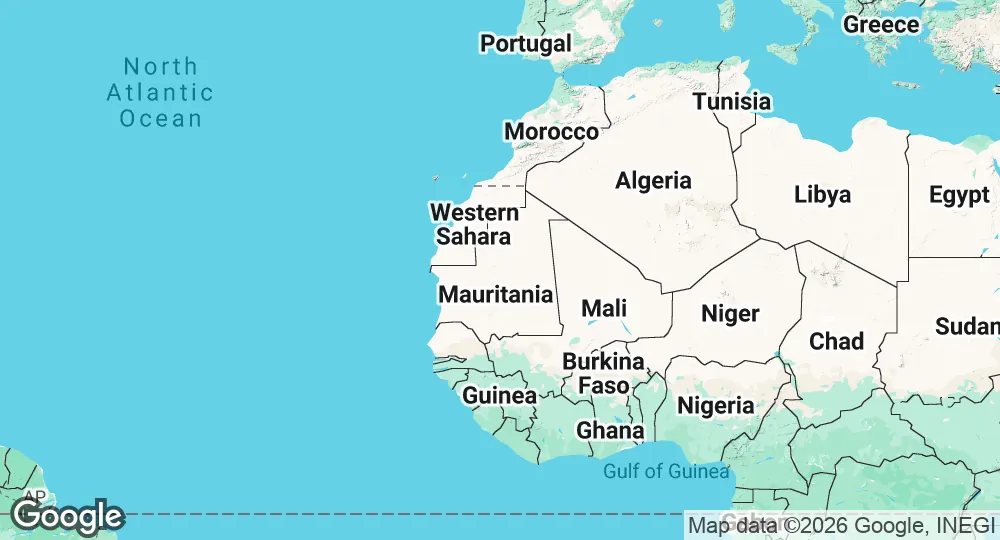
Mauritania occupies a buffer position between the Maghreb and Sub-Saharan Africa, sharing borders with Western Sahara, Algeria, Mali, and Senegal. Since 2022, its primary security concern has shifted to the 2,237-kilometer border with Mali, following the withdrawal of Western forces from neighboring Sahelian states and the subsequent rise in activity by militant groups and foreign mercenary organizations. Unlike its neighbors in the Alliance of Sahel States, Mauritania maintains a pro-Western security orientation and remains a partner in NATO’s Mediterranean Dialogue.
Strategic priorities center on border containment and neutrality regarding the Western Sahara conflict. In 2025, Mauritania signed a bilateral defense cooperation agreement with the Czechia, supported by NATO through 2026, focusing on counter-terrorism, CBRN protection, and cybersecurity. Relationships with Morocco and Algeria are characterized by a balancing act; while Mauritania cooperates with Morocco on infrastructure and intelligence, it maintains diplomatic channels with Algeria to manage regional stability and avoid entanglement in the Western Sahara dispute.
Military Forces
The Mauritanian Armed Forces (Forces Armées Mauritaniennes) are under the command of the President as Commander-in-Chief. The structure includes the Army, Navy, Air Force, and Gendarmerie. Total active personnel are approximately 20,000, with an additional 10,000 personnel in paramilitary roles across the National Gendarmerie and the National Guard.
Army The Army is the dominant branch, organized primarily into mobile, desert-capable units. The Special Intervention Groups (Groupements Spéciaux d’Intervention - GSI) are the elite cadre tasked with high-mobility counter-insurgency and border patrol.
-
Armor: Operates Soviet-era T-54/55 main battle tanks and a growing fleet of Chinese WMA-301 tank destroyers acquired in 2025.
-
Reconnaissance and APCs: Fields Panhard AML-90 and RAM V-2 armored cars, alongside Bastion and Casspir armored personnel carriers.
-
Artillery: Maintains towed howitzers, multiple rocket launchers, and anti-aircraft guns.
Air Force The Islamic Republic of Mauritania Air Force focuses on Intelligence, Surveillance, and Reconnaissance (ISR) and light attack capabilities.
-
Attack/COIN: Operates Embraer EMB 314 Super Tucano aircraft for counter-insurgency.
-
Transport and ISR: Utilizes Cessna 208 Caravan and CASA C-212 Aviocar platforms.
-
Rotary Wing: Maintains a fleet of Harbin Z-9 and AgustaWestland helicopters.
Navy The Navy and Coast Guard are tasked with protecting the 754-kilometer coastline and the Exclusive Economic Zone (EEZ), particularly the offshore gas fields.
-
Vessels: Operates a fleet of patrol boats, including the Adlum-class and Limam el-Hadrami class.
-
Training: In 2025, the Navy participated in NATO-led maritime situational awareness training to enhance interdiction capabilities.
Strategic Trends
Defense spending has historically fluctuated between 2.5% and 3.9% of GDP. Procurement trends in 2025-2026 show a diversification of suppliers, with a notable shift toward Chinese armored platforms and unmanned aerial systems (UAVs) to offset the aging Soviet and French equipment.
Modernization efforts are focused on the "Border Shield" doctrine, which emphasizes the use of remote sensors and rapid-reaction GSIs to prevent spillover from the conflict in Mali. A key institutional shift involves the 2025 military-to-civilian career transition program, supported by NATO through 2026, which aims to professionalize the force and prevent the recruitment of retired veterans by non-state actors.
The primary constraint remains the vast, under-populated desert interior, which necessitates high logistical expenditures and continuous investment in mobile satellite communications and persistent aerial surveillance. Efforts to standardize operational procedures with Western partners continue through the annual Flintlock exercises, which were conducted in 2025 to refine special operations coordination.
Military Expenditure: CIA World Factbook. Last updated on 4 August 2026. Suggest a change
Frequently Asked Questions
How large is Mauritania's military?
What is Mauritania's defense budget?
How does Mauritania rank militarily in the world?
Does Mauritania have nuclear weapons?
How many aircraft does Mauritania's air force have?
How many tanks does Mauritania have?
What percentage of GDP does Mauritania spend on defense?
What is Mauritania's military personnel per capita?
Does Mauritania have paramilitary forces?
- AUG 42026 Updated Global Military Index updated in a site-wide editorial pass
- JUL 162026 Updated Global Military Index updated in a site-wide editorial pass
- JUN 162026 Updated Yearly statistics, military spending and 2 more fields updated
- MAR 172026 Updated Description updated
- JAN 172026 Updated Main battle tank count added; Global Military Index updated
- JAN 132026 Updated Description added