EMB 312 Tucano
Brazilian military trainer aircraft, utilized heavily in the 1980s, known for participation in the Iran–Iraq war. Key figures: top speed 448 km/h, range 1,916 km, service ceiling 9,145 m, max takeoff weight 3,175 kg, unit price $1.7M, built 624. In service with 11 air forces as of 2026 — Egypt (54), Brazil (31), Venezuela (17) and 8 others.
| Length | 9.9 m (32.3 ft) |
| Wingspan | 11.1 m (36.5 ft) |
| Height | 3.4 m (11.2 ft) |
| Wing area | 19.4 m² (208.8 sqft) |
| Empty weight | 1,870 kg (4,123 lbs) |
| Max. takeoff weight | 3,175 kg (7,000 lbs) |
| Powerplant | 1 × turboprop Pratt & Whitney Canada PT6A-25C 559 kW each |
| Ejection seat | Martin-Baker Mk 8A |
| Maximum speed | 448 km/h (278 mph) |
| Operational range | 1,916 km (1,191 mi) |
| Service ceiling | 9,145 m (30,003 ft) |
| Climb rate | 11.33 m/s (37.2 ft/s) |
| Takeoff distance | 374 m (1,227 ft) |
-
 Egypt
54
Egypt
54
-
 Brazil
31
Brazil
31
-
 Venezuela
17
Venezuela
17
-
 Colombia
14
Colombia
14
-
 Angola
12
Angola
12
-
 Argentina
12
Argentina
12
-
 Kenya
11
Kenya
11
-
 Iran
10
Iran
10
-
 Honduras
8
Honduras
8
-
 Paraguay
6
Paraguay
6
-
 Mauritania
5
Mauritania
5
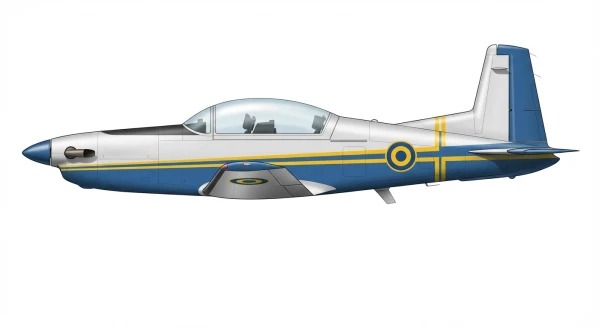
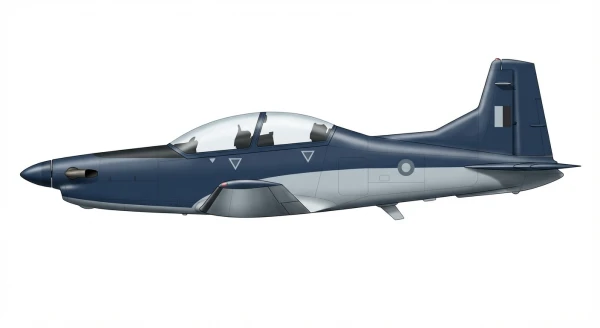
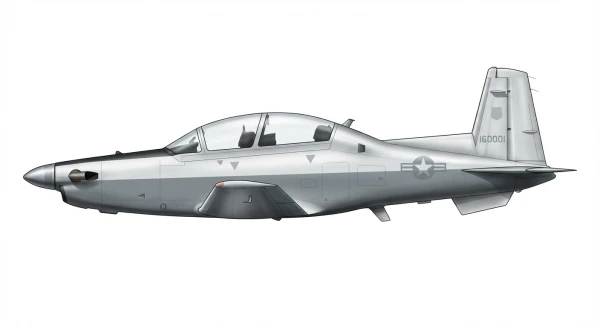
Description
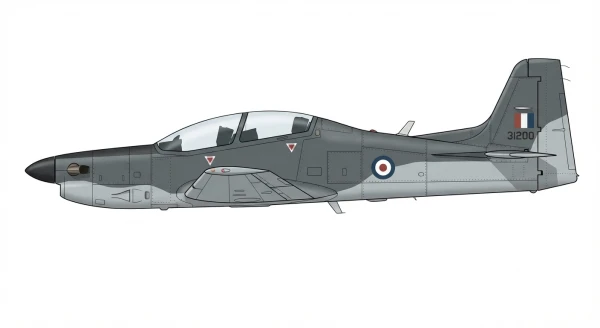
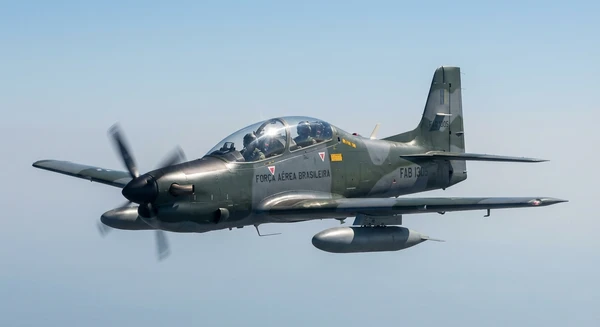
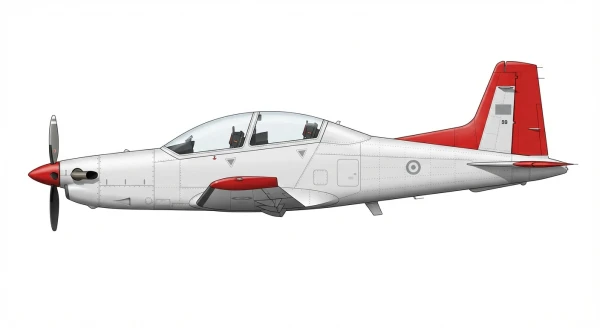
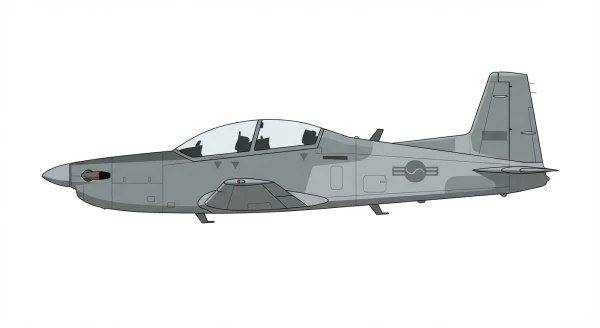
The Embraer EMB 312 Tucano (Portuguese for "toucan") is a low-wing, tandem-seat, single-turboprop basic trainer and light attack aircraft built by Embraer in Brazil. Designated T-27 in the trainer role and AT-27 in the ground attack role, it entered Brazilian Air Force service in September 1983. A total of 637 were produced — 477 by Embraer and 160 by Short Brothers — and the type has flown with 18 air forces.
Development
The Brazilian Air Force sought a replacement for its Cessna T-37C in 1977, requiring low operating costs, jet-like handling and ejection seats. Embraer first offered the EMB-301 and the PT6A-powered EMB-311; the latter drew interest and was redesigned by a team under Guido Fontegalante Pessotti and Joseph Kovács into the EMB-312. A contract for two prototypes and two fatigue airframes was awarded on 6 December 1978, and the first prototype flew on 16 August 1980. The second prototype disintegrated in August 1982 during dive trials after exceeding Vd by 64.7 km/h; both crew ejected. A third prototype, PP-ZDK, flew on 16 August 1982 and appeared at Farnborough the following month. Under a May 1984 agreement, Short Brothers assembled the Short Tucano for the RAF, winning a £126 million order for 130 aircraft in March 1985. Egypt assembled 120 aircraft at Heliopolis Air Works under a US$181 million contract signed in December 1983.
Design
The Tucano was the first turboprop trainer designed from the outset to replicate jet handling. It has a raised rear seat under a frameless bubble canopy, Martin-Baker Mk8L ejection seats, an automatic torque control system, and a single-lever throttle combining engine power and propeller pitch. The retractable tricycle undercarriage has a steerable nosewheel, and reverse pitch control shortens the landing run and permits reverse taxiing. Internal fuel is 694 litres; two 660-litre underwing tanks extend endurance to nine hours.
Armament
Four underwing pylons carry up to 1,000 kg of ordnance. Weapons include 7.62 mm and 12.7 mm gun pods, RMP LC rocket-machine-gun pods with a 12.7 mm M3P, 127 mm HVAR rockets, SBAT 37 mm and 70 mm rocket pods, and Mk 81, Mk 82 and Mk 76 practice bombs.
Operational History
Six Brazilian Tucanos flew close air support during Operation Traira in February 1991 against FARC forces. Peru received 30 aircraft from 1987; its Tucanos flew night raids with Mk 82 bombs against Ecuadorian positions in the Cordillera del Cóndor on 5 February 1995 during the Cenepa War, and shot down at least nine civilian aircraft under the Air Bridge Denial Program between 1992 and 2001. Honduran AT-27s downed drug flights in April 2003 and June 2012. A Venezuelan Tucano was shot down by loyalist F-16s during the 27 November 1992 coup attempt. Other operators include Angola, Argentina, Colombia, Egypt, Iran, Iraq, Mauritania, Mozambique and Paraguay. France operated 50 EMB-312F from 1995 until 22 July 2009.
Variants
- EMB-312A: Standard production model with 8,000-hour fatigue life, covering the YT-27 prototypes, T-27 trainer and AT-27 light attack versions.
- EMB-312F: French Air Force version with TEAM avionics, Thomson-CSF navigation aids, de-icing and a ventral airbrake; first flown 7 April 1993.
- EMB-312S: Short Tucano, licence-built in Belfast with a 820 kW Garrett TPE331-12B, four-blade propeller, pressurised cabin and 12,000-hour fatigue life.
- EMB-312G1: Garrett-engined prototype flown in July 1986 and dropped after the Brazilian Air Force declined interest.
- EMB-312H: Stretched, pressurised JPATS contender flown from 1991, which led to the EMB-314 Super Tucano.
Frequently Asked Questions
What type of aircraft is the EMB 312 Tucano?
What is the maximum speed of the EMB 312 Tucano?
What is the range of the EMB 312 Tucano?
When did the EMB 312 Tucano first fly?
How many EMB 312 Tucano have been built?
Which countries operate the EMB 312 Tucano?
How much does a EMB 312 Tucano cost?
What is the service ceiling of the EMB 312 Tucano?
- AUG 302026 Updated Description updated
- JUL 232026 Updated Sources and cross-references refreshed
- APR 72026 Updated Picture credits updated in a site-wide editorial pass
- JAN 242026 Updated Price updated
- JAN 122026 Updated Range updated in a site-wide editorial pass
- OCT 222023 Updated Specifications and description reviewed