Mauritius Military Forces 🇲🇺
Military Strength Overview
| 👮♀️ Paramilitary | 2,550 personnels |
Global Military Index
| 🪖 Manpower (15%) | 41.2 | Active, reserve & paramilitary: 765 effective |
| 🛡️ Ground Firepower (20%) | 0.0 | Main battle tanks: 0 |
| ⚓ Naval Power (20%) | 0.0 | Weighted by ship type: carriers, submarines, destroyers... |
| ✈️ Air Power (25%) | 0.0 | Weighted by aircraft type: combat, bombers, helicopters... |
| ☢️ Nuclear Deterrent (10%) | 0.0 | No declared nuclear capability |
| 💰 Defense Budget (10%) | 21.2 | $23M annual military spending |
Methodology: Log-scaled composite index using SIPRI, IISS, and GMNET data. Each pillar is normalized to 0-100, then weighted by strategic importance.
Geography
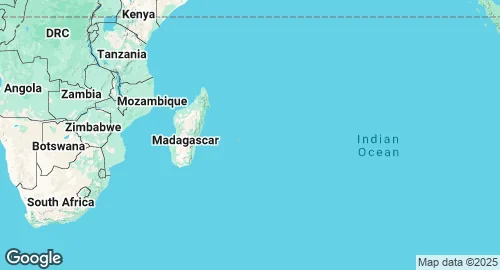
| Capital | Port Louis |
| Land Area | 2,030 km² |
| Coastline Length | 177 km |
National Flag

Defense Statistics & Key Metrics
| Population | 1.3 million (2023) |
| GDP | $14.6 billion (2023) |
| GDP per capita | $11613 (2023) |
| Military Budget | $23.0 million (2024) |
| Share of GDP in Milex | 0.2% (2024) |
| Share of Govt Expenditures | 0.5% (2024) |
| Military spends per capita | $18 (2024) |
| Inflation Rate | 4.1% (2024) |
| Military Personnel | 3,000 (2020) |
Mauritian Military Budget History
Population and Military Personnel Trends
GDP and Inflation Rate Trends
Strategic Overview in 2026
Strategic Position
The Republic of Mauritius maintains a non-military security posture, as the state does not possess a standing army. National security is integrated into the Mauritius Police Force (MPF), which operates under the aegis of the Prime Minister’s Office. The country’s primary security concerns are centered on maritime domain awareness, the protection of its 2.3 million square kilometer Exclusive Economic Zone (EEZ), and the management of territorial disputes.
The most prominent geopolitical issue remains the sovereignty of the Chagos Archipelago, currently administered by the United Kingdom as the British Indian Ocean Territory. In 2025, bilateral negotiations concerning the future status of the islands and the strategic base at Diego Garcia influenced national budget planning, with projected lease revenues integrated into the 2025/2026 fiscal cycle.
Mauritius’ security doctrine is heavily influenced by its partnership with India under the "Security and Growth for All in the Region" (SAGAR) policy. This relationship is formalized through extensive military-to-military cooperation, including the secondment of Indian officers to lead the National Coast Guard and the Police Helicopter Squadron. Mauritius is also a member of the Southern African Development Community (SADC), the African Union (AU), and the Indian Ocean Rim Association (IORA). In 2025 and early 2026, Mauritius increased its cooperation with the United States through exercises such as Cutlass Express, focusing on counter-trafficking and maritime law enforcement.
Military Forces
The security architecture of Mauritius is comprised of approximately 12,500 personnel within the Mauritius Police Force. This total includes civilian police and two specialized paramilitary units that fulfill military functions.
Special Mobile Force (SMF) The SMF is a paramilitary motorized infantry battalion of approximately 1,500 personnel. It is organized into six infantry companies, an engineering squadron, and a mobile wing. The SMF is tasked with internal security, disaster response, and explosive ordnance disposal. It maintains a tactical unit known as the Groupement d’Intervention de la Police Mauricienne (GIPM), which specializes in counter-terrorism and high-risk operations. The unit's training is based on conventional military doctrine, often conducted in coordination with French and Indian forces.
National Coast Guard (NCG) The NCG is the primary maritime security branch, responsible for surveillance, search and rescue, and fisheries protection. The fleet includes offshore patrol vessels, most notably the CGS Barracuda, and patrol boats such as the CGS Victory and CGS Valiant. The NCG also maintains a Commando Unit for maritime interdiction. In 2024 and 2025, maritime domain awareness was expanded through the development of infrastructure on the Agalega Islands.
Air Capabilities Aviation assets are divided between the Maritime Air Squadron and the Police Helicopter Squadron. Fixed-wing capabilities consist of Dornier Do 228 aircraft configured for maritime reconnaissance and search and rescue. The helicopter fleet includes HAL Dhruv and HAL Chetak models, as well as Eurocopter Fennec aircraft. These assets are primarily used for EEZ surveillance and medical evacuations.
Strategic Trends
The primary trend in Mauritian defense is the expansion of maritime infrastructure in cooperation with India. In early 2024, a 3,000-meter airstrip and deep-sea jetty were inaugurated on North Agalega Island. This facility is designed to support large maritime patrol aircraft and naval vessels, enhancing the capability of both Mauritian and Indian forces to monitor the Southwest Indian Ocean. While the government officially designates the site as a logistics hub, the infrastructure is capable of supporting P-8I surveillance aircraft and frigate-class warships.
Defense spending remains a low percentage of the national budget, typically hovering around 0.15% to 0.2% of GDP. Procurement is largely facilitated through foreign grants and soft loans, particularly Indian Lines of Credit. For the 2025/2026 period, strategic priorities include the implementation of the National Cyber Security Strategy and the transition toward a "Big Ocean State" framework, which emphasizes the "Blue Economy" and the interdiction of illegal, unreported, and unregulated (IUU) fishing and narcotics trafficking.
Constraints on the security apparatus include the high cost of maintaining surveillance over a vast maritime territory relative to a small personnel base and the ongoing requirement for technical assistance from foreign partners to manage sophisticated radar and communication systems.
Frequently Asked Questions
What is Mauritius's defense budget?
How does Mauritius rank militarily in the world?
Does Mauritius have nuclear weapons?
What percentage of GDP does Mauritius spend on defense?
Does Mauritius have paramilitary forces?
Military Expenditure: SIPRI Milex. Suggest a change