Do 228
German utility-transport aircraft, mainly used for regional air services and maritime surveillance since the 1980s. Key figures: top speed 470 km/h, range 396 km, service ceiling 8,534 m, max takeoff weight 6,400 kg, unit price $8M, built 370. In service with 13 air forces as of 2026 — India (90), Thailand (7), Nigeria (6) and 10 others.
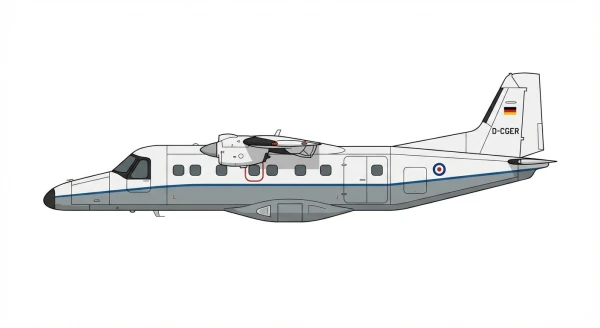
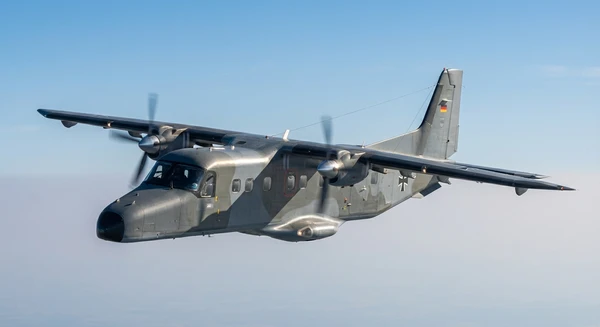
| Length | 16.6 m (54.3 ft) |
| Wingspan | 17.0 m (55.7 ft) |
| Height | 4.9 m (15.9 ft) |
| Wing area | 32 m² (344.4 sqft) |
| Empty weight | 3,739 kg (8,243 lbs) |
| Max. takeoff weight | 6,400 kg (14,110 lbs) |
| Powerplant | 2 × turboprops Garrett TPE331-5-252D 578 kW each |
| Maximum speed | 470 km/h (292 mph) |
| Operational range | 396 km (246 mi) |
| Service ceiling | 8,534 m (27,999 ft) |
| Climb rate | 7.5 m/s (24.6 ft/s) |
-
 India
90 +14
India
90 +14
-
 Thailand
7
Thailand
7
-
 Nigeria
6
Nigeria
6
-
 Bangladesh
4
Bangladesh
4
-
 Italy
3
Italy
3
-
 Venezuela
3
Venezuela
3
-
 Germany
2
Germany
2
-
 Guyana
2
Guyana
2
- 🇲🇻 Maldives 2
-
 Seychelles
2
Seychelles
2
-
 Sri Lanka
1
Sri Lanka
1
-
 Malawi
1
Malawi
1
-
 Niger
1
Niger
1

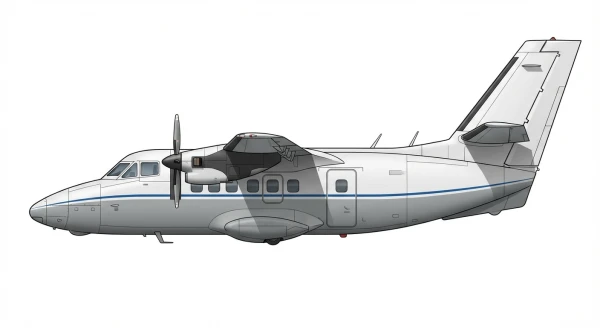
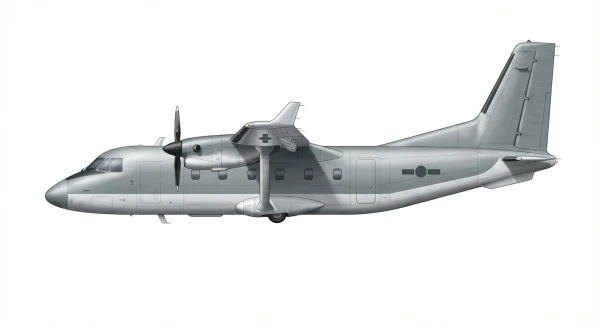
Description
The Dornier 228 is a twin-turboprop STOL utility aircraft designed by Dornier GmbH of West Germany, produced from 1981 to 1998 and later by successor firms in Germany, India and Switzerland. It carries up to 19 passengers or cargo and has been configured for commuter, military transport, maritime surveillance and special-mission roles. The type entered commercial service in July 1982 and is identified by its rectangular fuselage, large side-loading doors and supercritical TNT wing.
Development
The design originated in the late 1970s with the TNT (Tragflügel neuer Technologie) wing, developed under German government subsidy and flight-tested on a Do 28 airframe fitted with Pratt & Whitney Canada PT6 engines, later re-engined with Garrett TPE331-5 units as the Dornier 128. Two fuselage lengths were developed, the 15-seat E-1 (Dornier 228-100) and 19-seat E-2 (Dornier 228-200), displayed statically at the ILA Berlin Air Show in 1980. The prototypes flew on 28 March 1981 and 9 May 1981; German certification followed on 18 December 1981, with British and American approval on 17 April and 11 May 1984. About 245 aircraft were built at Oberpfaffenhofen before the German line closed in 1998. A licence agreement signed with Hindustan Aeronautics Limited in November 1983 established a line at Kanpur, where the first aircraft rolled out in 1985 and 125 had been completed by 2014. RUAG acquired the type certificate in 2003 and launched the Dornier 228NG in December 2007, with HAL supplying fuselages, wings and tail assemblies under a ten-year, €80 million contract and final assembly in Germany. EASA certification came on 18 August 2010. General Atomics bought the Oberpfaffenhofen line on 30 September 2020, completing the purchase in February 2021, and announced the Do 228 NXT.
Design
The wing is a rectangular box formed from four integrally milled alloy panels, with Kevlar ribs, stringers, trailing edge and Fowler flaps and a conventional alloy leading edge, reducing weight by an estimated 15% and cutting roughly 340 man-hours per aircraft. Fuselage and tail are conventional but chemically milled to save weight. Power comes from two Garrett/Honeywell TPE331 turboprops; the NG uses TPE331-10 engines of 579 kW driving five-blade composite MT-Propellers, with time between overhaul up to 7,000 hours. The NG introduced over 350 changes including a Universal UNS-1 glass cockpit with two primary flight displays and two multifunction displays, certified for single-pilot IFR. Navigation equipment includes VOR, DME, ADF, radar altimeter, GPS, air data computer and flight management system, with optional three-axis autopilot, weather radar, TCAS and TAWS. Mission fits include 360-degree surveillance radar, side-looking airborne radar, FLIR, searchlight, operator station, real-time datalink, satellite uplink, auxiliary fuel tanks and an air-openable roller door. Endurance is ten hours.
Operational History
The Dornier 228-100 entered service with Norving in July 1982 and the 228-200 with Jet Charters later that year; New Central Aviation received the first NG in September 2010. Operators include police, law enforcement, paramilitary and military users. By July 2018 the fleet had logged over four million flight hours with 57 aircraft in commercial service. Alliance Air placed an HAL-built 17-seater on the Dibrugarh–Pasighat route on 12 April 2022. The type has been involved in 54 accidents and incidents, including 41 hull losses and 205 fatalities.
Variants
- Dornier 228-100: Initial 15-seat production version, certified in December 1981.
- Dornier 228-200: Stretched 19-seat variant, in service from late 1982.
- Dornier 228NG: RUAG modernisation with TPE331-10 engines, five-blade composite propellers and Universal UNS-1 glass cockpit, EASA-certified in August 2010.
- Hindustan-Dornier 228: HAL-built civil version certified by the Indian DGCA in late 2017 in 17- and 19-seat, business and air ambulance configurations.
- Do 228 NXT: General Atomics version announced after the 2021 acquisition of the Oberpfaffenhofen line.
Frequently Asked Questions
What type of aircraft is the Do 228?
What is the maximum speed of the Do 228?
What is the range of the Do 228?
When did the Do 228 first fly?
How many Do 228 have been built?
Which countries operate the Do 228?
How much does a Do 228 cost?
What is the service ceiling of the Do 228?
- AUG 302026 Updated Description updated
- APR 72026 Updated Picture credits updated in a site-wide editorial pass
- JAN 242026 Updated Top speed updated
- JAN 122026 Updated Range updated in a site-wide editorial pass