Palau Military Forces 🇵🇼
Military Strength Overview
Geography
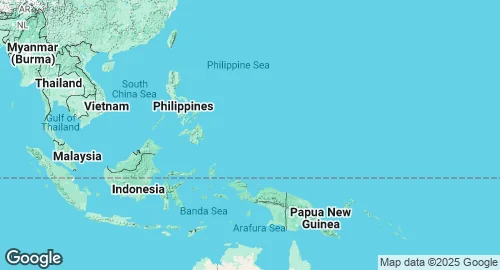
| Capital | Melekeok |
| Land Area | 459 km² |
| Coastline Length | 1,519 km |
National Flag

Defense Statistics & Key Metrics
| Population | 17783 (2021) |
| GDP | $235.8 million (2021) |
| GDP per capita | $13257 (2021) |
| Inflation Rate | 2.61% (2021) |
Population and Military Personnel Trends
GDP and Inflation Rate Trends
Strategic Overview in 2026
Strategic Position
Palau maintains a unique defense status defined by the Compact of Free Association (COFA) with the United States. Under this bilateral agreement, Palau has no standing national military, and the United States assumes full responsibility for the country's defense and security. This mandate includes the authority to exclude third-party militaries from Palauan territory and the right to utilize land and water for military purposes.
Geopolitically, Palau is situated in the Western Pacific as part of the "Second Island Chain." Its location provides a link between United States bases in Guam and the Philippine archipelago. Primary security concerns involve maritime domain awareness, illegal, unreported, and unregulated (IUU) fishing within its Exclusive Economic Zone (EEZ), and regional competition for influence in the Pacific.
Palau is one of the few nations that maintains formal diplomatic recognition of Taiwan, which influences its regional relationships and subjects it to economic and political pressure from the People's Republic of China. Strategic priorities focus on the implementation of the COFA, which was renewed in 2024 to extend financial and security arrangements through the 2040s. The defense doctrine emphasizes integrated deterrence, relying on the presence and capability of the United States Indo-Pacific Command (USINDOPACOM).
Military Forces
Palau does not maintain a traditional military structure, branches, or command hierarchy. National security and law enforcement functions are consolidated under the Ministry of Justice.
The Division of Marine Law Enforcement (DMLE) serves as the primary paramilitary organization responsible for maritime security, search and rescue, and fisheries protection. Personnel numbers for the DMLE are approximately 50 to 80 officers. The unit operates a small fleet of patrol vessels provided through international security assistance programs. This inventory includes Guardian-class patrol boats provided by Australia and a larger patrol vessel provided by the Nippon Foundation of Japan. These assets are tasked with patrolling Palau's 600,000-square-kilometer EEZ.
While Palau lacks domestic armed forces, it hosts a rotating presence of United States military personnel. This includes United States Army Pacific (USARPAC) units, United States Marine Corps rotational forces, and United States Air Force detachments. These forces utilize Palauan infrastructure for regional exercises such as Valiant Shield and Cope North.
Specialized capabilities are provided by United States assets stationed in or deployed to the islands. These include Explosive Ordnance Disposal (EOD) teams tasked with clearing World War II-era unexploded ordnance and United States Navy Seabees engaged in infrastructure development. Palau has also requested a permanent United States military presence, including the installation of coastal surveillance systems and integrated air and missile defense assets.
Strategic Trends
The defense posture in Palau is undergoing a period of infrastructure expansion and technological integration. The United States is currently constructing a Tactical Over-the-Horizon Radar (TACMOR) system in Palau, designed to provide long-range maritime and air surveillance capabilities across the Western Pacific. This project is a central component of the region’s integrated air and missile defense architecture.
Modernization efforts focus on "Agile Combat Employment" (ACE) concepts. This involves the upgrade of Palauan airfields to support heavy transport and combat aircraft. Recent projects have improved the runways at Roman Tmetuchl International Airport and the Angaur Airstrip to accommodate C-130 Hercules and C-17 Globemaster III aircraft. Peleliu’s airfield is also undergoing rehabilitation to restore its operational utility for military rotations.
The defense budget of Palau is negligible, as the United States provides the majority of security funding and equipment through the COFA and the Foreign Military Financing (FMF) program. Future force structure trends indicate an increased frequency of United States multi-domain task force deployments rather than the creation of a Palauan national army. Constraints include limited domestic manpower for maritime law enforcement and the environmental impact of military infrastructure projects on the archipelago’s sensitive ecosystems. Efforts in 2025 and 2026 emphasize the hardening of communication nodes and the establishment of more permanent logistics hubs to support contingency operations in the Philippine Sea.
Frequently Asked Questions
Does Palau have nuclear weapons?
Military Expenditure: SIPRI Milex. Suggest a change