C-17 Globemaster III
American military transport aircraft, extensively deployed in global conflict zones since the 1990s for strategic airlift missions. Key figures: top speed 930 km/h, range 4,480 km, service ceiling 13,715 m, max takeoff weight 259,460 kg, unit price $340M, built 279. In service with 8 air forces as of 2026 — United States (222), India (11), United Arab Emirates (8) and 5 others.
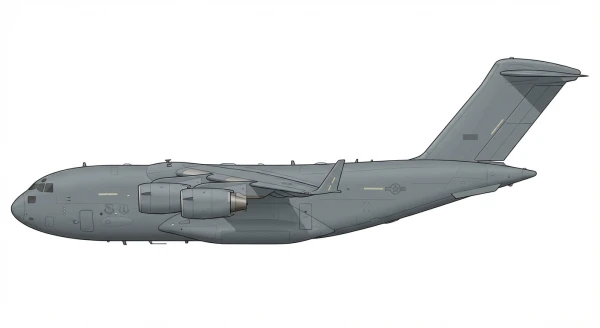
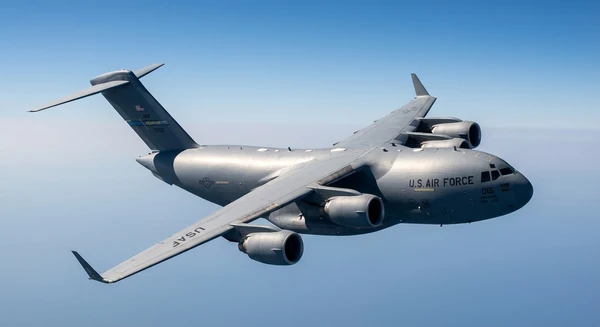
| Crew | 3 (2 pilots, mechanic) |
| Length | 53.0 m (174.0 ft) |
| Wingspan | 51.8 m (169.8 ft) |
| Height | 16.8 m (55.1 ft) |
| Wing area | 353.0 m² (3800.0 sqft) |
| Empty weight | 122,000 kg (268,964 lbs) |
| Max. takeoff weight | 259,460 kg (572,011 lbs) |
| Powerplant | 4 × turbofans Pratt & Whitney F117-PW-100 18,909 kgf each |
| Maximum speed | 930 km/h (578 mph) |
| Operational range | 4,480 km (2,784 mi) |
| Service ceiling | 13,715 m (44,997 ft) |
| Takeoff distance | 2,500 m (8,202 ft) |
-
 United States
222
United States
222
-
 India
11
India
11
-
 United Arab Emirates
8
United Arab Emirates
8
-
 Australia
8
Australia
8
-
 United Kingdom
8
United Kingdom
8
-
 Qatar
8
Qatar
8
-
 Canada
5
Canada
5
-
 Kuwait
2
Kuwait
2
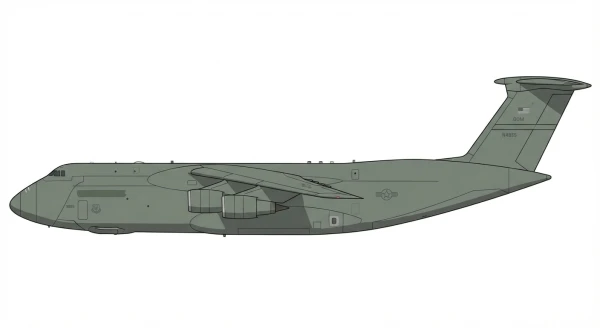
Description
The C-17 Globemaster III is a military transport aircraft developed by McDonnell Douglas, which later became a part of Boeing. It was conceived in the 1980s as a successor to the C-130 Hercules and the C-141 Starlifter, with the aim to fulfill the United States Air Force's (USAF) need for rapid strategic airlift capabilities. The aircraft first flew in 1991 and was officially introduced into service with the USAF in 1995. It was designed to perform both tactical and strategic airlift missions, and can carry oversized cargo, troops, and airdrop supplies.
Development
The development of the C-17 Globemaster III was a multi-year endeavor that faced both technical and budgetary challenges. Initially, McDonnell Douglas and the U.S. Air Force aimed to create an aircraft that combined the best features of existing airlifters while incorporating advanced technology to improve performance and versatility. After a competitive selection process, the C-17 was chosen as the Air Force's next-generation airlift aircraft.
Design
The aircraft was designed to be versatile, with both tactical and strategic capabilities. It incorporates a high-wing, T-tail design and is powered by four Pratt & Whitney F117-PW-100 turbofan engines. One of its distinguishing features is its ability to take off and land on short and unprepared runways, making it suitable for operations in challenging environments. The use of a fully articulated landing gear system allows for this level of flexibility in landing conditions.
Inside, the C-17 was designed with a spacious cargo hold, capable of accommodating various types of oversized cargo, from military vehicles to supplies and troops. The cargo area has a unique rail system to facilitate the loading and unloading process, and the aircraft is designed to be compatible with the existing USAF pallet loading systems. It also includes advanced avionics and a glass cockpit, streamlining operations and reducing the crew requirements.
The aircraft's design integrates elements that make it easier to maintain and operate. It has built-in test equipment and diagnostics, simplifying the maintenance process. Its design also allows for rapid conversion between different mission profiles, such as medical evacuation or troop transport, thus increasing its operational flexibility.
Operational History
The C-17 Globemaster III became operational with the U.S. Air Force in 1995 and has since become a workhorse in both strategic and tactical airlift missions. It has seen extensive service in various military operations and humanitarian efforts globally.
In military contexts, the C-17 played a significant role in Operation Enduring Freedom in Afghanistan and Operation Iraqi Freedom, providing airlift support for the rapid deployment of troops and equipment. It has been used for long-haul missions to transport military hardware, including tanks and helicopters, as well as troops, directly into areas of conflict. The aircraft's capability to land on austere runways has made it particularly valuable in these operations.
The C-17 has also been crucial in humanitarian missions. It was employed in disaster relief operations following events like the 2004 Indian Ocean tsunami, Hurricane Katrina in 2005, and the Haiti earthquake in 2010. Its ability to carry large quantities of relief supplies and medical equipment, and to operate from makeshift or damaged airstrips, has made it indispensable in such missions.
Beyond the U.S. Air Force, the C-17 has found a home in several other countries' air forces, including the United Kingdom, Australia, Canada, Qatar, and India, among others. These nations have employed the aircraft in a range of operations, from combat missions to humanitarian aid, further solidifying its reputation as a versatile and reliable airlift platform.
While the production of the C-17 ended in 2015, the aircraft is expected to remain in service for several more decades.
Variants
There aren't many official variants of the C-17, as the aircraft is already designed to be adaptable for various mission profiles. Instead, improvements and modifications are often done through incremental software and hardware upgrades.
-
C-17A Globemaster III: The basic and most common version, used primarily by the U.S. Air Force for strategic and tactical airlift missions.
-
C-17A ER (Extended Range): An unofficial designation for C-17s equipped with additional fuel tanks, extending their operational range.
-
C-17B: A proposed variant that would have featured advanced engines, more cargo capacity, and additional landing gear for shorter takeoff and landing. It was never produced.
-
CC-177 Globemaster III: The designation used by the Canadian Armed Forces for their C-17s. These are essentially similar to the C-17A models but are named differently for Canadian service.
-
C-17 "UK": A version modified for the needs of the Royal Air Force, though changes are mainly in avionics and support systems rather than in the basic airframe or performance characteristics.
Frequently Asked Questions
What type of aircraft is the C-17 Globemaster III?
What is the maximum speed of the C-17 Globemaster III?
What is the range of the C-17 Globemaster III?
When did the C-17 Globemaster III first fly?
How many C-17 Globemaster III have been built?
Which countries operate the C-17 Globemaster III?
How much does a C-17 Globemaster III cost?
What is the service ceiling of the C-17 Globemaster III?
- APR 72026 Updated Sources and cross-references refreshed
- JAN 242026 Updated Price updated
- JAN 122026 Updated Range updated in a site-wide editorial pass
- OCT 222023 Updated Specifications and description reviewed