Akula-class
Summary
| Origin country | 🇨🇳 Ex-USSR |
| Category | Submarine |
| Subtype | Nuclear attack submarine |
| Manufacturer | Komsomolsk-on-Amur |
| Year commissioned | 1984 |
| Approx. unit cost | $1550 million |
| Units |
K-154 Tigr K-157 Vepr K-295 Samara K-317 Pantera K-328 Leopard K-331 Magadan K-335 Gepard K-419 Kuzbass K-461 Volk |
Technical specifications
| Displacement | 8140 tons |
| Displacement submerged | 12770 tons |
| Range | Unlimited, except by food supplies |
| Endurance | 100 |
| Crew | 73 members |
| Width | 13.6 m (44.6 ft) |
| Length | 110.3 m (361.9 ft) |
| Max. depth | 600 m (1968.5 ft) |
| Propulsion | one 190 MW OK-650B/OK-650M pressurized water nuclear reactor, 1 OK-7 steam turbine 43,000 hp (32 MW), 2 OK-2 Turbo generators producing 2 MW, 1 seven-bladed propeller, 2 OK-300 retractable electric propulsors |
| Armament |
|
| Maximum speed | 10 knots |
| Max. speed submerged | 35 knots |
Description
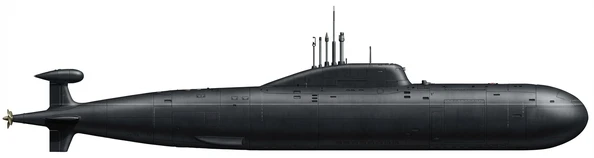
The Akula class, Soviet designation Project 971 Shchuka-B, is a series of fourth-generation nuclear-powered attack submarines. NATO assigned the reporting name Akula to the class, though the Soviet Union used that name for the Project 941 Typhoon class. The class was developed to succeed the Victor and Sierra classes, with construction taking place at the Amur Shipyard in Komsomolsk-on-Amur and Sevmash in Severodvinsk. The first vessel entered service in 1984. The project includes four sub-classes: Akula I, Improved Akula I, Akula II, and Akula III.
The design features a double-hull system with an inner pressure hull and an outer light hull, which provides higher reserve buoyancy. A cylindrical housing on the vertical rudder contains a towed sonar array. Most units incorporate the SOKS wake detection system, utilizing hydrodynamic sensors on the sail and hull to detect temperature and salinity changes. Internal and external torpedo tubes are fitted; the external tubes are located outside the pressure hull and require port facilities or a submarine tender for reloading. Propulsion is provided by an OK-650 series pressurized water reactor. Early production units featured tubular reactor coolant scoops, while later hulls starting with the Bratsk utilized shorter scoops. Noise reduction was a primary development focus, aided by the acquisition of nine-axis milling equipment from Toshiba and Kongsberg for propeller manufacturing. Akula II and III variants were lengthened to accommodate additional quieting measures.
The class has been operated by the Soviet, Russian, and Indian navies. Following the dissolution of the Soviet Union, several hulls were canceled or remained unfinished, with some hull sections later used in the construction of Borei-class submarines. Operational history includes Atlantic deployments in 1996, where the Tigr detected and tracked a U.S. Ohio-class submarine. In 2009, two Akula-class submarines operated off the East Coast of the United States, and further activity was reported in the Gulf of Mexico in 2012. The Indian Navy leased the Nerpa under the name INS Chakra between 2012 and 2021. During 2008 sea trials, an accidental activation of the halon fire-extinguishing system on the Nerpa resulted in 20 fatalities. As of 2024, several Russian units remain active while others are undergoing modernization. A deal was signed in 2019 to lease another vessel to India, designated Chakra III, with delivery expected by 2028.