Daphné-class
Summary
| Origin country | 🇫🇷 France |
| Category | Submarine |
| Subtype | Diesel-electric submarine |
| Manufacturer | Chantiers Dubigeon |
| Year commissioned | 1964 |
| Units | Daphné, Diane, Doris, Eurydice, Flore, Galatée, Minerve, Junon, Vénus, Psyché, Sirène, PNS Hangor, PNS Shushuk, PNS Mangro, PNS Ghazi, NRP Albacora, NRP Barracuda, NRP Cachalote, NRP Delfim, SAS Spear, SAS Umkhonto, SAS Assegaai, Delfín, Tonina, Marsopa, Narval |
Operators
Technical specifications
| Displacement | 700 tons |
| Displacement submerged | 1038 tons |
| Range | 4300 km at 7 knots |
| Endurance | 30 |
| Crew | 45 members |
| Width | 6.76 m (22.2 ft) |
| Length | 57.75 m (189.5 ft) |
| Max. depth | 300 m (984.3 ft) |
| Propulsion | 2 shafts, 2 SEMT-Pielstick diesel engines, two 450-kilowatt diesel generator sets, and two electric motors creating 750 kilowatts (1,000 shp) sustained |
| Armament |
|
| Maximum speed | 13 knots |
| Max. speed submerged | 16 knots |
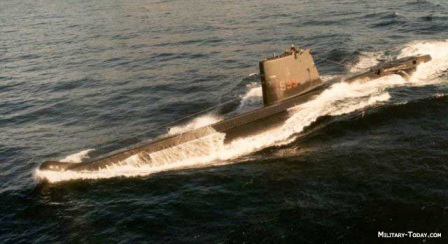
Description
The Daphné class was developed from the preceding Aréthuse class as a second-class counterpart to the ocean-going Narval class. Designed and constructed for the French Navy, the diesel-electric class entered service in 1964. The design was marketed for export, leading to the construction of subclasses for the navies of Pakistan, Portugal, and Spain, and acquisition by South Africa.
The class features a double-hull design with an emphasis on maneuverability and low noise production. Maintenance was based on a modular replacement system, which allowed for a reduced complement but precluded the carriage of torpedo reloads. Propulsion is provided by diesel engines and electric motors driving two shafts. Armament consists of torpedo tubes located in both the bow and stern. Electronic suites originally included search radar and sonar, with modernizations from 1971 introducing search and attack sonar in a bow dome, passive sonar, acoustic telemeters, and updated fire control systems. Specific variants were modified for national requirements, such as tropicalized equipment for the Portuguese Navy and the integration of submarine-launched anti-ship missiles for the Pakistan Navy.
Twenty-five vessels were completed between 1964 and 1975. In French service, the class remained operational through the 1990s to maintain capability until the availability of nuclear-powered replacements. The French Navy lost the submarines Minerve in 1968 and Eurydice in 1970, while Sirène was salvaged after sinking in 1972.
The Pakistan Navy operated four vessels, designated the Hangor class. During the 1971 Indo-Pakistani War, PNS Hangor sank the Indian frigate INS Khukri. Portugal commissioned four Albacora-class vessels, selling one to Pakistan in 1975. South Africa acquired three hulls, which were the first submarines in its naval history; these were modernized locally during the 1980s. Spain constructed four vessels under license at the Bazan dockyard, designated the Delfín or S-60 class. Several vessels have been preserved as museum ships in France, Pakistan, Portugal, South Africa, and Spain. The final units of the class were decommissioned by 2010.