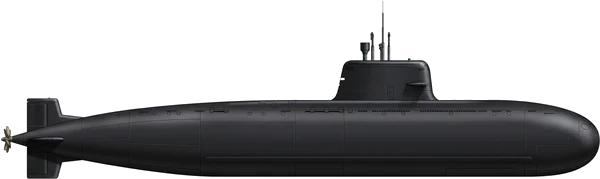
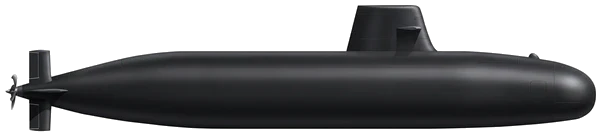
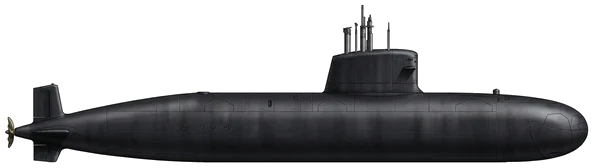
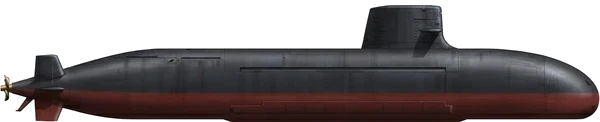
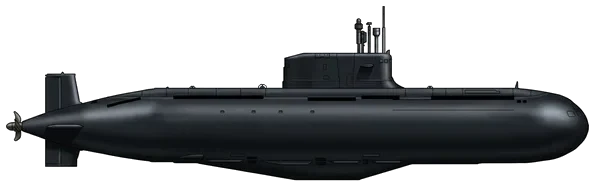
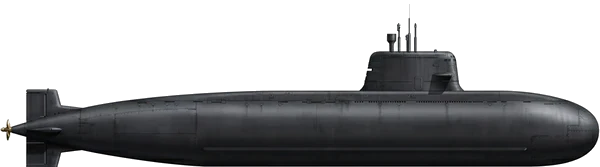
The Hangor class is a series of diesel-electric attack submarines manufactured for the Pakistan Navy by the China Shipbuilding Industry Corporation (CSIC) and Karachi Shipyard & Engineering Works (KSEW). The Hangor class is an export derivative of the Chinese Type 039A attack submarine operated by the People's Liberation Army Navy. The Pakistan Navy initiated negotiations for Chinese submarines in 2011 following the cancellation of a 2008 agreement for German Type 214 submarines due to financial constraints. In April 2015, Pakistan approved the purchase of eight submarines, with the initial four built by Wuchang Shipbuilding Industry Group in Wuhan, China, and the remaining four built by KSEW in Karachi under a technology transfer agreement. The class is named after PNS Hangor, a Daphné-class submarine that sank the Indian Navy frigate INS Khukri during the 1971 Indo-Pakistani War.
The design of the Hangor class is based on the S26 export design, which is an air-independent propulsion (AIP) variant of the S20 submarine. It features a double-hulled structure built with 921A and 980 steel and assembled using modular construction. The hull is divided into six compartments. For propulsion, the submarines utilize a Stirling-powered AIP system developed by CSIC’s 711th Institute. Although originally designed to use German MTU 12V 396 SE84 engines, a European Union embargo on military technology sales to China blocked their export. The Pakistan Navy subsequently tested and accepted Chinese CHD620 diesel engines as the alternative. The submarines are designed to conduct anti-access/area denial operations, equipped with six 533 mm torpedo tubes and anti-ship cruise missiles, and are compatible with Pakistan's Babur-3 submarine-launched cruise missiles.
To support construction of the four domestic vessels, KSEW upgraded its Karachi facility with a twin-lane construction hall and a Syncrolift drydock. Secure communications for the fleet are supported by the Sindh-based very low frequency station, PNS Hameed. The first Pakistani-built submarine, Tasnim, underwent steel cutting in December 2021 and keel laying in December 2022, followed by the keel laying of the second vessel, Seem Maai. The lead vessel of the class, PNS Hangor, was launched in China on 26 April 2024 and officially commissioned by the Pakistan Navy on 30 April 2026 in Sanya, China. Three additional Chinese-built boats—Shushuk, Mangro, and Ghazi—were launched in 2025 and are undergoing sea trials. PNS Hangor arrived at Karachi on 11 June 2026 following her commissioning at Sanya; Shushuk, Mangro and Ghazi remain in trials.