Grisha-class
Summary
| Origin country | 🇷🇺 Russia |
| Category | Corvette |
| Subtype | Anti-submarine corvette |
| Manufacturer | Zelenodolsk Gorky Plant |
| Year commissioned | 1970 |
| Units |
054 Yeysk 064 Muromets 071 Suzdalets 113 Yunga 138 Naryan-Mar 164 Onega 190 Monchegorsk 196 Snezhnogorsk 199 Brest 323 Metel 332 MPK-107 350 Sovetskaya Gavan 362 Ust-Ilimsk 369 Kholmsk 375 MPK-82 390 Koryeyets |
Technical specifications
| Displacement | 980 tons |
| Range | 4000 km at 10 knots |
| Crew | 60 members |
| Width | 9.8 m (32.2 ft) |
| Length | 71.6 m (234.9 ft) |
| Propulsion | 3 shaft, 2 M-507A cruise diesels, 20,000 shp, (2 shafts); 1 boost gas turbine, 18,000 shp, (1 shaft) |
| Armament | |
| Maximum speed | 34 knots |
Description
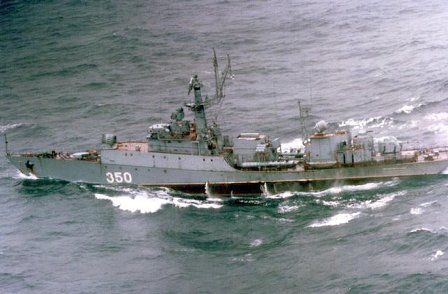
The Grisha class, Soviet designation Project 1124 Al'batros, is a series of anti-submarine corvettes built between 1970 and 1990. Construction took place at the Zelenodolsk Gorky Plant, Leninska Kuznya in Kiev, Kirov Shipyard in Khabarovsk, and Eastern Shipyard in Vladivostok. These vessels were designed as small anti-submarine ships (MPK) for coastal operations and are succeeded by the Gepard and Steregushchiy classes.
The design is optimized for littoral environments and incorporates retractable fin stabilizers. Sensor systems include air and surface search radars, fire control radars, and a sonar suite consisting of hull-mounted and dipping units. Electronic warfare is managed via the Bizan-4B suite. The class was developed through several variants: the Grisha I (Project 1124.1); the Grisha II (Project 1124P) for border guard service; the Grisha III (Project 1124 2nd batch) with updated electronics; the Grisha IV (Project 1124K) missile test ship; and the Grisha V (Project 1124M), which replaced the original twin gun mount with a single primary gun mount. Some Russian vessels are undergoing modernization with the Tornado 2 combat complex for anti-submarine missiles.
The class entered service in 1970. Beyond the Soviet and Russian navies, operators have included the Soviet Border Troops, the Russian Coast Guard, and the navies of Ukraine, Lithuania, and Georgia. Lithuania retired its units in 2009. Ukraine operated several vessels transferred from Soviet stocks or completed post-independence, such as the Ternopil, which entered service in 2006. Following the 2014 annexation of Crimea, Russian forces captured several Ukrainian Grisha-class ships. The Ternopil was later utilized as an exercise target, while the Vinnitsa was reported scuttled in 2022. As of 2025, 17 units remain active in the Russian Navy, with seven assigned to the Pacific Fleet, six to the Northern Fleet, and four to the Black Sea Fleet.