Halibut-class (SSGN-587)
Summary
| Origin country | 🇺🇸 United States |
| Category | Submarine |
| Subtype | Nuclear-powered guided missile submarine |
| Manufacturer | Mare Island Naval Shipyard |
| Year commissioned | 1960 |
| Units | USS Halibut |
Operators
Technical specifications
| Displacement | 3655 tons |
| Displacement submerged | 5000 tons |
| Range | Unlimited, except by food supplies |
| Crew | 97 members |
| Width | 8.8 m (28.9 ft) |
| Length | 110.0 m (360.9 ft) |
| Propulsion | S3W reactor, 7300 shp; two turbines, two shafts |
| Armament |
|
| Maximum speed | 15 knots |
| Max. speed submerged | 20 knots |
Description
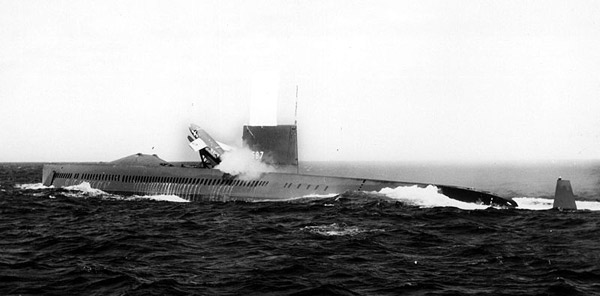
USS Halibut (SSGN-587) was the first submarine initially designed to launch guided missiles. Developed under project SCB 137, the vessel was originally planned as a diesel-electric submarine but was completed with nuclear power under project SCB 137A. Mare Island Naval Shipyard laid the keel on 11 April 1957. The vessel launched on 9 January 1959 and entered service on 4 January 1960.
The original design featured a main deck positioned high above the waterline to provide a dry flight deck for missile operations. The missile system was automated, utilizing hydraulic machinery operated from a central control station. In 1965, the vessel was redesignated as an attack submarine (SSN-587) and underwent conversion for special operations. Modifications included the installation of side thrusters, a hangar section sea lock, fore and aft mushroom anchors, and a saturation diving habitat. Specialized equipment added during this period included side-look sonar, a Sperry UNIVAC 1224 mainframe computer, and induction tapping and recording equipment. The hull was fitted with seabed skids and a winch system for a towed underwater search vehicle.
During its initial service period from 1960 to 1964, Halibut operated as part of the Pacific Fleet based at Pearl Harbor. On 25 March 1960, it became the first nuclear-powered submarine to launch a guided missile. The vessel conducted seven deterrent patrols in the Pacific before being replaced in that role by Lafayette-class submarines. In late 1964, it participated in evaluations of the attack capabilities of Permit-class submarines.
Following its 1965 conversion, Halibut was utilized for underwater espionage and intelligence missions against the Soviet Union. In 1968, the vessel located and surveyed the wreck of the Soviet submarine K-129 in the Pacific Ocean. During Operation Ivy Bells, the submarine was used to install recording devices on a Soviet communication line located on the seabed of the Sea of Okhotsk. The vessel operated with Submarine Development Group One until its decommissioning on 30 June 1976. It was struck from the Naval Vessel Register on 30 April 1986 and disposed of through the Ship-Submarine Recycling Program in 1994.