Lafayette-class (SSBN-616)
American submarine, introduced in 1963, displaced 7,443 tons and carried ballistic missiles. Key figures: displacement 7,443 tons, length 130 m, top speed 16 knots, crew 140, built 9. No longer in service; operated by 1 navy over its career.

| Subtype | Nuclear-powered ballistic missile submarine |
| Displacement | 7443 tons |
| Displacement submerged | 8383 tons |
| Crew | 140 members |
| Width | 10.0 m (32.8 ft) |
| Length | 130.0 m (426.5 ft) |
| Max. depth | 400 m (1312.3 ft) |
| Propulsion | 1 × S5W PWR, 2 geared steam turbines (15,000 shp (11,000 kW)), 1 shaft |
| Units | USS Lafayette, USS Alexander Hamilton, USS Andrew Jackson, USS John Adams, USS James Monroe, USS Nathan Hale, USS Woodrow Wilson, USS Henry Clay, USS Daniel Webster |
| Range | Unlimited, except by food supplies |
| Maximum speed | 16 knots |
| Max. speed submerged | 21 knots |
- 16 Polaris A2/A3 or Poseidon C3 missiles
- 4 × 21-inch (533 mm) torpedo tubes
- 12 torpedoes
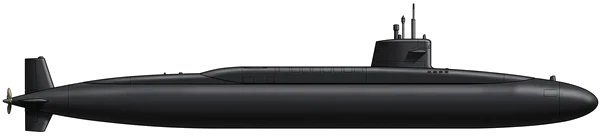
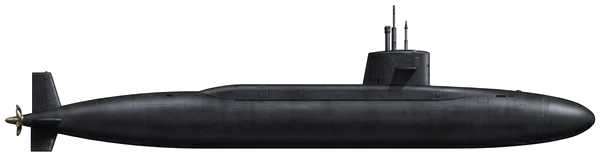
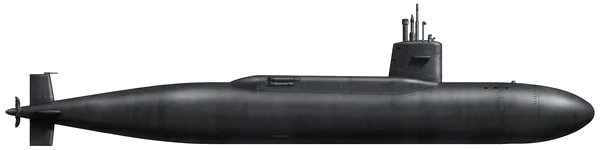

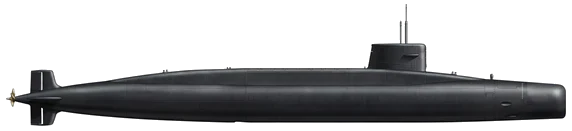
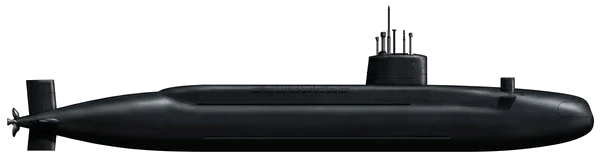
Description
The Lafayette class was a series of nine nuclear-powered ballistic missile submarines built for the United States Navy between 1961 and 1964. An evolutionary development of the preceding Ethan Allen class, the design featured a larger hull and various technical improvements. The class was part of the "41 for Freedom" group of submarines that served as the naval component of the United States nuclear deterrent force through the late 1980s.
Design modifications included the integration of larger missile tubes to accommodate updated weapons systems. The first eight vessels initially carried Polaris A-2 missiles and were later refitted with the Polaris A-3. The final boat, USS Daniel Webster, was equipped with the A-3 from its commissioning. In the mid-1970s, the entire class underwent refits to carry the Poseidon C3 missile, taking advantage of the larger tube diameter. Unlike the similar James Madison and Benjamin Franklin classes, the Lafayette class was not updated to carry Trident I missiles. To improve firing efficiency, the vessels utilized a hovering system to manage trim during missile launches, which increased the potential rate of fire. USS Daniel Webster was originally constructed with experimental diving planes mounted on a sail near the bow to minimize porpoising. These were replaced with standard fairwater planes during a mid-1970s overhaul because the initial configuration reduced hydrodynamic efficiency.
The class entered commission between 1963 and 1964. The submarines remained in active service until the late 1980s and early 1990s. Decommissioning took place between 1986 and 1992, influenced by the requirements of the SALT II treaty, the introduction of Ohio-class submarines, and the dissolution of the Soviet Union. Eight of the vessels were processed through the Ship-Submarine Recycling Program. USS Daniel Webster was converted into a Moored Training Ship (MTS-626) following its removal from active service, where it was utilized for nuclear power training in Charleston, South Carolina, until its scheduled inactivation.
Frequently Asked Questions
What type of ship is the Lafayette-class?
What is the displacement of the Lafayette-class?
What is the maximum speed of the Lafayette-class?
What is the range of the Lafayette-class?
How many crew members serve on the Lafayette-class?
How many Lafayette-class ships have been built?
Which countries operate the Lafayette-class?
- JUL 232026 Updated Sources and cross-references refreshed
- APR 72026 Updated Description updated in a site-wide editorial pass
- JAN 242026 Updated Range added
- JAN 182026 Updated Type, manufacturer and 8 more fields updated