La Fayette-class
Summary
| Origin country | 🇫🇷 France |
| Category | Frigate |
| Subtype | General purpose frigate |
| Manufacturer | DCNS |
| Year commissioned | 1996 |
| Approx. unit cost | $1750 million |
| Units |
F710 La Fayette F711 Surcouf F712 Courbet F713 Aconit F714 Guépratte |
Operators
Technical specifications
| Displacement | 3200 tons |
| Range | 9000 km at 12 knots |
| Endurance | 50 |
| Crew | 164 members |
| Width | 15.4 m (50.5 ft) |
| Length | 125.0 m (410.1 ft) |
| Air Park |
|
| Propulsion | 4 diesel SEMT Pielstick 12PA6V280 STC2, 21,000 hp (16,000 kW) |
| Armament | |
| Maximum speed | 25 knots |
Description
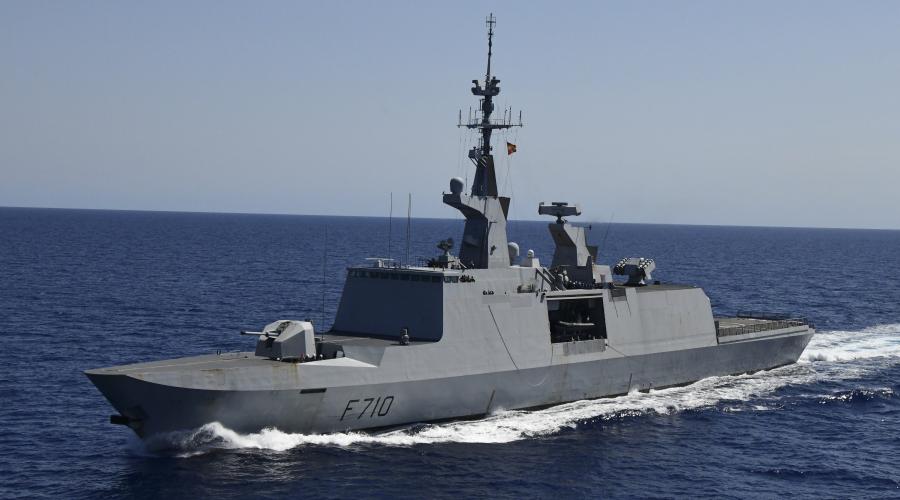
The La Fayette class, designated as Frégate Légère Furtive (FLF), is a series of general-purpose frigates developed by DCNS. Conceptual studies began in the late 1980s to produce a vessel suited for low-intensity conflicts, exclusive economic zone (EEZ) protection, and humanitarian operations in the post-Cold War era. The class was designed to replace the D'Estienne d'Orves-class avisos. The French Navy ordered five ships in 1988, with the lead vessel entering service in 1996.
The design incorporates a reduced radar cross-section through the use of inclined hull sides and clean superstructures. Mooring equipment, stairs, and other external structures are housed internally or covered by clear surfaces. The superstructure is constructed from radar-absorbent synthetic materials, including glass-reinforced plastic and light alloys. To minimize thermal signatures, the ships utilize a dissipation system that cools exhaust gases before discharge through pipes located aft of the mast. Acoustic signatures are managed via elastomeric engine supports and the Prairie Masker system, which generates air bubbles under the hull to disrupt sonar tracking. The ships were built using a modular method involving prefabricated sections.
Internal systems include a centralized Information Processing System and a naval command support system for data management. The ships are equipped with a Samahé helicopter handling system, allowing the operation of aircraft such as the Panther or NH90 in high sea states. Munition magazines and the command center are protected by armor.
In the French Navy, the class includes La Fayette, Surcouf, Courbet, Aconit, and Guépratte. Between 2021 and 2023, the French Navy initiated mid-life upgrades for La Fayette, Courbet, and Aconit. These modifications include the installation of KingKlip Mk2 hull-mounted sonar and the replacement of the Crotale point-defense system with SADRAL launchers operating Mistral missiles. These three vessels are scheduled to remain in service into the 2030s. Surcouf and Guépratte are designated for transition to offshore patrol roles before their scheduled withdrawal from service. The class is being replaced in first-rank service by the Frégate de Défense et d'Intervention (FDI) starting in 2025.
International variants are operated by Saudi Arabia, Singapore, and Taiwan. The Saudi Al Riyadh class is an enlarged version configured for anti-air warfare using Aster missiles. Singapore’s Formidable class incorporates local construction by Singapore Technologies Marine and utilizes Harpoon missiles. The Taiwanese Kang Ding class is configured for anti-submarine warfare and surface attack, integrating Hsiung Feng II and Sea Chaparral missiles. Taiwan announced plans in 2021 to upgrade these vessels with Sky Sword II and Sky Bow III systems.