Nimitz-class
Summary
| Origin country | 🇺🇸 United States |
| Category | Aircraft carrier |
| Subtype | Aircraft carrier |
| Manufacturer | Newport News Shipbuilding Company |
| Year commissioned | 1975 |
| Approx. unit cost | $4500 million |
| Units |
CVN-68 USS Nimitz CVN-69 USS Dwight D. Eisenhower CVN-70 USS Carl Vinson CVN-71 USS Theodore Roosevelt CVN-72 USS Abraham Lincoln CVN-73 USS George Washington CVN-74 USS John C. Stennis CVN-75 USS Harry S. Truman CVN-76 USS Ronald Reagan CVN-77 USS George H.W. Bush |
Operators
Technical specifications
| Displacement | 100000 tons |
| Range | Unlimited, except by food supplies |
| Crew | 5000 members |
| Width | 76.8 m (252.0 ft) |
| Length | 332.8 m (1091.9 ft) |
| Air Park | |
| Propulsion | 2 × Westinghouse A4W nuclear reactors, 4 × steam turbines, 4 × shafts, 260,000 shp (190 MW) |
| Thrust | 64000 hp |
| Armament |
|
| Maximum speed | 30 knots |
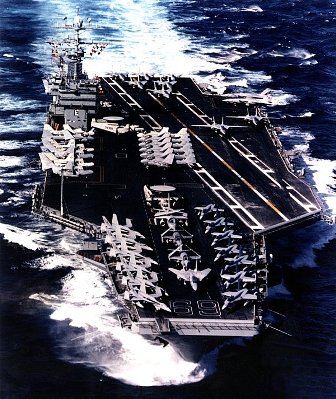
Description
The Nimitz class consists of ten nuclear-powered aircraft carriers operated by the United States Navy. Developed to supplement and eventually replace older carrier classes such as the Midway and Forrestal, the design drew on operational experiences from the Vietnam War. Construction of the class took place at Newport News Shipbuilding in Virginia between 1968 and 2006. The lead vessel, USS Nimitz, entered commission in 1975, while the final ship, USS George H. W. Bush, was commissioned in 2009.
These vessels utilize a nuclear propulsion system consisting of two pressurized water reactors. This configuration occupies less space than the eight reactors found on the preceding Enterprise class, allowing for increased storage of aviation fuel and ordnance. The flight deck uses a CATOBAR arrangement, featuring steam catapults and arrestor wires to facilitate the operation of fixed-wing aircraft and helicopters. Defensive features include Kevlar armor over vital spaces and a hangar deck divided into three fire bays by steel doors to restrict the spread of fire. Starting with the Theodore Roosevelt subclass, modular construction methods were employed to increase production efficiency. Later vessels in the class incorporated design changes such as bulbous bows to reduce wave resistance and redesigned island structures to improve flight deck operations.
Nimitz-class carriers have participated in combat operations, including the 1980 attempt to rescue hostages in Iran and the 1981 Gulf of Sidra incident. During the 1990s, the class supported the Gulf War and maintained flight operations during Operation Southern Watch. Following 2001, the vessels were deployed for operations in Afghanistan and Iraq. Beyond combat roles, the ships have functioned in humanitarian capacities, providing disaster relief following the 2004 Indian Ocean tsunami, Hurricane Katrina, and the 2010 earthquake in Haiti. At approximately the mid-point of their service lives, each ship undergoes a Refueling and Complex Overhaul (RCOH) to replace nuclear fuel and modernize onboard systems. The class is scheduled for phased replacement by the Gerald R. Ford class as vessels reach the end of their service lives.